
On Books and Goose-Stepping Morons
It’s never a pleasure to burn books

One of my favorite movies is Indiana Jones and The Last Crusade. Maybe not what you’d expect from a dealer in old books. You might expect me in tweed and smoking a pipe. You’re more likely to find me in a black v-neck tee and battle jacket, covered in studs and patches honoring some of my favorite music—The Ramones, Screeching Weasel, and Rancid.
I watched Last Crusade, I don’t know how many times. But one scene stayed with me, and it’s one I—unbeknownst to myself at the time, spoon-deep in Frosted Flakes, would eventually base my adult life on.
In the scene, a Nazi officer is interrogating Sean Connery’s Henry Jones, Sr., about codes and notes he left in his diary—his lifelong obsession and search for the Holy Grail.
Col. Ernst Vogel: What are you hiding?
Vogel slaps Henry, Sr. with a leather glove.
Vogel: What does the diary tell you that it doesn’t tell us?
He goes for another slap, and Henry catches his wrist.
Henry, Sr., through clenched teeth: It tells me—that goose-stepping morons like yourself should try reading books instead of burning them.
I never thought it would be apt to live as a grownup. The Nazis were dead, weren’t they? Given their proper treatment—executed, jailed, or exiled to backwaters in South America to cower in fear from the strong right hand of democracy.
But lately?
The presumably fabricated story of the conservative group Moms for Liberty tweeting and deleting a reference to Hitler’s 14 Words was fact-checked and found wanting by Reuters. But it was certainly believable. It’s not like M4L has the best track record for honesty, and makes their denial questionable.
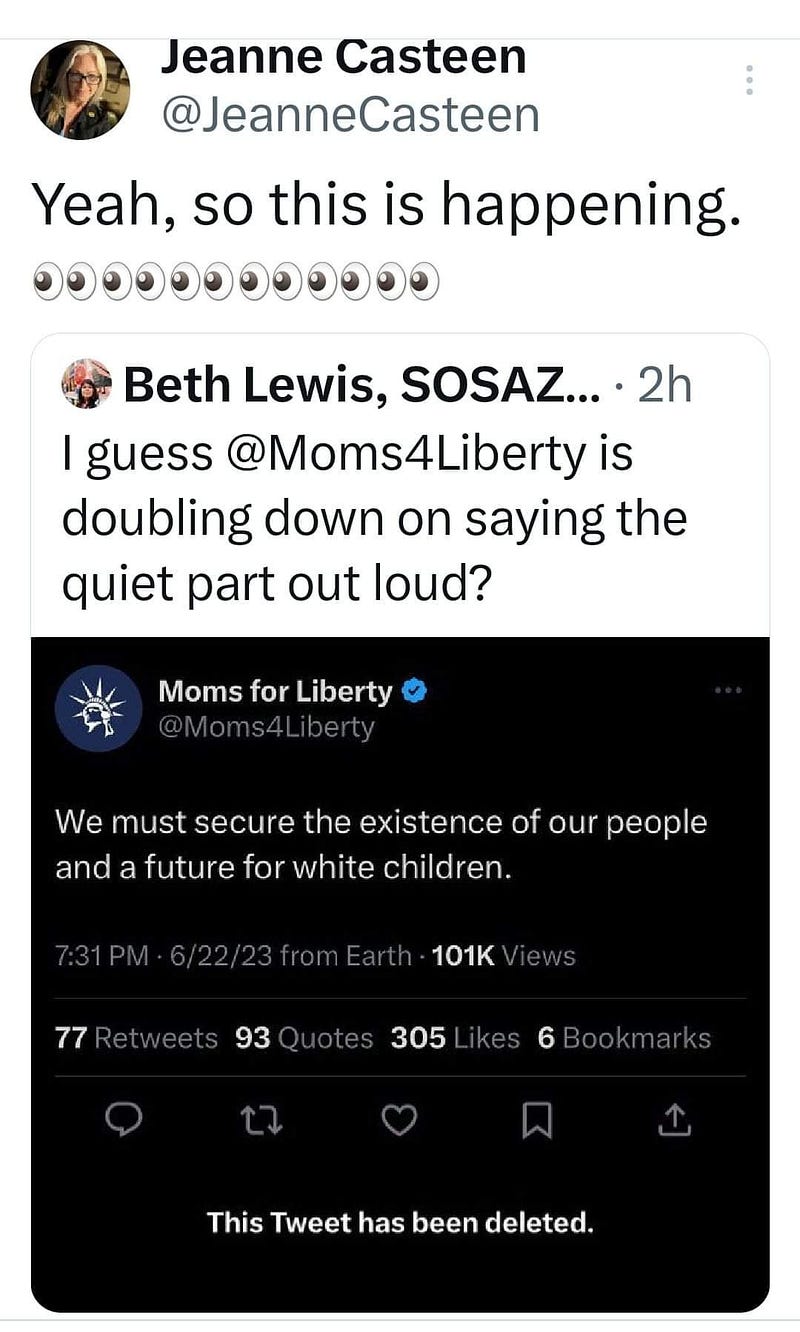
The 14 words are familiar to most of us in the punk subculture. We’re used to the skinheads and neo-Nazi would-be brownshirts parroting them. It’s a reference to Mein Kampf, bastardized by one David Eden Lane of the now-defunct white supremacist domestic terrorist organization, The Order. Goes like this:
”We must secure the existence of our people and a future for white children.”
In subcultures and terrorist organizations, it’s often used in combination with the number 88. It’s a thinly-veiled code—8th letter of the alphabet, twice: HH. It means, Heil Hitler. You’ll run across the number 1488 a lot on Twitter, Reddit, the chans, and other anonymous and username-based places on the internet.
How does this apply to Moms for Liberty? They quoted Hitler. In a newsletter to parents.
This one actually did happen, and their defenses of it have been…to put it plain, abject horseshit.
The quote, “He alone, who OWNS the youth, GAINS the future,” is an apocryphal one. It was supposedly said by Hitler in a 1935 rally for the Nazi Party. Despite it being up for debate whether old Adolf said it or not, Moms for Liberty made the decision to attribute it. Why did they use it in the first place?
Allegedly:
“The quote from a horrific leader should put parents on alert. If the government has control over our children today, they control our country’s future. We The People must be vigilant and protect children from an overreaching government.”
Followed by the kind of PR damage control you’d imagine. The chapter chair that allowed it to be published in M4L’s June 2023 drop of The Parent Brigade (author’s note: can’t make that title up), Paige Miller had this to say:
“We condemn Adolf Hitler’s actions and his dark place in human history,” she said. “We should not have quoted him in our newsletter and we express our deepest apology.”
But one Shelly Stewart, co-founder of the Hamilton County Indiana chapter, said this instead:
“We have had a few questions around the quote from Adolf Hitler and why it was used. His quote is meant to shock and scare every liberty-loving adult. We the People must protect our children and keep government in check.”
We must secure an existence for our people, and the future of our children, you might say.
A school board member from the Central Bucks School District in Pennsylvania, posted a comment on another thread, quoting Hitler not once, no. Twice.
In a kind of warped, Orwellian doublespeak, they paint themselves as the oppressed.
I hate to break it to you, but it’s only ever been oppressors who want to ban and burn books. They’re never the good guys.
In the 1940s, most of the developed world was involved in war—one that shaped modern history as we know it, laid low empires that were, and birthed a new, modern democracy. It was war between groups that wanted to subjugate, and murder, and burn books that challenged their ideologies, and one that didn’t. The latter were the Allies. Unwilling as some of us were to get involved.
Want to know two books that consistently top the list of banned (oh, excuse me. The proper term is, ‘challenged’) books every year?
- Harper Lee’s To Kill a Mockingbird—arguably one of the most damning indictments on American racism, along with Mark Twain’s Huck Finn and Uncle Tom’s Cabin: the book that most influenced the leadup to the Civil War, that Lincoln counted among his favorites. They also usually top the list. Shocker.
- Art Spiegelman’s Maus: a graphic novel that tells the story of an Auschwitz survivor, via mice. It’s a beautiful work, and one of my own favorites. Why is this one banned? Abject horseshit:
When books are challenged, there are reasons given and taken before school and library boards. What does Maus usually get?
- A Tennessee school board banned it back in 2022, for having 8 words of profanity (damn), mentions of violence, and a very mild, and decidedly unsexy illustration of a nude cat. Yeah. A naked cat. Oh, and “rough language,” was cited.
One of the teachers, instructional supervisor Melasawn Knight, made the pretty obvious statement—there are other things at grade level that the school board approved of, that were more in line with the kind of objectionable content they banned Maus on the grounds of Bridge to Terabithia (author’s note: it’s always too soon to talk about this one unless you want me to cry), The Whipping Boy, and To Kill a Mockingbird.
Another one of my favorites, and one that changed how I saw books: Ray Bradbury’s Fahrenheit 451. Most people I’ve met don’t know how it got its title—paper burns at 451 degrees Fahrenheit.
In the book, fireman Guy Montag’s boss, Captain Beatty says,
“Where’s your common sense? None of those books agree with each other. You’ve been locked up here for years with a regular damned Tower of Babel. Snap out of it! The people in those books never lived. Come on now!”
Famously, and deliciously ironically, in 2006, it was banned here in my home state—Texas. Why? Going against, “religious belief,” by depicting the burning of a Bible.
It’s also up there on frequently-challenged book lists, for depictions of violence, vulgarity, and drug use. Which…just tells me the people challenging it would much rather burn the books than read them first. I’ve read it…I don’t know how many times since I was a kid. And I can’t tell you off the top of my head if it uses anything worse than maybe a handful of, “damn,” and goes beyond taking psych meds, in so far as drug use.
Do you know what does though? One of my least favorite books (and for the record, despite my undying hatred for it, I don’t recommend banning it): Catcher in the Rye. Another classic too, Lord of the Flies. Both of which are rarely challenged. Catcher has been—but always for profanity. Never for any of the worse themes.
Another perennial favorite for banning? Nabokov’s Lolita. The fun part about Lolita is that you’d actually have to read it to understand it doesn’t glorify the objectification of the titular Lolita, no. It paints Hubert Humphrey as a total piece of shit. Nabokov did this so beautifully, in the vein of Jon Swift—he did it too well. And people really missed it, by taking it on a surface read, and putting it down while they made grumpy faces and took to their jewelry boxes to clutch their pearls.
But—they’d actually have to read the books. Or take a note from Beatty—and find their common sense.
At this point, I’m wondering about their capability of reading. They might learn something from history. The kinds of people who want books banned.
Who has, historically, wanted to ban books?
- The U.S. And always conservative groups.
- Russia, and the Soviet Union prior. Famously Nabokov and (another Russian fave for me) Mikhail Bulkakov. His Master & Margarita was a scathing indictment of repression in the Soviet Union. Chekov was also variously banned. Too violent, they said.
- Pakistan has banned books frequently—as have all countries living under primarily fundamentalist Sharia-based governments. Iran’s literary freedom regressed heavily following the Arab Spring.
- Islamic fundamentalists, while we’re on the subject—a group in Mali incinerated a library, causing a loss of at least 4,000 ancient manuscripts.
- Hindu fundamentalist nationalist organizations in India—famously Rohinton Mistry’s Such a Long Journey. Citing—you guessed it—profanity and vulgarity.
- James Joyce dealt with moralists in Ireland. He wrote a letter to his American publishers talking about his experience with Ulysses (that he actually went to court over, on obscenity charges). “Some kind person,” had bought the entire first run, just to burn it.
- The Nazis. Goes without saying, but long before the devastating losses of Dresden (at the time, Germany’s cultural center) to bombing, the Nazis did a great job themselves—burning art, books, sheet music, anything that went against the party line.
- Victor Hugo’s Les Miserables was put on the Index Librorum Prohibitorum, books banned by the Catholic Church. If you guessed, “for vulgarity and immorality,” you’re getting good at this.
- The Maoists in China famously systematically destroyed not just family genealogies dating back hundreds of years—but entire libraries.
- The Pope himself ordered the burning of all of Martin Luther’s German bibles.
There’s plenty more, but never people you’d want to emulate. Especially not if you give a shit about freedom of the press, or speech, or little things like “a democratic system of government, where leaders are accountable to the people.”
If you’re following along at home, you’ll notice a trend. The astute reader will notice that, among the various forms of abject horseshit, there’s a common theme—
Morality.
And in particular, religious morality.
You see, religions don’t like to have questions asked of them. They do love telling people the value of the faithful having their faith (like poor, poor Job) put to trial—but never the institutions themselves, and certainly not the doctrine and dogma.
The old-time religion of groups like Moms for Liberty and other alt-right jackasses besides, is one of hellfire, brimstone, and subjugation of all the people lesser than they feel themselves to be. Deep down in their little chicken-fried souls.
The simple fix to this would be what our own founders here in the U.S. suggested, and lacked the foresight (and likely, votes) to put it in the Constitution—a clear, defined line of separation of church and state.
Even Jesus believed in that, really. It was, after all, Jesus who made a big deal of saying, “Render unto Caesar what’s due Caesar, and render unto God what’s due God.”
Yet another passage the faithful love ignores when it suits them. The doctrine itself they purport to follow pitches the separation of Caesar and God. It says little about securing the existence of their people and a future for their little pasty-white, brown-shirted babies.
But I guess—they’d have to actually read books, before they decide to burn them, to catch that.
If you enjoyed this, you’ll enjoy all my work — I’m delightful. Mostly. You can obviously check me out here on Medium — you can sign up here, if you need to — or you can creep on me via my Carrd.