
SELF-AWARENESS
On Being A Little Light in the Loafers
Called out at age eight
Mom got back from running errands, and dear Auntie greeted her with these words —
“Eileen, your son’s a sissy!”
We visited my mom’s Aunt Helen — affectionally known to us as Auntie, our great aunt — a few times a year.
Auntie had kept an eye on me while Mom was away, letting me play to my heart’s content in the side yard. I was seven or eight at the time, but based on her tone, I was quite sure that being a sissy wasn’t exactly a good thing. It certainly sounded negative.
Or was the exact wording, “Eileen, you’re raising a sissy,” which was more designed to lay blame at my mother’s feet, like a shortcoming that she needed to address and make right?
It was one of the two, no matter.
I’ll always remember the tone, the vehemence of that proclamation, and the feeling deep in the pit of my stomach.
But what’s funny is I have zero recollection of my mother’s reaction or what she might’ve said back, if anything. Perhaps she just breezed by, brushed it off as they both went into the house. Perhaps they had a heated discussion. All I know is, thankfully it didn’t lead to any awkward chat during the drive home about how maybe I should act differently.
But I have to wonder: what on earth did little-boy Joey do in the side yard to make Auntie come to such a pointed conclusion?
Was I quoting Bette Davis dialogue at age seven?
Did I discuss the merits of why John Schneider was the sexier of the Hazzard boys in those tight jeans on The Dukes of Hazzard?
It’s not like I was practicing my best Lynda-Carter-Wonder-Woman spin, whipping my imaginary hair around in a moment of fantastic TV transformation in her yard.
Hmmm. Or… was I?
All right, yes, I did own the LP to the movie Annie, and yes, I did kinda-sorta dance around the basement to “It’s a Hard-Knock Life” every time it came on. I couldn’t help myself; It was fun! But that was back at home, hidden in the basement — it’s not like Auntie could’ve ever seen that.
It’ll always be a mystery, what I said or did to arrest her attention that day. But I think I should mention this wasn’t the first time this happened.
Come with me now back to first grade at St. John the Evangelist School in Uniontown, PA, where a bunch of terrified six-year-olds were under the care of one Sister Mary Jude.
Entire psychological journals could be written about the messed up fear, angst and survival skills Sister Mary Jude could bring to your day. I watched two to three young girls’ shoes go sailing out the window because they were lazily playing with said shoe with their foot, and not wearing it, a no-no in this first grade prison.
Side note: Isn’t it a bit odd that the Catholic Church attracted women who actively eschewed marriage and children, made a conscious choice to not be mothers, required them to take vows of chastity … and then as a reward locked those potentially self-identified, non-maternal-at-all women in a classroom forever surrounded by children?
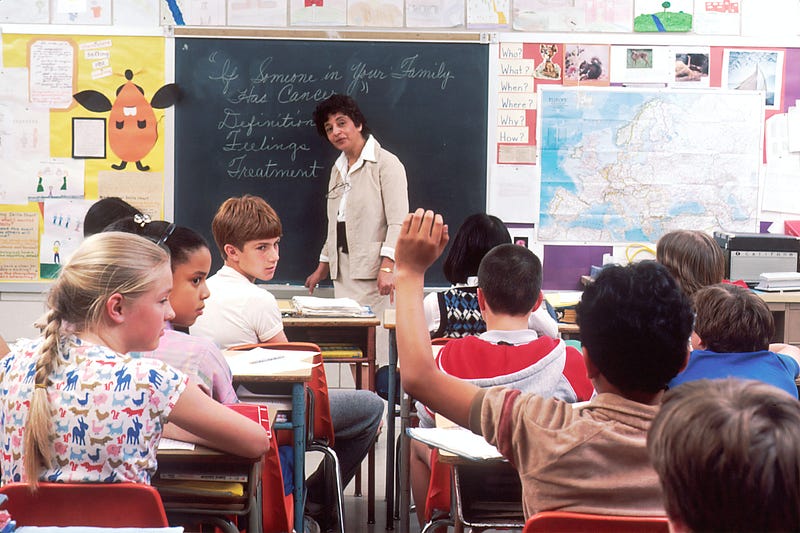
Back to our story. I’m age six and it’s recess time. Kids are being kids, loudly playing and frolicking in the parking lot just outside Sister’s window. I’m in a corner by the back wall of the church, chatting up some girl classmates who are probably jumping rope. And then I hear it — a violent pounding — rap, rap, rap!… rap, rap, rap! There she is, Sister Mary Jude, pounding on the window. She points at me, then signals over to her left, to where the boy classmates are roughhousing and playing football.
Rap, Rap, Rap. Point, point, point — You, Joey — point, point, point — you belong over there, with the boys. Now! Go over, there!

So… I guess I did? I don’t recall.
I certainly was a rule follower and always wanted to do what adults said, so I suppose I did meander over and try to look interested.
But come on! Hanging with the girls was just easier, and made sense! I could sit there discussing the fine art of hair braiding or some girl-done-me-wrong drama between Missy and Bobbie Jo, and instead Sister is staring me down because I belong over there, where the boys are all sweaty, tackling each other, making loud and disgusting hawker and loogie noises, ruining their school uniforms by slamming one another on the asphalt, scraping up the knees, being all dumb.
It’s not that I wanted to be a girl as a kid. Sorry to disappoint you, but I’m not one of those gay guys with stories about playing dress up in mother’s clothing and makeup, or doing a twirl in grandma’s housedress. But I certainly remember feeling like my life would be easier if I were a girl, pre-puberty. Because, well, I didn’t know how to be around the boys. I felt like an anxious pink donkey with a fishtail standing there amongst a bunch of energetic, sports-crazy hyenas.
None of this was about sex or being attracted to boys or “perversion.” I was six. I didn’t know what gay was; I didn’t know what sex was.
I was just being told I was doing something incorrectly… again.
I’d forgotten about that whole Sister Mary Jude episode until the “your son is a sissy” moment with Auntie. And then in fourth grade — oh, here we go again — my mom comes in for an in-person parent-teacher conference, and one of my (up until then) favorite teachers tells my mother how well I’m doing in school, but then closes it out with, “I’m a little concerned that Joe seems to be more comfortable playing with the girls. He needs to spend more time with the boys.”
Sigh. Rinse and repeat.
And thankfully, again, I have no memory of any difficult conversation with my mom on the way home. I have no scars from some forced act-more-like-a-boy workshop or visits to any therapist or psychiatrist, or taking part in any Catholic-sanctioned process for light-in-the-loafers kids.
Many probably weren’t so lucky.

I can honestly give my parents credit for not taking stock in these initial calls for concern and acting on them. I just learned to go through childhood with my head down, trying not to be noticed, not to engage.
In truth, my mother liked me as a good little boy who wasn’t violent, who followed rules, who listened to adults and avoided trouble, who wasn’t picking up swear words and being crass.
After all, I was under ten in fourth grade. Despite three women bringing to her attention that her son might be a little soft, she didn’t take it to mean I was on my way to Gay City and credit card debt from attending Cher’s newest farewell concert!
But you know what’s interesting? It was around this time, just after fourth grade, that I fully discovered my salvation — the joys of reading, and getting sucked into book after book after book, hiding from the world, avoiding all the games of pick-up basketball in the driveway, the new Atari video game strategies, or the boys marveling over their older brother’s copy of Playboy. And as long as I had such a good, adult-pleasing hobby like reading, always improving my vocabulary and being a “good kid,” hiding from the world with my nose in a book, they didn’t bother me any more about playing with the boys, acting more normal-boyish.
I should remind you that this was the very early ’80s, so everything I’ve just described was just common practice — if a kid was a certain way, you worked hard to straighten him out. And Auntie wasn’t some tyrant or villain in my life. Quite the opposite. This was one afternoon, not something she ever mentioned or fixated on again. She didn’t call me queer, she called me a sissy. But it was the tone, the tone — I knew it wasn’t a good thing.
She was a sharp-tongued, old-school proud German woman who never married, always making her opinions known in a household of middle-aged brothers where she was the only woman for decades after her mother’s death. She’d had to be tough from age 16, and she’d been through the Depression and two World Wars. But she was a loving, generous presence all the way into my college years, always sending me a few dollars in every card in the mail.
Yet, the stinging memory of that one afternoon remains.
You could’ve never convinced the 18-year-old, 22-year-old or even 25-year-old me that I would ever be strong enough to live my life as an out gay man, but here I am. I could fill a book — and just might! — about why I remained closeted until age 26 or 27 —
- super-Catholic mother
- A last name, G-U-A-Y, technically pronounced “gay.”
- being a teen during AIDS, when every pic of a gay man was a dying man and there were zero positive role models in media
- a slight ability to “pass” as straight
- and an early childhood memory where sissy was obviously negative
We never forget those touch points — those moments when, even at age six or seven, an adult you loved passionately expressed disgust, said those words, when you were just living life, being yourself.
© Joe Guay, 2023


