
Travel & Photography
On A Small Island in Maine, A Better Way of Life
On North Haven, ME, community, solitude, and geography collide
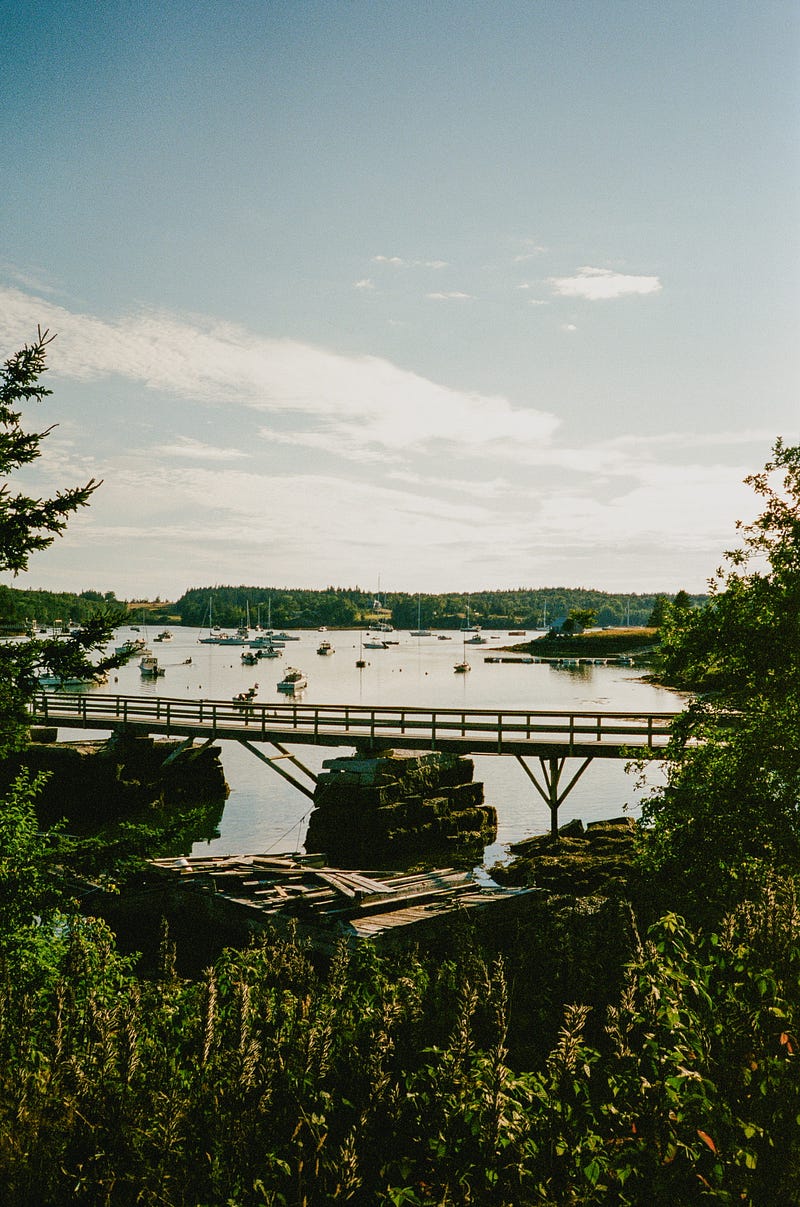
Arrival
North Haven, Maine is perhaps one of the few perfect places left on Earth — and I do not mean that lightly. In the summer of 2022, my close friend Seb, and I ventured to North Haven for a 3-day trip as part of our second annual sojourn to Maine.
From the moment I stepped foot onto the wharf after our ferry crossing from Rockland, I knew I was in a special place. We were met at the wharf by our host for the next three days, Bob, or Dr. Bach as we called him with deference — having been a long-time physician in the area. He stood over 6-feet tall, spoke softly, walked with a slight limp, and had a weathered face that was almost always drawn up in a grin.
Dr. Bach — the father of our former elementary school principal and family friend — and his wife Gail have lived on the island for years and are some of the few “year-rounders” left. Over the years, the declining population of “year-rounders” has given way to the pervasive yet seemingly amiable “summer people.”
After a quick handshake, Dr. Bach drove us to their home which was set back at the end of a long gravel road. Their property was a no-nonsense homestead, comprising a main house, a two-story barn — where a pristine Ford Model-A was parked — and an off-grid cabin that sat tucked away from a small estuary spilling into Pulpit Harbor. The day we arrived, a neighbor was helping them set up Starlink — a reminder that we hadn’t strayed too far from civilization.
After we dropped off our packs in the cabin where we’d spend the next few nights, we decided to hop on our bikes and explore. There was one main road that circumnavigated the island, marked by undulating hills, verdant fields, and unspoiled ocean views.
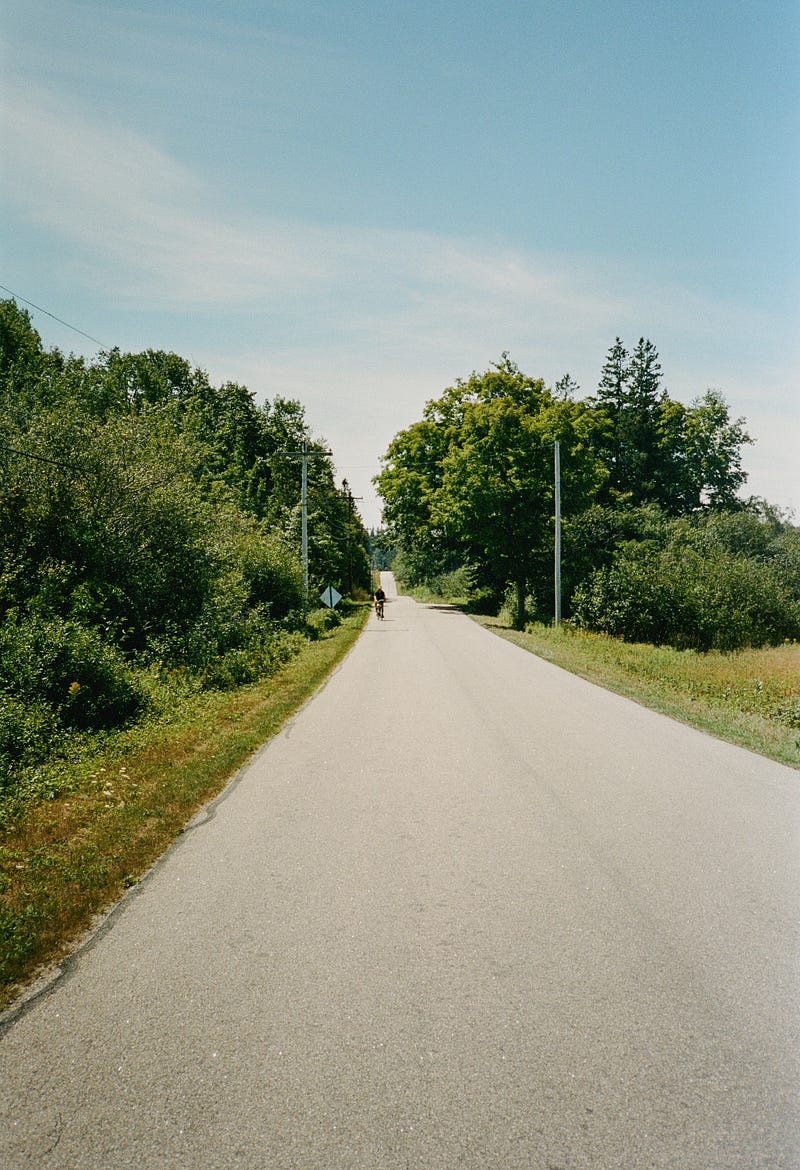
As we pedaled along the open road, the first car that passed us proffered a friendly wave. We thought little of the gesture until the next car that passed us waved, too — and then the next, and the next car after that.
Once it became apparent to us that everyone waves to each other on the island — no matter who you are — we quickly joined in. It seems to say a lot about the current state of our society that such a simple acknowledgment of another human could be so disarming and out of the ordinary.
Despite having grown up in a tight-knit neighborhood where we knew most people and would eagerly exchange waves, a friendly hello to or from a stranger roaming the neighborhood was rarely procured by either party. On North Haven, waving to passersby is just another piece of the magic.
Salt Water Farm
The highlight of the trip came the morning of day 2. After an early wake-up and a quick bowl of oats, the two of us and Dr. Bach were off to go lobstering. Having grown up in a place very similar — geographically — to North Haven, Seb and I were both seasoned lobstering hobbyists.
A short drive to the town dock at Pulpit Harbor brought us to where Dr. Bach kept his boat — a black, twenty-something-foot dory with a twenty-horsepower outboard — on a mooring. It is also where we first met Kate, Dr. Bach’s long-time lobstering partner.
Kate was the local librarian, a Mainer through and through, with a Maine drawl I didn’t know existed. And, like a true Mainer, she arrived with freshly baked blueberry muffins, complete with wild North Haven blueberries.
After brief introductions and scarfing down a muffin whole, Dr. Bach and Kate ambled into the dinghy tied up along the town dock to retrieve the dory. The two of them wasted little time getting the boat and picking Seb and me up. Dr. Bach assumed the role of captain while Kate was the chief trap hauler.
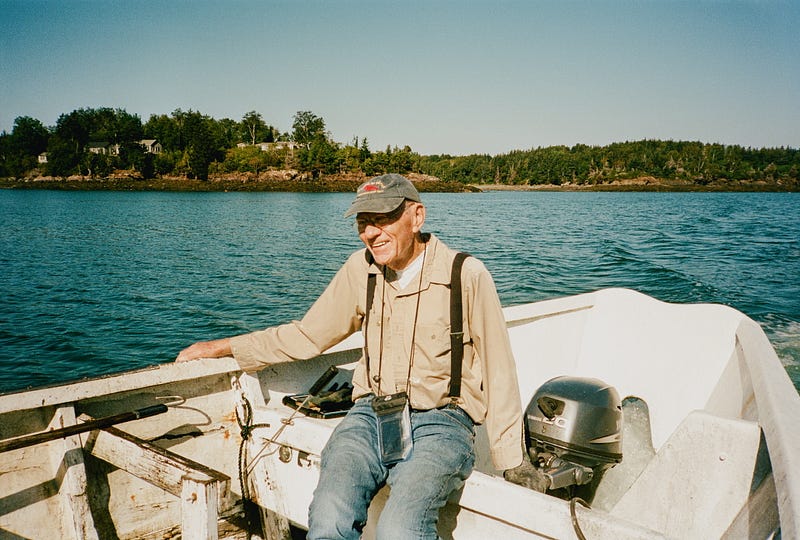
Once underway, we readied the deck —making space for the traps and setting up the davit. But first, we needed to pick up bait. As we made our way out of Pulpit Harbor, we pulled up alongside a floating bait dock where a boy, no older than twelve, sold us ten herring-stuffed bait bags. Anywhere else, a young boy running a bait dock by himself would have been odd, but on North Haven, it just made sense.
With the bait bags crammed into a five-gallon bucket, we were now on the lookout for ten green and yellow buoys. All around us, Technicolor buoys bobbed and swells rolled by amid a gorgeous day. The sky was clear, the air was crisp, and the summer sun blanketed us with a gentle warmth.
As we started to spot the first buoys, Seb and Kate took on the hauling responsibilities. I sat, perched on the bow, with my 35mm film point-and-shoot camera trying to capture what I could.
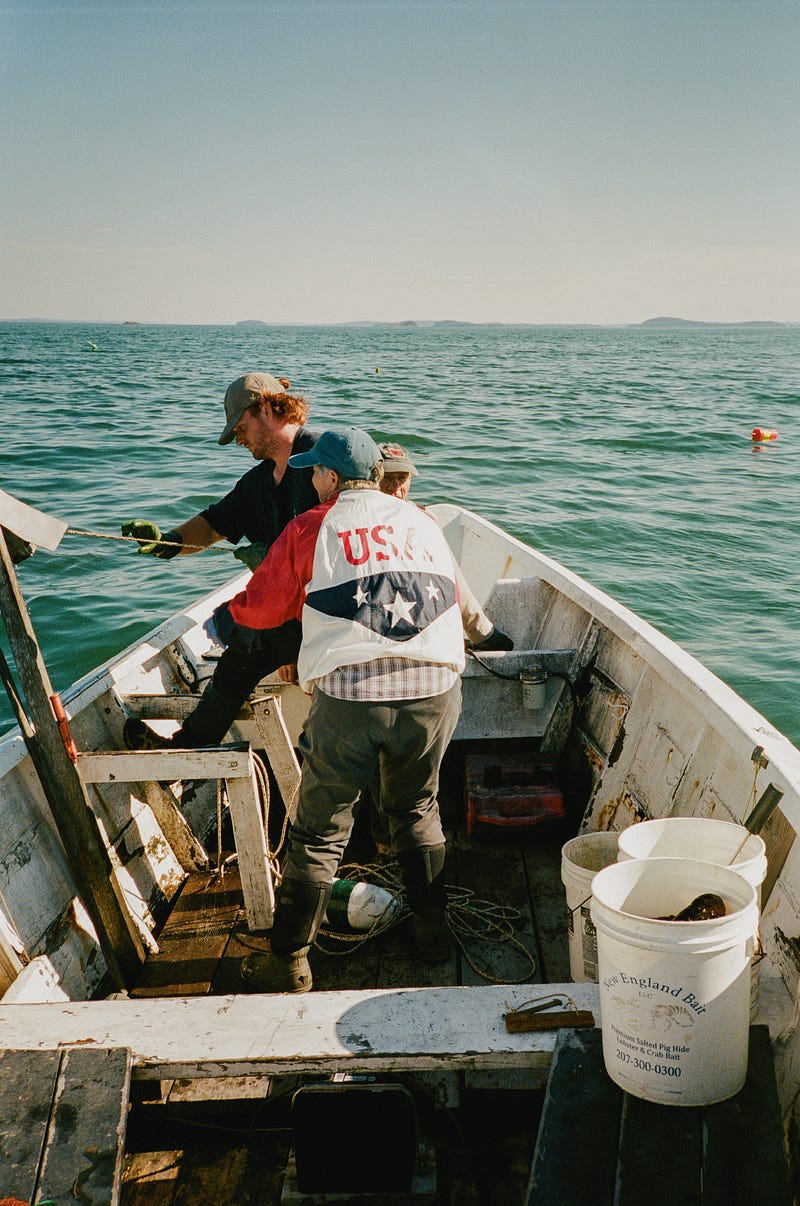
The first trap was empty, so it was quickly re-baited and tossed back over. The next trap held two small lobsters that were quickly measured and thrown back in — too small to keep. The third trap brought in our first keeper. It was a male, about 1.25 pounds — often considered the size that maximizes tastiness.
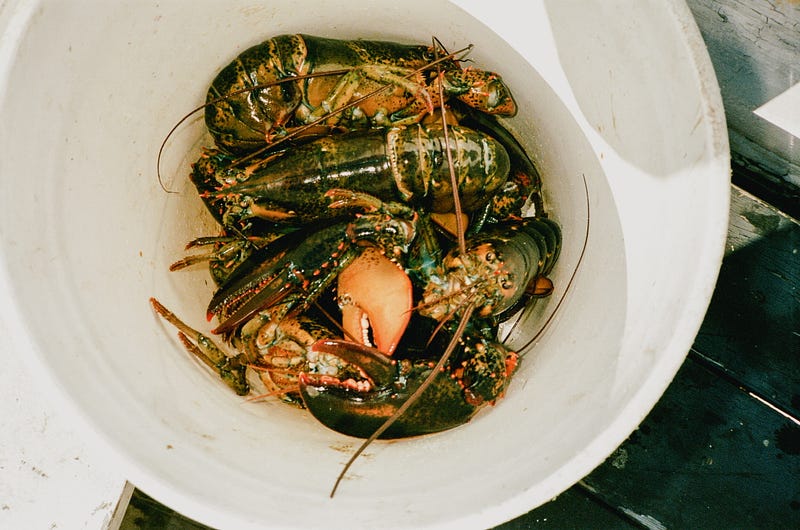
After making quick work of the next 7 traps, we landed ten keepers in all — the biggest “bug” coming in at nearly 3 pounds! As we motored back, it was amicably decided that the 3 of us would take 6 lobsters and Kate would take 4.
It was not even 10am when we arrived back at the dock. We’d been on the island for less than a day and already I’d noticed the hold time had on us was nearly gone. It’s as if stepping ashore on North Haven had just rewired our brains to think not in terms of time but in terms of purpose — measured by fulfillment rather than money or accomplishment.
In Walden, Henry David Thoreau described his days in nature “as if you could kill time without injuring eternity.”
It wasn’t until going to North Haven I understood what Thoreau meant. For us, and Thoreau, indebted to nothing but nature, the subjectivity of time came from within us — for once. And for a moment, I wondered if time really passed when I wasn't checking a clock.
To Town and Back
After lobstering, we tried to see as much of the island as we could.
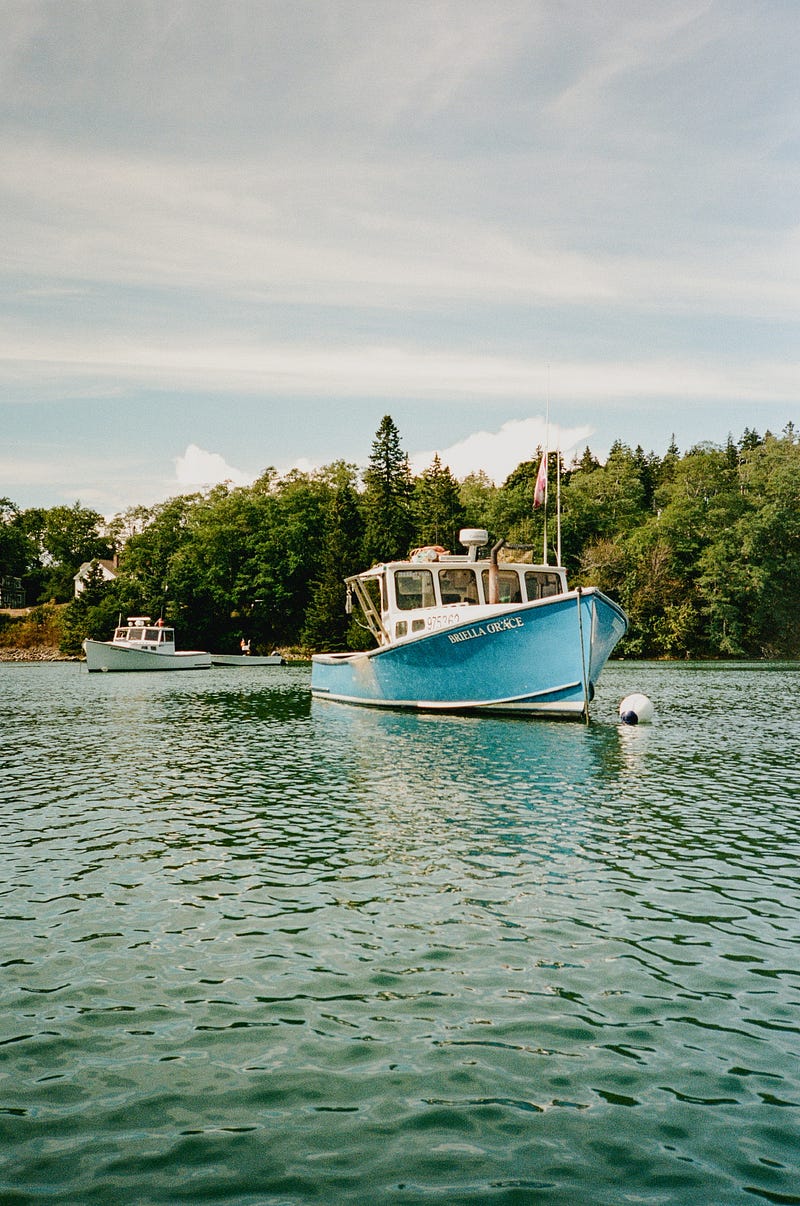
At high tide, we took Dr. Bach’s canoe out behind the house into the estuary and paddled out into Pulpit Harbor. All around us were the ubiquitous Maine pines, a smattering of lobster boats, and all sorts of Maine-built wooden sailboats at rest — like show horses just waiting to perform.
Afterward, we rode our bikes downtown. It was not a lively downtown but those who were wandering about were certainly not tourists like us — they were lobstermen, sailors, dockworkers, and townsfolk. No one was in a rush, which was a common theme on the island. People took life as it came to them — slow and steady.
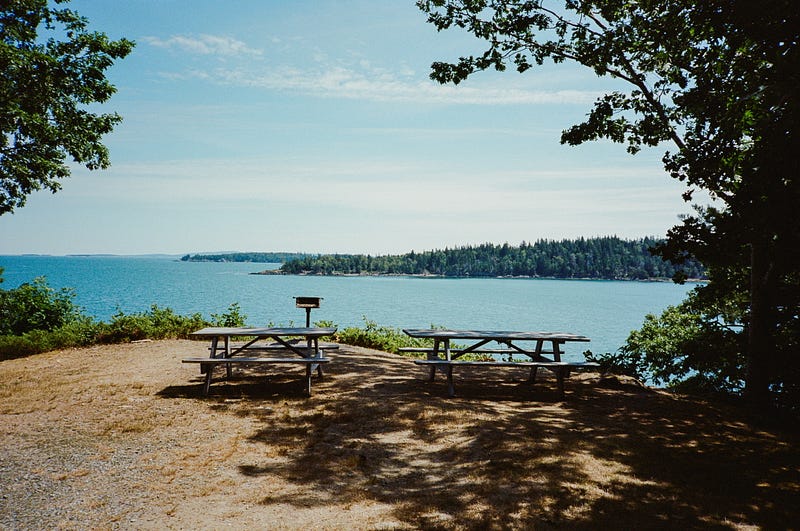
At Mullen Head State Park, we wandered the trails until we made our way to a campsite that overlooked Casco Bay. It was another sunny day, the ocean and sky mirrored a rich cerulean. Scattered around the campsite were errant bullet casings of all sizes — a reminder we were still very much in the state of Maine.
We stopped at a farm that was selling various meats, dairy products, and ephemera. After stuffing my remaining cash in an honor-system lockbox, I took a couple jams and tossed them in my bag.
Our final stop was to Cubby Hole — the natural geography of which still puzzles me. It was a small tidal inlet on the south side of the island that was almost completely lake-like, surrounded by trees, but had a small cut in the land that allowed the ocean to flow through. Naturally, we went for a swim.
Despite many previous plunges into the Gulf of Maine, I seem to forget how much colder it is than at home on Massachusetts Bay. The water was a — welcomed — shock to the body. Floating in the unfamiliar icy water, with the whole area to ourselves had a way of putting us at ease — like anywhere on the island did.
Maine Dinner
That evening, lobster was the featured item on the dinner menu. And like any good lobster dinner, it was accompanied by copious amounts of drawn butter, corn, and sourdough bread to soak up what remained on our plates.
With only 3 of us eating lobster, I imagined the other 3 lobsters would be saved for leftovers — but no. After we all got through our first lobster, Dr. Bach was insistent that we go for a second — including himself. We were hesitant, but with full bellies and the beginnings of food comas, we dug into our second, with Seb taking the nearly 3-pounder.
I’ve had many lobster dinners over the years, but none more special than that. But it wasn’t just about the dinner — the lovely company and conversation certainly helped. It was about what it took to get to that point, waking up early, working together, and seeing the day in simpler terms.
I have long been an advocate for sourcing food yourself when you can. There is something so present and pure and ancient in hunting and fishing for our food that has been forgotten by society today. E.B. White knew this all too well back in 1938 while living on the Maine coast.
“A man who has spent much time and money in dreary restaurants moodily chewing filet of sole on the special luncheon is bound to become unmanageable when he discovers that he can produce the main fish course directly, at the edge of his own pasture…” (E.B. White, One Man’s Meat)
White’s timeless words are somewhat of a message to us. To find simplicity and content in the complexities of life where we can.
Laws of North Haven
North Haven is quintessential Maine, not the Maine that is advertised — the real Maine that only a true Mainer would recognize. It’s a place where connection commingles with privacy. It is where community is as core as solitude. And for outsiders like us, North Haven is where idealism is the thief of realism.
In all my years of travel, it was one of the first places I’d visited that I would’ve been fine never going home from. Of course, I’d been to places where I would’ve wanted to stay longer but North Haven had a hold on me that was hard to shake.
It was difficult to believe that another New England community not dissimilar to my own, would feel so different. But it did not come as a surprise. Having visited Maine many times in the past, I knew the state was special — I just didn't know to this extent.
We were much younger than the typical North Haven year-rounder. But that did not stop us from feasting on the universal fruits the island offered. In fact, we likely benefited to a greater extent as we took in all the palpable wisdom that emanated from the people of the island.
On North Haven, the laws of man and nature were simple: Days were measured by nothing other than sunrise and sunset. Get your food at the source. And, by God, wave to your neighbor.


