
Older Women — Show up For The Youngsters
They need our support, not our sarcasm.

The resurgence of the #MeToo movement in 2017 coincided with my daughter's entrance into the workforce and my odyssey into the mid-to-late-50s (from where I doled out even fewer f***s.)
Listening to daught's experiences and reading about the Hollywood horrors, I was apoplectic that the sexism I'd dealt with back in the day was still alive and kicking. For Pete's sake, did I get written up as "unprofessional" and "difficult" for nothing? Was my Master's ranty thesis about working mothers in vain?
Sure we've had a few laws passed here and there but let's face it, the people who want to harass or discriminate don't really give a ****. Especially in the workplace, they often get away with it if they want to, given how draining and expensive it can be to take a stand. While topless posters in the staff kitchen are now verboten, there's still a lot of sexist BS going on.
What I found even more annoying was the number of older women who'd been-there-got-the-T-shirt, yet were utterly scathing when younger women dared even talk about it. Imagine being a 20-something, plucking up the courage to call out the guy who talks to her cleavage, only to be called a snowflake by someone who should empathize.
I'd be genuinely interested to know what makes some women do this. The obvious reason seems to be, "I put up with it, so you should too", but it still begs the question "Why?" Surely most of us recognize that when we say we 'put up with' something, we acknowledge that it wasn't okay. Even a few friends of mine who've spent decades in male-dominated fields weren't as supportive as I thought they'd be. To the old example of the perv in the photocopying room, their response was, "Just come back later."
Just no! We're telling young women to accommodate sexism or harassment when we say that.
Obviously, no one's doing mountains of photocopying anymore, but the principle stands. Telling girls and women to change their behavior or routine to 'avoid' sexists, puts the onus on them to 'solve' the problem. And it never does. Mr Photocopier will lie in wait for the next young woman to enter the lair. Until someone outs him, he'll continue doing his thing, and if there are no consequences, he'll return to it with renewed vigor.
From workplace discrimination to public street harassment, telling young women to put up with it does a lot of damage:
- Signals that they're on their own. Let's not forget that by the time a girl or young woman mentions what's going on, it's usually not the first time, and it could be the tip of a humungous iceberg. A 2020 report by the Australian Human Rights Commission found that of respondents who said they'd been sexually harassed or abused -
49% said the same type of harassment had happened to them previously at the same workplace. 45% of those who said they experienced the same type of sexual harassment previously, said it had been ongoing for 12 months or longer.
- Makes them question their experience and subsequent feelings, and thus is a form of gaslighting. They know they're upset or angry, but they're being told it's not such a big deal or it's something they should be able to 'cope with'.
- Ensures they won't bother reporting next time because, well, what's the point? As well as nothing being done about it, a backlash sometimes tarnishes their reputation and negatively impacts their career. While many countries have laws about retaliation for reporting sex discrimination, it's often draining and taxing to take action.
- Reinforces societal expectations that girls and women shouldn't 'make a fuss'. It's telling them that 'boys will be boys', to expect it and develop 'coping skills'. Their feelings don't matter. When it involves a guy with a reputation to protect, asking victims to say nothing because of the damage it might cause him is asking them to put themselves second.
- Normalizes sexism. The 'put up with it' message has ramifications for every woman. Not only does it set the standard in a workplace, it emboldens offenders to keep going.
- When sexism is normalized, it often gets worse. According to Rape Crisis, England & Wales, and many other organizations:
When we talk about ‘rape culture’, we’re talking about a society where sexual violence and abuse is normalised, played down and laughed off. And where women and girls are seen as ‘less than’ men and boys.
The proof is everywhere
A rapid review ordered by the UK government in 2021 looked at peer-on-peer sexual harassment in schools and found an alarming number of girls didn't report it. The assumption that nothing would be done and the feeling that things were so commonplace there was "no point' in raising them, were key barriers to speaking up.
A 2021 survey from UN Women UK found that 97% of 18–24-year-old women have been sexually harassed, yet 96% did not report the incidents.
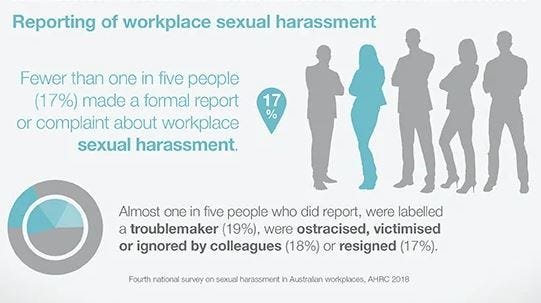
For working women, there's a risk to their professional reputation and career path when they speak up about harassment or abuse. A 2018 Australian survey found significant evidence of this:
Why is our support crucial?
It's one thing not to want to stand up to sexism oneself, but women who demean others who do, become part of that problem. Like bystanders who don't intervene, their disdain silences the woman and enables the sexist. These women might think they've blazed a trail and often do, but they're really upholding the patriarchy.
The UN report mentioned above found that:
44% of women agreed that having more confidence that reporting the incident would prevent it from happening again would encourage them to report.
It is incumbent on older women to help with that. We can give them that confidence by showing our support.
Think about it. Although more and more men are declaring themselves 'allies', we're not yet able to rely on them en masse. So while I don't propose 'group-think' just because we're women, how can it hurt to support younger women when they take a stand against sexism?
Because let's get one thing straight, from Professor Christine Blasey Ford to the teen barista in the local coffee shop, it takes courage to speak out. While there's no judgment for women who choose to remain silent, let's not diminish the effort and risk some women face when they use their voices.
In fact, let's raise our voices with them!