avatarAdel Aali - History Behind News Podcast

Free AI web copilot to create summaries, insights and extended knowledge, download it at here

2960

Abstract

etry. The Case of Nazarbayev’s Kazakhstan</i></a>.</li><li><a href="https://www.tandfonline.com/doi/abs/10.1080/02634937.2021.1926924"><i>The Kazakhstani Soviet not? Reading Nazarbayev’s Kazakhstani-ness through Brezhnev’s Soviet people</i></a>.</li></ul><figure id="d94f"><img src="https://cdn-images-1.readmedium.com/v2/resize:fit:800/1*gKOBf6wrRuaHPMLgFHB7sQ.png"><figcaption></figcaption></figure><h1 id="69f1">IN THE PAST:</h1><h2 id="1c88">Kazakhstan’s Uprising Was About More Than Just Fuel Prices</h2><p id="7205">What do Hummer taxi cabs and Bentleys parked in apartment buildings have to do with Kazazhstan’s recent uprising?</p><p id="4d57">As Professor Tutumlu explains, the doubling of fuel prices essentially cut off Kazakhs’ additional means of making a meager living, <i>i.e.</i>, giving rides for a fee. Although this may seem strange to us here in America, in Kazakhstan even owners of luxury cars depend on this secondary means of income.</p><p id="6bc8">This month’s uprising demonstrated Kazakhs’ mounting frustrations and dwindling hopes. By all indications, Kazakhs should enjoy decent standards of living. Their country is rich in natural resources, <i>e.g.</i>, oil and uranium, and straddles trade routes between China, Russia and the Middle East. And to boot, Kazakhstan has one of the lowest population densities in the world: 1.7 persons per square kilometer. To put this in perspective, China’s density is 100,000 persons per square kilometer. Ergo, there should have been more national wealth to go around for each Kazakh citizen. But as Professor Tutumlu laments about her homeland, decades of oligarchy and corruption instilled by Kazakhstan’s former president, <b>Nursultan</b> Nazarbayev, who still wields considerable power from behind the scenes (hint: the nation’s capital was renamed <b>Nur-Sultan</b>), have pushed down living standards for most Kazakhs to poverty levels.</p><p id="49c1">If you are wondering why we don’t hear much about Kazakhstan, its corruption and human rights violations, well, it’s not by accident. Kazakhstan assiduously polishes its international image. And it does this with the help of American PR, law and lobbying firms!</p><p id="bf3e">I asked Professor Tutumlu about President Putin’s claim that Kazakhs “had never had statehood” and his references to Kazakhstan as an artificial state. <i>See</i> <a href="https://www.wsj.com/articles/russias-putin-seizes-on-crises-to-assert-control-over-former-soviet-republics-11641738063?page=1">WSJ, 1/9/22</a>. She starts her response with “it’s a broken imperial ego…” and continues to explain Russia’s relationship with Kazakhstan, including the true purpose of the Collective Security Treaty Organization, an alliance of sorts among select post-Soviet states. As she tells it, the CSTO is not at all about mutual security. The Organization gets involved with its member countries, including Kazakhstan in this case, only when one of Russia’s frie

Options

ndly dictators is in danger!</p><figure id="e158"><img src="https://cdn-images-1.readmedium.com/v2/resize:fit:800/1*gKOBf6wrRuaHPMLgFHB7sQ.png"><figcaption></figcaption></figure><h1 id="dd6b">IN PERSPECTIVE:</h1><h2 id="d0e6">Kazakhstan’s History of Multi-vector Foreign Policy</h2><p id="de91">How do most Western and, more specifically, American specialists of Central Asia analyze that region, including Kazakhstan?</p><p id="b7c7">This question is not meant for the deep academic types. Non-academics like you and I can answer it too. Just try and recall what you heard or watched on the news about Kazakhstan. Professor Tutumlu helps us here. Most of our so-called “experts” are still stuck in the Cold War era. And their failure to move forward with the times limits their analysis of Kazakhstan as merely a pawn in the competition for influence between the great powers, namely China, Russia, the U.S. and a handful of Western European countries. As if Kazakhs don’t have any say or impact in what happens in their own country. That Kazakhstan is “just a field”. That it “doesn’t have people in it”.</p><p id="ca6a">This is where Professor Tutumlu informs us of Kazakhstan’s multi-vector foreign policy. It is a nationally astute scheme of dividing influence in Kazakhstan’s major economic and strategic sectors between different countries. In this system, if…, say China, wants to muscle more power in a certain economic sector of Kazakhstan, it not only has to wrestle with Kazakhstan’s national interests, but it also has to elbow other countries’ international interests in Kazakhstan. This system seems to successfully prevent the dominance of one country over Kazakhstan’s internal matters, particularly Russia.</p><figure id="137d"><img src="https://cdn-images-1.readmedium.com/v2/resize:fit:800/1*gKOBf6wrRuaHPMLgFHB7sQ.png"><figcaption></figcaption></figure><figure id="f1a5"><img src="https://cdn-images-1.readmedium.com/v2/resize:fit:800/1*3qg3mRL4dau8CSr_Mry8ZA.png"><figcaption></figcaption></figure><p id="5621"><b>Visit</b> our <a href="https://thepeel.news/">website</a>.</p><p id="614f"><b>Listen</b> to this <a href="https://anchor.fm/the-peel-news/episodes/S2E3-Old-Man-Get-Out--Story-Behind-Kazakhstans-Uprising-e1d6ikb">full episode</a>.</p><p id="d3b7"><b>Watch </b>us on social media<b>: <a href="https://www.youtube.com/channel/UCYFgxDDW77x0VnF7YZZgM5w"></a></b><a href="https://www.youtube.com/channel/UCYFgxDDW77x0VnF7YZZgM5w">YouTube</a>; <a href="https://www.tiktok.com/@thepeel.news?lang=en">TikTok</a>; <a href="https://www.instagram.com/thepeel.news/">Instagram</a>; <a href="https://www.facebook.com/thepeel.news/">Facebook</a> & <a href="https://www.linkedin.com/company/historybehindnews/?viewAsMember=true">Linked-In</a></p><p id="7058"><b>Get</b> our podcast<a href="https://news.us20.list-manage.com/subscribe?u=907fb5e7ecff411c689f88513&amp;id=57b5d80cda"> highlights in your inbox</a>, free</p></article></body>

“Old Man Get Out!” Kazakhstan’s Uprising And History…

The story behind Kazakhstan’s uprising: Bentleys in apartment buildings and Hummer taxi cabs!
IN THE NEWS:

“Old Man Get Out”

Verbal sparring between heads of state and diplomats makes for dramatic news. One such incident occurred just two weeks.

Regarding Russia’s troop presence in Kazakhstan, the U.S. Secretary of State Antony Blinken said “one lesson in recent history is that once Russians are in your house, it’s sometimes very difficult to get them to leave.” See WSJ, 1/9/22.

In response, Russia’s foreign ministry posted the following statement: “When Americans are in your house, it may be difficult to stay alive, not to be robbed or violated.” It should be noted that Russia’s troops are leaving Kazakhstan (see NYTimes, 1/13/22), which seems to negate Secretary Blinken’s statement.

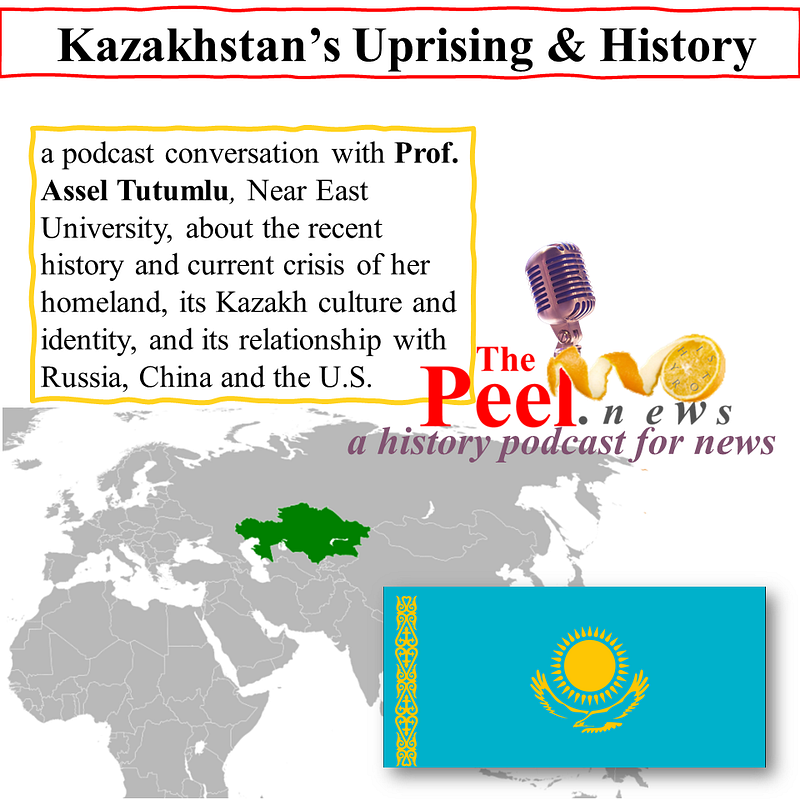
As Professor Assel Tutumlu of the Near East University explains in our podcast conversation, for which she joined us from Turkey, Russia’s presence in Kazakhstan has more to do with preserving the rule of its fellow dictators in its geographic sphere of influence than protecting the peace. And as Kazakhs shouted “Old Man Get Out”, their uprising had more to do with replacing their corrupt system of government than just an increase in gas prices.

To learn more about Professor Tutumlu and her work, visit her academic homepage. Also, click this link and listen to my podcast conversation with her, which is also available on Apple and Spotify. For your convenience, here are several of her publications about Kazakhstan:

IN THE PAST:

Kazakhstan’s Uprising Was About More Than Just Fuel Prices

What do Hummer taxi cabs and Bentleys parked in apartment buildings have to do with Kazazhstan’s recent uprising?

As Professor Tutumlu explains, the doubling of fuel prices essentially cut off Kazakhs’ additional means of making a meager living, i.e., giving rides for a fee. Although this may seem strange to us here in America, in Kazakhstan even owners of luxury cars depend on this secondary means of income.

This month’s uprising demonstrated Kazakhs’ mounting frustrations and dwindling hopes. By all indications, Kazakhs should enjoy decent standards of living. Their country is rich in natural resources, e.g., oil and uranium, and straddles trade routes between China, Russia and the Middle East. And to boot, Kazakhstan has one of the lowest population densities in the world: 1.7 persons per square kilometer. To put this in perspective, China’s density is 100,000 persons per square kilometer. Ergo, there should have been more national wealth to go around for each Kazakh citizen. But as Professor Tutumlu laments about her homeland, decades of oligarchy and corruption instilled by Kazakhstan’s former president, Nursultan Nazarbayev, who still wields considerable power from behind the scenes (hint: the nation’s capital was renamed Nur-Sultan), have pushed down living standards for most Kazakhs to poverty levels.

If you are wondering why we don’t hear much about Kazakhstan, its corruption and human rights violations, well, it’s not by accident. Kazakhstan assiduously polishes its international image. And it does this with the help of American PR, law and lobbying firms!

I asked Professor Tutumlu about President Putin’s claim that Kazakhs “had never had statehood” and his references to Kazakhstan as an artificial state. See WSJ, 1/9/22. She starts her response with “it’s a broken imperial ego…” and continues to explain Russia’s relationship with Kazakhstan, including the true purpose of the Collective Security Treaty Organization, an alliance of sorts among select post-Soviet states. As she tells it, the CSTO is not at all about mutual security. The Organization gets involved with its member countries, including Kazakhstan in this case, only when one of Russia’s friendly dictators is in danger!

IN PERSPECTIVE:

Kazakhstan’s History of Multi-vector Foreign Policy

How do most Western and, more specifically, American specialists of Central Asia analyze that region, including Kazakhstan?

This question is not meant for the deep academic types. Non-academics like you and I can answer it too. Just try and recall what you heard or watched on the news about Kazakhstan. Professor Tutumlu helps us here. Most of our so-called “experts” are still stuck in the Cold War era. And their failure to move forward with the times limits their analysis of Kazakhstan as merely a pawn in the competition for influence between the great powers, namely China, Russia, the U.S. and a handful of Western European countries. As if Kazakhs don’t have any say or impact in what happens in their own country. That Kazakhstan is “just a field”. That it “doesn’t have people in it”.

This is where Professor Tutumlu informs us of Kazakhstan’s multi-vector foreign policy. It is a nationally astute scheme of dividing influence in Kazakhstan’s major economic and strategic sectors between different countries. In this system, if…, say China, wants to muscle more power in a certain economic sector of Kazakhstan, it not only has to wrestle with Kazakhstan’s national interests, but it also has to elbow other countries’ international interests in Kazakhstan. This system seems to successfully prevent the dominance of one country over Kazakhstan’s internal matters, particularly Russia.

Visit our website.

Listen to this full episode.

Watch us on social media: YouTube; TikTok; Instagram; Facebook & Linked-In

Get our podcast highlights in your inbox, free

Kazakhstan
Turkey
Oil
Asia
Russia
Recommended from ReadMedium
