
“How the Mighty” Chapter 5 — Carrie
Old Bones, Young Hearts
The official party
For an Australian, this was pretty close to paradise. A wide golden beach, grass-covered dunes behind rising to a wooded bluff. The only thing missing was some decent surf. Otherwise, Carrielle Watson could have been at the Gold Coast before the high-rise and the shopping malls turned it into one long city.
The English Channel stretched out to the horizon. A few patrol boats to keep yachties away from the VIPs — the Queen was here, and the British didn’t muck about when it came to safeguarding Her Majesty — but it was hard to imagine how it must have been seventy-five years ago, the bay filled with warships of every description.
There had been a couple of battleships sending over shells the size of fridges into this peaceful green land. Cruisers, barges firing a thousand rockets at a time, hundreds upon hundreds of landing craft full of men armed to the teeth.
And yet the Germans had held tight, trusting in Hitler’s Atlantic Wall of bunkers and barbed wire, mines and guns, veteran soldiers manning weapons carefully zeroed in on this beautiful beach.
There would have been obstacles to snare and gash open the landing craft: logs tipped with mines, metal tangles of rusting steel rails, and of course minefields and barbed wire coils covering the dunes.
Carrie had seen the photographs in the museum here at the cemetery. Nothing left now but a broken concrete bunker or two, overgrown and empty.
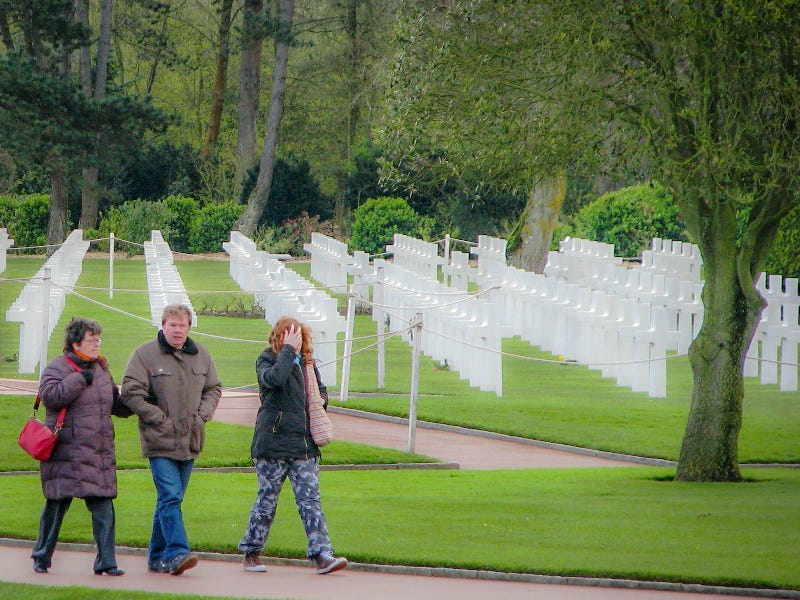
And the long rows of headstones. Crosses and Stars of David in their thousands marking the final resting places of boys — and they had been teenagers, most of them — who had come from a distant land to bring freedom to a dark empire.
The white gravestones against the smooth green lawns. Memorials and paths and gardens made this patch of Normandy a pleasant place to spend a few hours.
There were soldiers here again. Men and women in trim uniforms, police in black combat gear, quiet men in dark suits and dark glasses. The cemetery was emptying, all the visitors politely moved away to the rows of chairs fronting the official platform with its microphones and television cameras.
Carrie raised her camera to catch a couple of stragglers bending over a grave. Through the telephoto lens, she saw a lean and silvered man, medals on his chest, touching the name on a cross. What a shot! There was a story.
She moved closer, framing the old man, head bent, hand grasping the white marble, tears running down his face.
She lowered her camera then, unwilling to intrude further on the scene. A lump rose in her own throat. This must be one of the boys of that long-gone summer, returned for the commemoration ceremonies. What memories and emotions would he be feeling now?
He wasn’t alone. A young American soldier in a camouflage uniform was standing respectfully a few paces behind. He watched Carrie warily, in case she might intrude on his charge.
Or maybe his interest was of a different nature. Carrie was used to men examining her. Tallish, blonde ponytail, mid-thirties, a long-sleeved shirt, and a pair of slacks; but she wasn’t aiming to break any hearts. Not here, not today.
The old man stood up, came to attention, and saluted. It was then that Carrie noticed two red roses laid carefully before the cross. Roses, the universal sign of love. This old man must have brought them here for a comrade once sharing a closer bond than brothers in arms.
She couldn’t help herself. She gulped and sobbed, overcome by the poignancy of the scene.
The old man turned at the sound. He limped over to her, his minder offering a walking stick which he ignored.
He put his arm around Carrie’s shoulders, and dug around in his pocket for a handkerchief, crisp and white, handing it to her.
Carrie took it and dabbed at her face.
“I’m sorry,” she gasped, “I didn’t mean to…”
“There, there,” he said, giving her a squeeze. “It’s fine. Nearly sprung a leak myself.”
Carrie looked into his face, bearing its own shining evidence of grief. He looked back at her, concern in his eyes.
“It’s just that, when I saw the flowers you brought…”
“What?” He turned to look at the grave. “No, those were already here. I don’t know. Maybe a relative?”
The minder looked blank.
“May I take a photo of the headstone?” Carrie asked.
The minder — a young corporal — shrugged. “Don’t let me stop you,” he said. “You’ve got the official pass. You can photograph anything you want.”
“I wasn’t asking you.”
The old veteran looked at Carrie. She had two visible cameras, a bag which might hold one or two more, a media pass dangling on her neck, and a lifted eyebrow.
“That would be good,” he said. “If you can make me a copy, I’d be right glad to have it. I doubt I’ll get back here a third time.”
Carrie studied the light, slanting over the grave. She made a few adjustments to her camera, got down on her knees and framed the shot, taking care to get the lettering on the stone, and the two roses resting in front. Where the heart would be, she realised.
She made a close-up of the flowers: two red roses bound together with a piece of twine, a torn piece of paper bearing a single word: “Amour”. No florist’s hand in this bouquet.
The young soldier cleared his throat. “Time to get back, Sir. The ceremony will be starting soon, and it will take us a while.”
This time the proffered stick was not refused, and they set off, slowly, through the crosses. Here and there trees were planted, seemingly at random, and ahead were the flagpoles, monuments, and gathering crowd.
“We might take a bit of a rest on that bench up ahead. I’m not as young as I used to be. That okay, Corporal?”
“Yes. Sir. It will have to be a short one though. I’m sorry we didn’t bring the wheelchair now.”
The old man winked at Carrie. The young soldier kept checking his watch, visibly tense as the minutes ticked past, and they moved haltingly along the path.
There were some stone benches near the memorial and its crowds. Almost everyone had moved to the official rows of folding chairs, and there were only a few left straggling in. The veteran sank gratefully down on the weathered stone. The young soldier signalled to another, who started off towards them with a wheelchair.
Carrie bent her head over her Leica, examining the photos she had just taken. She showed the best to the old man.
“That’s a good one,” he said. “I like the way you’ve got a bit of the sea in the background.”
“I’ll make sure to send you a copy. I’ll have to get your address.”
Carrie found a piece of paper — the back of the official program, as it happened — and jotted down an address in Missouri.
“That’s near Rolla, isn’t it? I’ve been there. Lovely country.”
“Got a farm there. My grandson runs the place now, but they still keep me around.”
“For stud, I’m sure,” Carrie said.
The wheelchair arrived. “No hurry now,” the soldier pushing it said. “There’s a delay of half an hour. The French president’s helicopter has blown a seal or something.”
“Hurry up and wait,” the old man said. “Nothing changes, eh? Here, get me up off this rock. It’s as hard and cold as my mother-in-law’s soul.”
Carrie fiddled with her camera, zoomed in on the picture of the headstone and showed it to him, as he seated himself gratefully into the wheelchair. “Can you tell me about this man? You must have been close.”
There was always a button you could press, Carrie had discovered. Some people talked about themselves, others their family, or their hobbies. Press the button and the stories came spilling out. Carrie told stories with photographs, and she was certain there was a good one here.
“He was a good man. A good soldier. We worked together in company headquarters. Had a few adventures together, had a few drinks together before this thing.”
He looked off at the cemetery, the white markers stark and clean against the trim lawns.
“He was a hero. A real hero. He should be here, being called Sir and thanked for his sacrifice. Me, it was all a picnic on the beach.”
He looked at the faces around him.
“Don’t believe me? Here, look.”
He reached into his jacket and pulled out a worn black and white photograph. An impossibly young and baby-faced version of himself smiled out at them, one hand holding a bottle of wine, the other around the waist of a young woman. He was in uniform, three sergeant stripes on his sleeve, standing before an old stone farmhouse, a chimney reaching up, a strange metal ornament holding the wall together.
Carrie gasped.
“See? That’s my D-Day memory. Wine, women, and song.”
But the tremor in his voice gave the lie to that.
“Say.” The young minder, shuffling from one foot to the other. “I’m just going to leave you here for a few minutes, if that’s okay, please, Sir? Call of nature, and I don’t think I can hold out another half hour.”
The veteran waved him away. “I’m not going anywhere.”
Carrie was flicking through the stored photographs on her camera. “There!” she said, triumphantly. “I thought I recognised it. I took some shots of the villages this morning, and this old house stood out. That big metal S on the wall. Look, it’s the same place, I’m sure.”
They compared the two images. Carrie’s photo was crisp and bright and in colour — or as much as an old grey stone building had any colour — there was a satellite dish on the roof, and a Toyota parked in front, but it was certainly the same building. The same chimney, the same metal fixture. Even the stones in the wall were the same sizes and shapes when she zoomed in.
Carrie felt a hand on her arm. “Do you think you could take me there? Now?”
She looked up. The American president was passing them, only a few metres away, a television crew in tow, a screen of security in crisp black and silver uniforms. They were heading away, towards the now empty cemetery and its photogenic rows of headstones.
The old man glared at the president. Not even a nod and a smile for a veteran. “That asshole’s not going to be making any speeches for a while, and even when he gets back, I don’t want to stand behind him for the cameras.”
Carrie looked around. That fidgety corporal had vanished, there was nobody watching them.
“My car’s in the carpark, this old house is only five minutes away. Yeah, I think we can do it.”
“Let’s go! A quick half hour and nobody will even notice.”
Chapter Five of my Normandy story. I seem to have lost a chapter or two, dealing with Rudi the German soldier, but I am sure that it has just been temporarily misplaced.
A bigger problem might be that I now have multiple copies of the same material, and inevitably different changes and edits get made to different versions, and then it is a job and a half to put them all together to create the best possible output.
And now this is yet another. I’m just digging myself in deeper.
I began writing this after last year’s 75th anniversary commemoration. Don Trump was giving a speech, and I wondered who else might be there. Veterans, of course, but maybe my travel photographer Carrielle could be covering the event, and what sort of erotic adventures might she get into?
At the moment — and this is a work in progress — a lot less than originally intended. This story turned into something more serious. And more tender.
Not to mention being pushed onto my back burner for months and months as I found myself overwhelmed by research and a few tricky plot problems.
I think I’ve found a way through the minefield. Expect a chapter a day from now on until we have it all sorted out.
Or maybe I’ll get hung up on something else. Who knows?
Britni
The whole story:


