
OKRs vs KPIs: What’s the Difference?
[FYI this was originally published in my newsletter 👉https://www.antmurphy.me/newsletter/okrs-vs-kpis]
You might be wondering; “what is the difference between KPIs and OKRs?”
I get this question regularly — and it seems OKRs have become quite the hot topic for me of late. So much so, that I recorded a video capturing some of the first principles when it comes to implementing OKRs 👇
Let’s first ensure we’re all on the same page with what OKRs and KPIs are.
What are OKRs?
OKR is an acronym that stands for Objectives, Key Results.
Its origins can be traced back to Peter Drucker in 1954 and the invention of MBO (Management by Objectives). MBO was then largely used by Intel and later became widespread through John Doerr, an ex-Intel employee and early advisor to the two Google founders. Since then, it has become widespread and known as OKRs.
OKRs break down into your:
Objective: the goal we wish to achieve, and;
Key results: measurable results that indicate whether we’ve achieved our goal or not.
OKRs are designed to describe an outcome — the impact you wish to achieve but not the how.
A common mistake is describing an output rather than an outcome as your OKR — something like “Launch app x” is not an OKR, it’s not the objective — it’s an output, instead launching app x to achieve blah — that’s your outcome.
🔥Pro tip #1: If you ever find yourself in this trap, simply ask “why?” — why are we launching app x? What benefit are we expecting to see? The answers to these questions are likely to be the outcome you’re trying to achieve.
The second crucial part of an OKR is the key result you expect to see — in other words, how will you measure the outcome? Fluffy statements like “drive customer engagement” are neither useful nor measurable. Key results need to be measurable, like “increase retention by 5%” — think SMART goals.
OKRs can be used at all levels, from high-level company OKRs to low-level Product development OKRs.
Ok, so that’s OKRs out of the way; what about KPIs?
What are KPIs?
Like OKRs, KPI is also an acronym that stands for Key Performance Indicators.
Whilst there doesn’t seem to be an exact origin for KPIs, the notion of having key indicators for performance for something has been around for centuries. However, KPIs seem to have been largely popularised the last several decades in terms of measuring business performance.
KPIs can be used to evaluate the success of a particular activity, such as a project or product. You could define what indicators would suggest success for this project, activity, product, etc?
Where there is a ton of guidance on OKRs there’s not nearly as much for KPIs. Therefore OKRs and KPIs can be interchangeable in the right application.
OKRs vs KPIs
At the end of the day, they’re just labels.
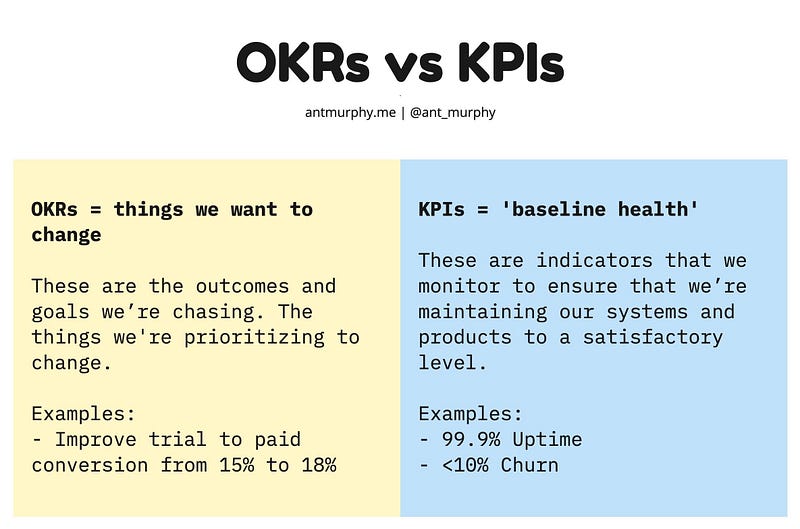
But how I like to differentiate them are by using KPIs as persistent measures that I use to track general performance and health, whilst OKRs measure the things I am deliberately choosing to change.
KPIs = measures of health
OKRs = things we want to change
In my training courses, I use the analogy of flying a plane.
Imagine you’re a pilot about to land, and your OKR is to decrease your altitude by 100m per second.
Now imagine that metric is the only dial you have on the dash. You’re staring at it, waiting to hit your OKR.
Now imagine you have a second dial (a KPI) on the dash and it says that you just lost an engine.
Now you have a problem!
You can think of all the other dials on the dash which you’re not directly trying to influence (altitude descent) but are still important to maintain at appropriate levels, like pitch, speed, altitude, etc. as your KPIs.
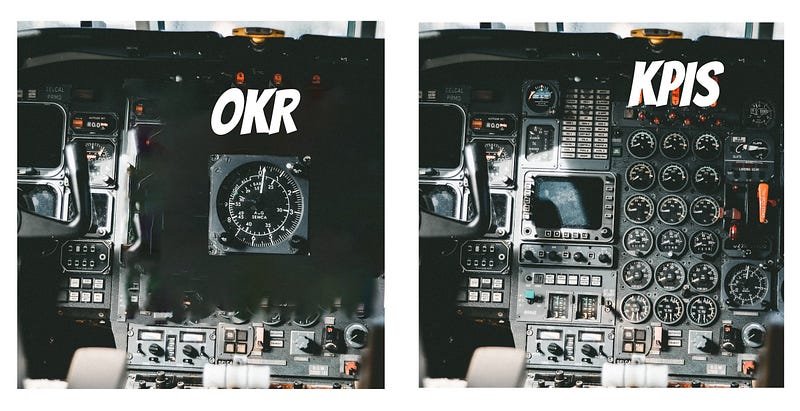
Therefore you want to have KPIs that you regularly monitor. These should represent what you consider as key indicators of a healthy product/business.
KPIs can be anything from operational expenses, profit margin, cost of customer acquisition, retention/churn, acquisition/growth, even customer satisfaction and usage.
Whereas OKRs, on the other hand, become the things you wish to influence or change.
Note: OKRs can, and often will, come from your KPIs. When you notice that the product/business is struggling in one area — e.g. ‘churn’, you then focus on that.
However, it’s important not to be reactive here.
I mentioned in the OKR video that your OKRs should be a representation of your strategy.
What I mean by that is your strategy is the choices you make to forward the business (resulting in a positive influence on your KPIs as the business grows and improves its health).
However, you may have a handful of KPIs that need improving, but realistically, you cannot influence all of them simultaneously.
So, we need to make a choice.
We need to prioritize even at the goal/OKR level (which is why prioritization is a multi-layered activity). We must choose which will help us forward our strategy more.
Your OKRs then become that choice.
They represent a strategic lever you intend to pull in order to make an incremental step toward realizing your strategy.


