
‘Oklahoma!’ Canceled Over Trans Teen and Bizarre ‘Adult Themes’ Claims
If Oklahoma is too adult for high school, what isn’t? Barney? Sesame Street?
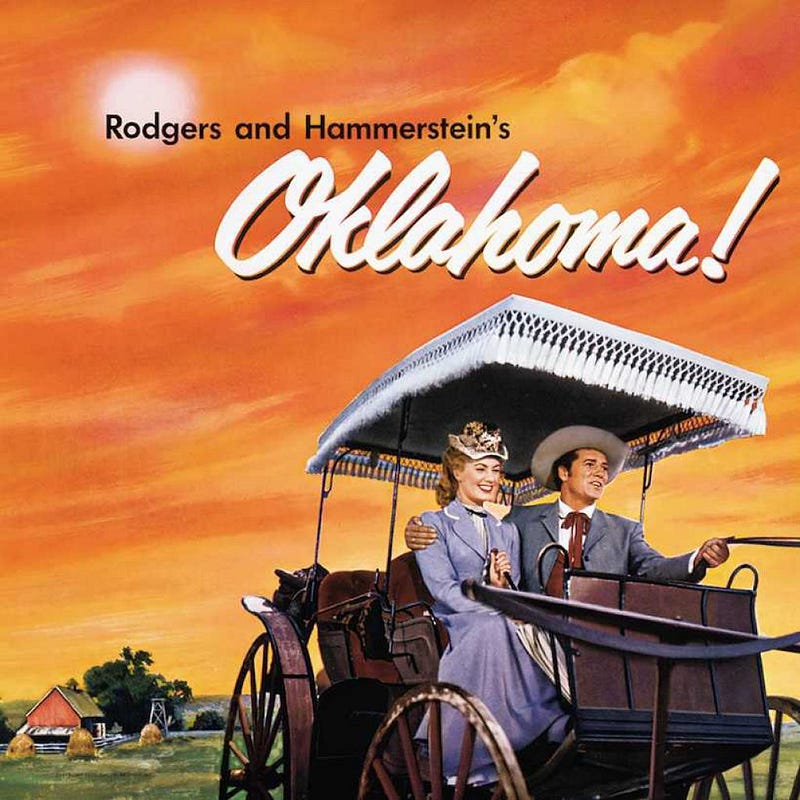
OoooooOOOH — klahoma where the wind comes sweepin’ down the plain And the wavin’ wheat Can sure smell sweet When the wind comes right behind the rain.
— “Oklahoma” (Rodgers/Hammerstein II) © 1943, Copyright Renewed, Williamson Music Company (ASCAP) c/o Concord Music Publishing.
I don’t know which part of this story distresses me more, that a high school senior was fired from his school musical for being transgender, or that the musical was later canceled in its entirety over absurd puritanical claims of adult or sexual themes. Before I get into all that, let’s talk briefly about Oklahoma! so we’re all on the same page.
Do you know those lyrics above? Are you humming along and smiling? Or maybe cringing a tad because they feel old fashioned, schmaltzy, or fey? One thing’s for sure, if you grew up in the U.S., you’re probably reacting in some fashion. The Rodgers and Hammerstein musical is that present in our culture.
Some experts say the 75-year-old classic, “birthed the modern musical” or even “single-handedly revived the art form.” Maybe that’s overstated, I’m no theater expert, but as a long-time lover of the form, I can certainly appreciate that Oklahoma! is super important to U.S. theater traditions. In 1953, its eponymous lead number even became the official song of the State of Oklahoma, and it remains so to this day.
I also appreciate that the musical is widely regarded as sweet and wholesome, even while containing some darker underlying themes, including a murder.
“Wholesome” is how I’ve felt about Oklahoma! since I first saw it staged at my Iowa high school, an ordinary experience given that historically it’s one of the most-staged musicals in U.S. schools, edged out only in recent years by The Addams Family, Grease, and other contemporary fare.
What is Oklahoma! about? Nothing specific. It’s more character-driven and setting-driven than plot-driven, according to critic Laura Stavropoulos:
Based on Lynn Riggs’ 1931 play, Green Grow the Lilacs, Oklahoma! is loosely a coming of age story set in the romanticized Western Frontier on the cusp of the Oklahoma territory joining the union. Like most musicals, the plot is more of a framework than a driving force and the songs revolve around the complicated romantic relationships of the farmers, cowboys, traveling salesmen, and other colorful characters that inhabit this rustic terrain.
If you haven’t seen it and want a simpler description, it’s a romance with stirring music and majestic sets. There are lover’s quarrels, fights over partners, and moonlit serenades.
Some people find the story troubling because it romanticizes Western expansion without acknowledging the terrible toll it took on indigenous Americans. Others complain that Black people are not fairly represented and that guns are romanticized. Just a few months ago, a high school in Ann Arbor, Michigan responded to criticism by eliminating prop guns, “in instances that aren’t central to the plot.”
So why was the musical just canceled in Texas?
That’s a sad, frightening tale that starts a few weeks ago with Max Hightower, a senior at Sherman High School in the Dallas/Fort Worth region of Texas. He’s been active in his drama department “for years,” his dad Phillip Hightower has told local news station KXII.
According to Phillip, “It was a beautiful day,” when Max learned he’d landed the part of Curly, the male lead, adding that Max was “thrilled” and that he deserved the role. “He puts in the effort. I mean, I can’t tell you how many times they’ve been singing in the bedroom.”
But just two weeks into rehearsals, Max got a “crushing” phone call from his high school principal.
He would not be permitted to go on stage. The principal told Max that because he is a transgender boy assigned female at birth, school policy prohibits him from playing a male role.
(Pink News reporters have been unable to identify any school or district policies of the sort. The Texas legislature did pass a law prohibiting drag shows earlier this year, but a federal judge struck it down. In any case, a theater production like this would not meet the law’s definition of suggestive or lewd dancing, and Max is not a drag king. He’s a student actor.)
“I was devastated,” Max said. “All kinds of actors have played all kinds of parts. I mean, I grew up watching Mrs. Doubtfire.”
He and his dad have both told reporters that theater traditions have included cross-gender casting since before the time of Shakespeare. I would add that such customs are still common today in professional repertory companies that stage multiple shows in rotation. Rep companies are often small enough that individual actors must play multiple roles in each show, sometimes switching up the genders of the characters they play.
I wrote about that last May in my story, “James and the Giant Peach Axed Over Imaginary Drag Queens,” in which Texas schools cancelled trips to a play because a repertory company was using standard mixed-gender, rotating casting — which nobody had objected to in all the decades of the company’s existence.
But wait, firing Max because he’s trans isn’t canceling the show. What’s that about?
It’s bad enough that Max’s principal arbitrarily fired him. That’s deeply transphobic and deeply unfair to Max, who worked hard to earn his spot. It’s bad enough that it sends a terrible message to Max’s peers: “Go ahead and discriminate against trans folks. If the respected adults in your life do it, so can you.”
But then this story gets strange and disturbing in different but connected ways. First, the school district released a statement contradicting Max’s principal:
There is no policy on how students are assigned to roles. As it relates to this particular production, the sex of the role as identified in the script will be used when casting. Because the nature and subject matter of productions vary, the District is not inclined to apply this criteria to all future productions.
Translation? The district doesn’t have a policy, but Max is out anyway. “Because we said so.” They won’t necessarily exclude transgender performers in the future, but they might if they feel like it. Anybody besides me find that message disrespectful and deeply inappropriate?
Oh, but keep reading!
Soon after Max was fired, student cast members say school officials told them the entire production was canceled, reportedly on the grounds that it is overly sexual and contains adult themes.
Astonished cast members and their families contacted local news reporters, and regional outlets starting picking up the story. People were bewildered and angry in equal measures. One of the most popular high school musicals ever is now “too adult” for high school? What bizarre parallel universe have we all been mysteriously transported to?
One student asked, “If Oklahoma is too adult for high school, what isn’t? Barney? Sesame Street?”
The district responded to the controversy with another contradictory statement, claiming the the cast had misunderstood. The musical wasn’t canceled after all, it was being postponed so it could be reworked:
The District will postpone the performances from December 8–10, 2023, to a later date. The District anticipates the public performances will be scheduled for some time after January 15, 2024. Between now and then, we will be working diligently to produce Oklahoma! as a musical that is appropriate for the high school stage.
Then they thanked everybody for their hard work. Except Max. He’s still out.
So what really happened? What to make of the district’s contractions and the principal’s apparent untruthfulness about policy? It’s hard to say for certain, but it’s not hard to imagine.
Here’s a plausible scenario:
Curly, the lead, has a kissing scene. Some conservative parent or community member noticed the scene and freaked out. (That’s so queer! It’s two “girls” kissing. Stop the show!)
That’s likely when Max’s principal fired him citing a nonexistent policy.
Then, the same community member/s likely dug into the script and noticed the play centers on romantic liaisons, disputes, pairings, and re-pairings. They noticed the play is not asexual, which offended their religious beliefs, and so they complained again. “Firing Max isn’t enough. Fire the whole show!”
That’s likely when high school administrators told the cast the play was canceled.
But then the district got wind of negative media attention, and re-evaluated. “Oops! We’re looking like laughing stocks. We’d better save face.”
Am I certain that’s what happened?
Of course not, but I’d be surprised if the broad strokes aren’t pretty close to reality. With conservative religious groups like Moms for Liberty working so hard to remove books with even the slightest adult theme from high school libraries, with them:
- offering bounties for turning in teachers,
- attacking the Trevor Project for working to prevent LGBTQ youth suicide,
- trying to ban a book about seahorses as “too sexual,”
- trying to get librarians arrested for offering mainstream YA fiction to teens,
- saying that two girls briefly kissing at a school dance is “lewd” and “traumatic”
One theme becomes crystal clear:
Conservative religious groups are trying to advance a reactionary, puritanical, absurdly sanitized version of American culture. Trying to ban Oklahoma! is a perfect example of that puritanical wave … because the musical is SO wholesome by reputation.
It’s so tame, so sweet, so unobjectionable that maybe we’d all better sit up and pay attention to where the extreme religious right is trying to take us.
Whether you’re a Republican, Democrat, independent, or whatever, do you truly want to live in a society where Oklahoma! is considered lewd, judged inappropriate for 16-18-year-olds?
I’d like to leave you with that, but before I finish, please spare a thought for 17-year-old Max, who spent his high school career working his ass off in the theater department. Because even if Oklahoma! goes on, Max will sit on the sidelines, at best humming along to the songs he worked so hard to master.
Max deserves so much better than that. The kids being taught that it’s okay to hurt Max deserve so much better than that too.
11/10/23 Correction: The role Max was originally offered, which I took from local news reports, was actually Ali Hakim, according to an interview Max just gave to The Washington Post. The role is not “the” male lead, but it is a major leading role.

My writing is always free to readers who click my social media links, but if you’d like to browse more, click here to join Medium and support thoughtful independent writing and journalism curated by humans, not algorithms.
To get an email whenever I publish a new story, Click Here.