
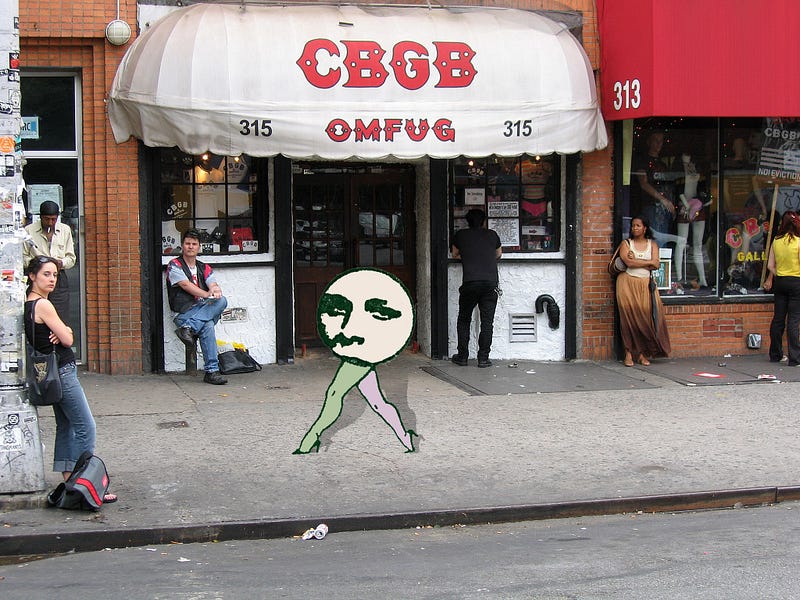
OK Punker!
Four Interludes at CBGBs
1978 The walls inside CBGBs were wet, dripping sweat breath booze excitement. The Dead Boys had just left the stage and my inner ears were fluttering. During their last number, Stiv Bators, the lead singer, took Performance Art to a new level—pulling out a package of baloney from his back pocket, taking a slice out, blowing his nose in it, and then eating it. (Was this an allusion to the band’s first album, named Young, Loud and Snotty?). I wrote the experience down in my journalist’s pad. It was 1978. A youth fueled energy had taken root in a highly spirited, instrumentally stripped down, powerfully dynamic music—inflamed with anti-establishment sentiments, and often a highly ironic sense of humor. Punk rock. A new musical intensity—rooted in rock’n’roll from a time before high-art pretensions had bloated it into “progressive rock”. It was Independent. Do-It-Yourself. Inspired by the spirit of 1960s garage bands, there were new bands emerging all the time — The Sex Pistols, The Damned, The Stooges, The X-Ray Spex, The Cramps — endless. A counter cultural barrage of animated social, political, and artistic dissent had burst forth. Rebellion. Ultimately all the artforms would be touched by this eruption of youthful creativity—and yet it would be a long time before the FM rock radio stations would play any of this music.
[I had departed New York City in 1970. I was resisting the Vietnam War draft and my girlfriend an abusive alcoholic father—so we went to Chicago. We were Just Runaways. By 1975 I had been forgiven by the FBI, was living alone, developing my writing skills, inventing a character named ZaZa Lispoidic, and dancing nights away at La Mere Vipere, a Chicago punk-dance club—loving the music. All of this excitement of the music and art and culture grabbed me by my ears and drew me back to New York City.]
A day job copywriting for a science publishing company provided rent and food. And fun—excitement and creativity—came via the music scene all around, time spent expanding my collage and other visual art skills, and being NYC punk-scene-correspondent for the Chicago zine Gabba Gabba Gazette.] I wrote a review of that mythical Dead Boys show at CBGBs, spinning words to try and capture the excitement and madness. I wrote at the end of that piece, wondering as I do now . . .
“In 40 or 50 years, if anyone should read this, will they think I made it up?!”
You be the judge.
1979 I had stopped in at Manic Panic and said hello to the proprietors, Tish and Snooky, as well as to drop off some copies of Issue #2 of Smegma the Magazine—a project I started the year before on which I was co-editor. I bought myself a copy of the East Village Eye which had just started publication earlier that year. The band The Lounge Lizards were on the cover. I went over to the Kiev restaurant for a bowl of their amazing vegetable soup, served with challah bread. I leafed through the paper—a wide range of articles wrapped up in collaged graphics. The topics covered a cultural analysis of jello, a defense of tenants’ rights, a review of the Dead Kennedys, a look at “wrapping” fabrics as a fasion statement”, and a guide to cheap dining with the help of free condiment packages. There was Mr Modern expounding on the Seers & Robot catalog, and something about a “Science Fair” project made by two individuals who called themselves TorridZone Igloo and Scarlatina Lust—it was called “How Time Works “and was comprised of an aquarium which features the “time machine antics of the three Hermit crabs: Moot Point, Zoot Suit and Foot Stool.” During this time the East Village was obviously a cornucopia of experiences reached through the Looking Glass. As the evening rolled in I walked back up Second Avenue for an eggcream at Gem Spa, and then made my way towards CBGBs—where I had planned to meet my sister. It was a Ramones’ night and the energy was ricocheting off the walls, as was the sweat heat in the overcrowded venue. As always I was filled with joyous energy when they broke into ( 1—2—3—4) “Sheena Is A Punk Rocker” . . . as my heart sang along with the line “…well New York City really has it all”.
My sister loved the show but the drinking and heat had gotten to her.
Puking in front of CBGBs was so fabulously punk.
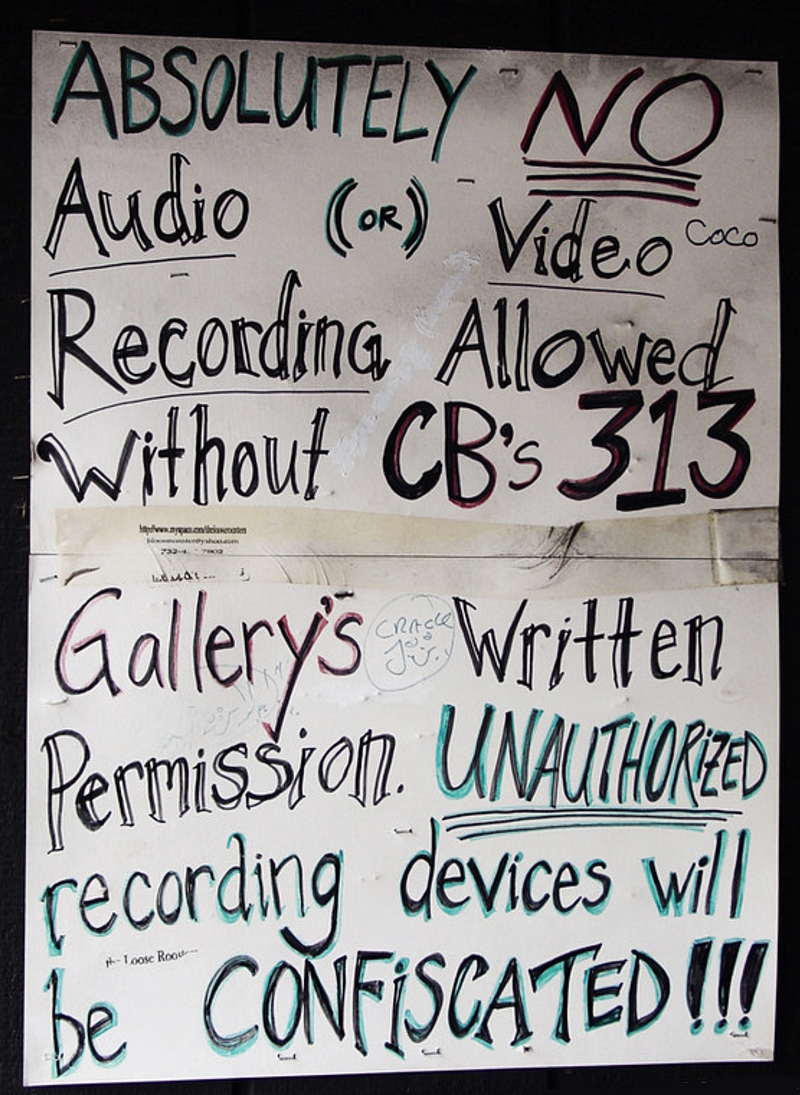
1984 Some years later, one cold March night, I was back at the club. I was lucky to get one of the rarified seats near the stage as the place filled up with the usual way-beyond-capacity crowd. People crushed against each other, swigging beers, loud conversation—everyone in their punky going-out best. Cowper and the Precums had just left the stage and the The Maroons were going to be next—followed by the headliners: The Chinless Butterballs. As I sat nursing my beer I noted a young woman, pink hair, leather jacket, emerging from the direction of the restrooms—followed soon after by a man who looked like he was in his 80s—pretty much like one of the local immigrants seen around this neighborhood. Not your typical clubber for sure. The girl headed back towards the bar but the old guy stood there, almost pogo-ing in place to the music as the band started to play. I was intrigued and thought I’d try to interview him later but after a couple songs he was gone. I told my friend Tyrone about the incident the next day and then a couple months later he came over to my place to show me the current issue of Screw Magazine. There was an article in it—written by a 79 year old man about his sexual exploits in the East Village from the 1950s to the 1980s. In the article he mentioned that very show I had attended.
1985 Early that year CBGBs suddenly found itself located in an up-and-coming neighborhood. The rent squeeze was coming, tripling the cost of the space. (The latest reports confirm that there are six times more landlords in hell than the next tier—lawyers and television news personalities.) Five nights of rent parties—each featuring five bands—were planned to benefit the venue. And I was lucky to go to the first one, on Friday June 14. There was tension in world news earlier that morning as a flight departing Athens for Rome had been highjacked with over a hundred people on board. My existential rumination that day was regarding the fact that even amidst nightmares in many distant places, we push on with life all around us. And there I was that first night—delighted to hear Chris Spedding rocking his 1970s hit “Pogo Dancing”.
This would turn out to be my last visit to CBGBs in the 20th Century.
Something was shifting. I regularly experienced a sense that I was losing my connection to the energy of New York City. The magic had turned to new pretentions. The art was begging its way into galleries. I was 33 years old. Changes were necessary but I had no idea how big they would be. As things turned out the following year I abandoned my possessions and took off traveling Europe and the Middle East for 6 months—afterwards relocating in Vermont and rasing a family. My three kids grown, I returned to New York in 2010, permanently I’m guessing.
2004 You won’t believe this. Six years before I finally moved back to the city I was visiting here. It didn’t take long to realize that I had left my heart in New York City—so I made frequent trips back. I happened to overhear a converastion on the subway that a very last show at CBGBs was planned that weekend. A good connection I had maintained not only got me access to the show but a great seat and endless free drinks. It was both a sad and magical experience as I had seen so many amazing performers in that space in the past—The Ramones, Blondie, Television, The Patti Smith Group, Pere Ubu, Richard Hell & The Voidoids, and so many many others. If it was possible the place was even more packed than it had ever been in the old days.
Patti Smith, who had been an inspiration to me over the years, performed. “CBGB is a state of mind . . . There’s new kids with new ideas all over the world,” she said “They’ll make their own places — it doesn’t matter whether it’s here or wherever it is.”
Was it something to be proud of that a 50 year old man, with tears in his eyes, threw up on the very same sidewalk that his sister had some 20+ years earlier?
You be the judge.
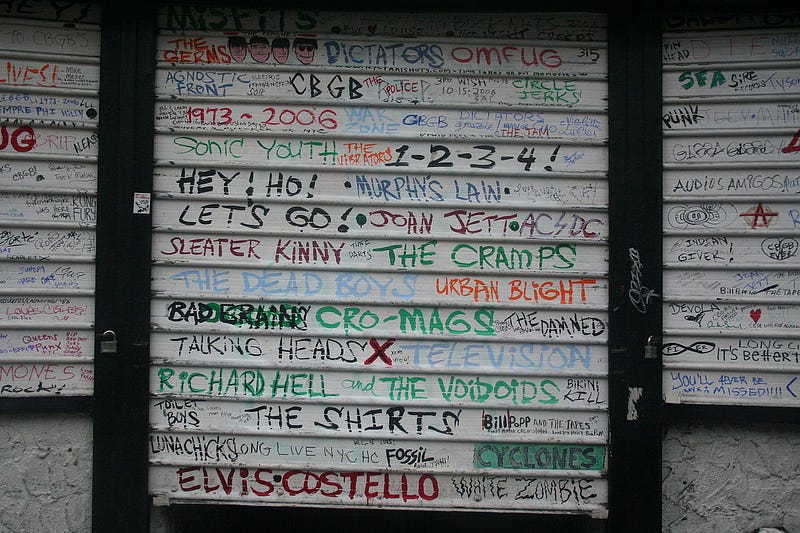
“It’s a symptom of the empty new prosperity of our city.” — Patti Smith, regarding the closing of CBGBs.
________________________________________________
© AleXander Hirka 2020. All Rights Reserved.


