
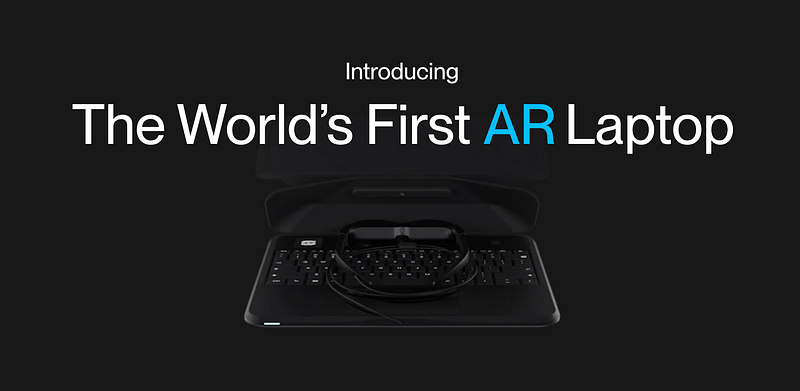
OK, Maybe An AR Laptop Can Work After All
One of the blogs I read is Cal Newport’s blog. This is one of the blogs in my RSS feeds that I just added ages ago and have no idea why I still follow. The articles from it are short and rare enough that I never get the desire to unsubscribe.
And one of the posts that I recently read is this one about ‘the end of screens’:
Believe it or not, one of the most important technology announcements of the past few months had nothing to do with artificial intelligence. While critics and boosters continue to stir and fret over the latest capabilities of ChatGPT, a largely unknown 60-person start-up, based out of Tel Aviv, quietly began demoing a product that might foretell an equally impactful economic disruption.
I only have one question: how much money does it cost to get a best-selling author to write a sponsored post for my app?
Anyways, the post covers a company called Sightful which is launching the world’s first AR laptop.
Although when you first go to the page it says ‘The World’s First Laptop’ which made me do a double take. It’s like when Lenovo announced the world’s first folding laptop.
Anyways Sightful is selling an AR laptop, the SpaceTop. Now I was very negative on the whole idea of an AR laptop.
But then I saw something that changed my mind: their video.
The Ultimate Nomadic Companion
So the user is using the product in a mobile van. And at the end of the video it is revealed that this van is parked in the middle of nowhere.
Now I’m not the biggest fan of van life. But this could actually work. I keep on comparing AR/VR to a traditional laptop and of course it can never compete. But if you consider it as a new device that allows you to use it in cramped settings with zero setup, it can actually work.
Although I still have my complaints. First of all this laptop will probably be Linux based so that it can do all the crazy virtual window stuff. Nothing wrong with Linux, in fact I have been thinking of switching to Linux, but a lot of programs don’t work with it. Second they’re selling it as having 5 hours of battery life as some groundbreaking feature. OEMs like to greatly exaggerate their battery life claims so ‘5 hours’ advertised can easily turn into 2–3 hours real world.
And of course the classic low resolution complaints. In a previous post I said there are 4 ways you can make a convincing VR monitor.
And it looks like Sightful is going with the HoloLens approach. In fact the device looks incredibly similar to HoloLens. So close that we can compare the two.
HoloLens
This is the HoloLens.
It’s a bit bulkier than the SpaceTop which leads me to believe that the SpaceTop will perform significantly worse than the Hololens. Also the HoloLens is $3500 even with the backing of Microsoft, the SpaceTop is only $2000.
And the HoloLens isn’t even that great of a device. The video above claims it only has a 43-degree field of view which is extremely low. I said in a previous post that a monitor usually covers 60 degrees so if you want to use this as a monitor you’re going to have to constantly move your head.
Although for that you’re going to get a very high pixel density. The HoloLens has a 1080p display and if that only covers two thirds of your monitor your display would effectively be QHD.
I suspect the SpaceTop would attempt to do something similar to the HoloLens. So if it’s two thirds the price let’s assume it’s two thirds as good. So it would use a 720p panel. That’s not the worst experience. You’d still be looking at a 1080p monitor. You’d just have to turn your head around a lot.
So, yes, it could work. The only question is if people would pay $2000 dollars for this when you could instead spend that on a nice Apple Silicon Macbook. Especially as the final product is likely to be about as bulky as a HoloLens.
Conclusion
You know I suspect Microsoft will come out with their own AR laptop. The Surface AR or whatever. It just makes sense, they already have the HoloLens. All they have to do is open up the field of view a bit and then they could crush the SpaceTop.
And they could also make their own version of Windows tailor built for the device. If they did that properly it might actually make me want to go back to Windows. I mean it would have to be a really great product to get me to want to use Windows. But it could happen.
If you liked this article consider following me on one of my publications: Lost But Coding (for programming content) or The Rest Of The Story (for everything else). You can do so with my RSS reader available on iOS (and Apple Silicon Macs) and Android.


