

The End Of Unity
How Unity Killed All Their Goodwill With One Blog Post
Introducing Unity’s Not-A-Revshare Revshare
Ah, Unity, I wrote a piece a while ago about how they shifted from an Unreal competitor to a company that is focusing on mobile games leading to some questionable decisions.
And here we have 2 possible options. You either continue growing at what a company is good at. For Unity this would mean improving the engine and competing with Unreal. Or option 2 is you ignore that and instead just do whatever makes you the most money. This would be going into the lucrative mobile market.
And I thought that was that. But now there’s a new controversy surrounding Unity. And it all revolves around this chart:
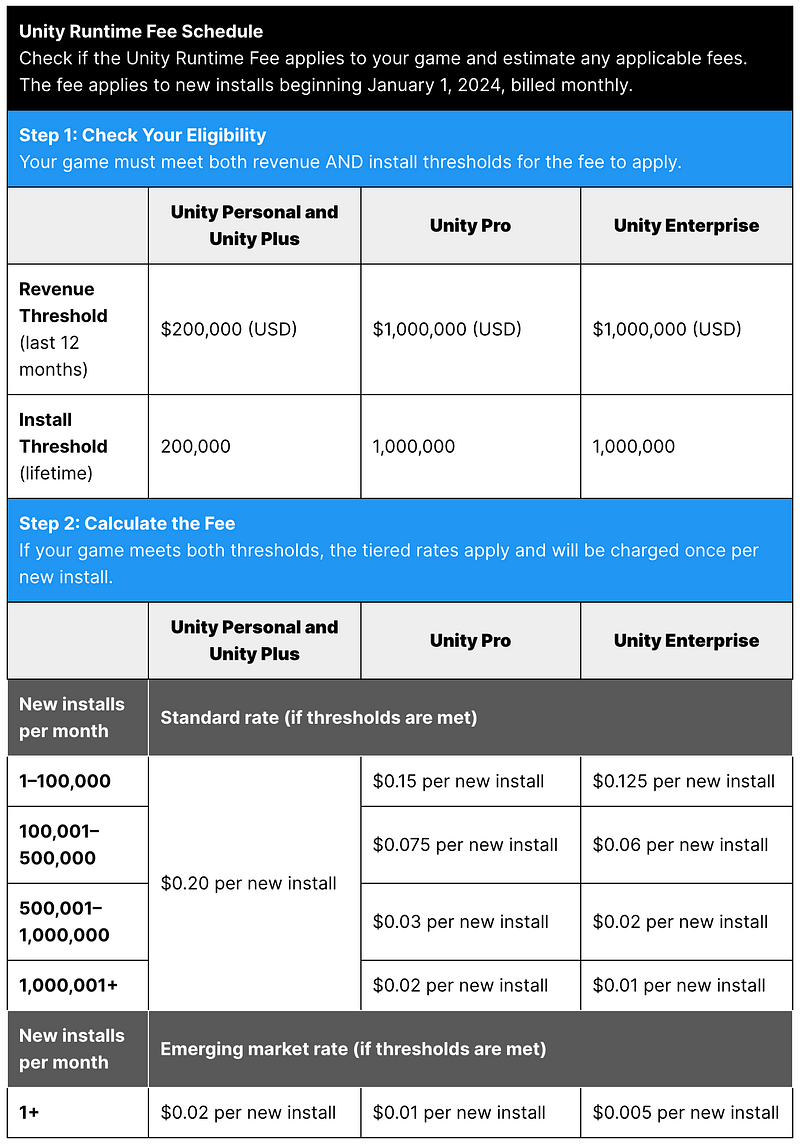
It has been updated since I first saw it yesterday. It’s more clear now. So this is how I understand it: you subscribe to the Personal, Plus, Pro, or Enterprise plan. Then this plan gives you a certain number of free installs. And if you go over you have to pay an overage charge.
An install is when a user installs your game on their machine. The problem people seem to have is the number of installs can be greater than the number of buyers. Why? Well for one piracy. And the other is web builds. When you play a game on the web every time you go to that page you’re technically downloading the game from scratch assuming there’s no caching. And I don’t think this has been properly thought through.
Update: It looks like Unity is now saying the policy does not apply to WebGL games. Probably for this reason.
A: No, the Unity Runtime fee does not apply to WebGL games.
Update: I should probably mention that Unity keeps on saying that they’ve solved the piracy problem. Although no one seems to believe them.
It would be nice for Unity to provide some assurance that the number of installs is tied to the number of purchases in some way but they have been very vague on this and some of their communications have been contradictory. Once they said every install would be counted, now they say only the first. Which one is true? And how will they know? The only thing that I believe from Unity is
A: We leverage our own proprietary data model. We believe it gives an accurate determination of the number of times the runtime is distributed for a given project.
What does this mean? No idea.
And if Unity is calculating this that’s extremely sketchy. Now unlike other people I don’t have a problem with Unity games connecting to the Unity servers. Because honestly I assume every framework is doing this. I assume Unreal games are connecting to Epic’s servers and I assume my Flutter app is connecting to the Google servers. And if it doesn’t I’m using Firebase so it connects to Google’s servers anyways.
The reason I do consider this sketchy is because it’s not usually done like this. The way billing is usually done is with a self-reported revenue share. Like with Unreal engine: they take 5% over 1 million dollars. Pretty simple. Unity does… this incredibly backwards error prone thing. In my opinion all of this could have been avoided if Unity simply did a simple revshare. But they didn’t for whatever reason.
Now there is some concern going around that people can just reinstall your game a million times and the devs will be out thousands of dollars. I don’t think this is a very likely case. Because first who has time to sit at a computer and reinstall a game thousands of times? I guess you could make a script to do it. But that would just automate the process, it would still take a long time to do. And if that did happen you could just tell Unity those installs are fraudulent and they’ll probably waive the fee. If they did not automatically detect it first. It would be pretty easy to do, if the IP is the same and the install happened in a short period it’s probably fake.
Also if you think of this program as a rev share it’s not that bad. The install fee is just an overage charge. The enterprise plan gives you 1,000,000 free installs so if you don’t have 1,000,000 installs you don’t have to pay it (assuming you’re in an appropriate plan). Also people keep on saying that the fee is 20 cents. Only for the personal/plus plan and then it’s probably better to just pay for a higher plan.
For most people that this overage charge applies to it’s going to be amortized at 1–5 cents per install. And that’s for big companies that can pay it. And it’s not even that bad. Let’s say you sell a game for $5. Then after Steam’s cut you get $3.50. Then 5 cents per install is less than 2 percent of your earnings. Now it is possible that the number of installs is higher than the number of purchases. But it’s also possible it’s lower. How big is your Steam backlog?
Although this will skew incentives a lot. The games that are really good tend to get installed over and over again. Apparently some OS’ have the ability to automatically install and uninstall apps based on storage space. By charging like this you’re basically incentivizing companies to make bad games that don’t get played often.
But the most insidious part of this is it essentially enforces a minimum profit per customer. So one of the questions is how will this affect things like Game Pass? You don’t know how many people are going to play your game. Now from what I hear services like Game Pass pay very well so it’s not a huge problem but it’s worth thinking about.
Another problem is free-to-play games. What if you don’t make 5 cents per install? And even if you do how much are those 5 cents per install going to eat into your profits? Some mobile games have an average revenue per user (ARPU) of only 10 cents. So that’s 50% of your money gone after your initial one million installs. And then there’s advertising fees. And then there’s demos.
And what if someone makes an abnormally low amount of money per user? Imagine if you make something like Wordle or Flappy Bird (without ads) and you suddenly get a million downloads for an unmonetized game overnight. You could be on the hook for a lot of money. You could be forced into a higher plan than you might be comfortable with. And this is where the 20 cents per install does come in. In my opinion it doesn’t make any sense to charge people that aren’t making much money more. If it was up to me I’d only apply this fee to enterprise users meaning you’re making 1 million plus a year.
Update: it looks like the fee only applies if you’re making over the $200,000 a year. So an unmonetized game would not trigger it. But what if you add monetization later? It’s still problematic.
I think what happened here is Unity looked at their spreadsheets and asked themselves, “How can we squeeze out more money?” And they decided on this incredibly overengineered monetization plan.
Because if you think about it this plan isn’t that bad for most people. I don’t think people should be freaking out as much as they are. But it’s just so opaque. And it’s risky. If you don’t make at least 10 cents per install it could seriously cut into your profits. I’m not sure if this is something worth worrying about because big companies are probably pretty good at monetization. But it’s always a risk.
I think a lot of mobile developers are going to be reassessing if Unity is the right choice for them about now. Especially with some other general price increases coming to the engine. The Unity subreddit has been full of users talking about switching to Unreal and Godot.
But this isn’t even the worst part. Most devs should not fear the install pricing. It’s dumb but it won’t even apply to most people using the engine. What most people will feel are the general price increases. It now costs 2 grand a year to remove the splash screen. That’s a lot. Especially as Godot is free and for most indies Unreal is also free.
But that’s not the worst part either. The worst part is that Unity is applying the new pricing retroactively. For games already developed, not games already installed.
Q: Are these fees going to apply to games that have been out for years already? If you met the threshold 2 years ago, you’ll start owing for any installs monthly from January, no?
A: Yes, assuming the game is eligible and distributing the Unity Runtime then runtime fees will apply. We look at a game’s lifetime installs to determine eligibility for the runtime fee. Then we bill the runtime fee based on all new installs that occur after January 1, 2024.
Normally if you download an engine the new terms only apply to people who have updated the engine. For example in the Unreal terms it says:
If we make changes to this Agreement, you are not required to accept the amended Agreement, and this Agreement will continue to govern your use of any Licensed Technology you already have access to.
However, if we make changes to this Agreement, you will not be allowed to access certain Epic services or download the Licensed Technology unless you have accepted the amended Agreement. If we make changes, we will provide you with notice, such as by sending an email or giving you notice when you next log into an Epic service.
Unity used to have this but they took it out.
And I think they only added it in response to another controversy. I don’t remember which one. Unity is full of controversies. But it’s gone now. Fool me once shame on you. Fool me twice…
If you liked this post and would like to stay updated with my future articles consider using my RSS app Stratum on iOS and Android. Also check out my language learning app Litany (iOS, Android) and my programming idle game ‘Pretentious’ (iOS, Android) based on my post on the GPL.


