
Of Literature and Other Abstract Thoughts
When meals tell a story, too
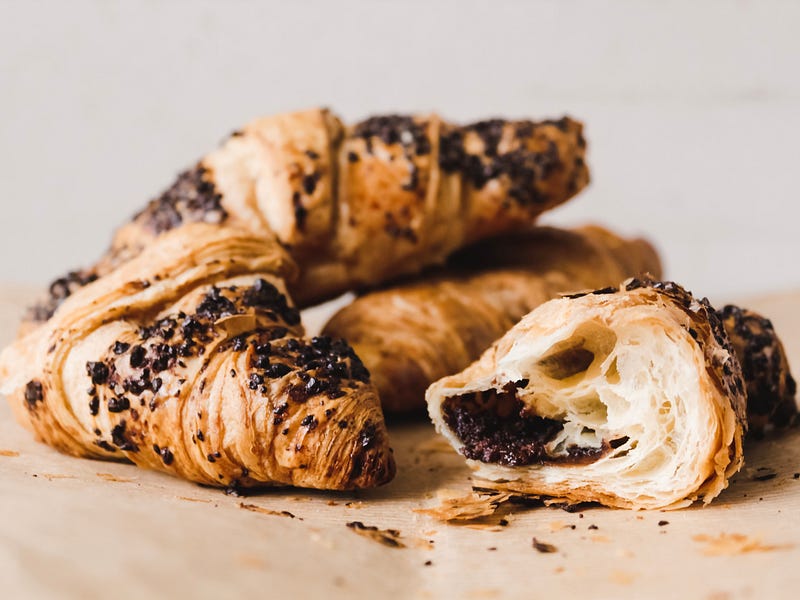
I only did realise after the seventh or eighth day in succession. It was the craving that did it. Window of our office semi-open (just the tiniest of gaps, enough to avoid the heater’s steam from misting up the glass) and the sweet aroma of croissant wafting up to the operations department where I worked at the time. The smell awakened a primal instinct in me and I could not wait until lunchtime to dash downstairs and part with my usual two or three quid for my regular prandial treat. That’s when I knew I was developing a problem. A croissant-and-hot-chocolate addiction by literary proxy.
I was reading Joanne Harris’ Chocolat at the time.
Forgettable plot and clichéd characters but sublime food. This is how I remember this novel.
Cuisine can play an important role in literature as the feature states. I still remember Leopold Bloom’s liver slices fried with crustcrumbs in Ulysses. And what to say about that Cuban masterpiece, Paradiso by Lezama Lima? Banana soup (probably plantain), beetroot salad and roast turkey amongst other succulent ingredients.
I imagine that authors are presented with a choice when including food in their narrative: be descriptive or suggestive. If I remember correctly the latter applies to Chocolat, which is probably the reason why every morning and afternoon for less than a fortnight (I read the book very quickly. As I mentioned before, if the plot had been as good as the food…) I would add an almond croissant and hot chocolate to my breakfast and the butter version and same hot beverage to my lunch after the main course. Descriptive meals tend to leave this madeleine-chaser somewhat cold.
I like my food. I am not afraid to say that. And when it comes to literature, I like “happening” upon food. A good example is in Chimamanda Ngozi Adichie’s novel, Half of a Yellow Sun, when Ugwu arrives at Odenigbo’s house to apply for a position as a houseboy and sees “a roasted, shimmering chicken” in the kitchen. He touches the chicken. This is a moment with even erotic connotations, bearing in mind that when it comes to epicurean matters, carnal desires can and do often make a cameo.
Sex and food
Talking of eroticism, I have occasionally heard comparisons between sex and food scenes and even a sort of continuum drawn between the two. I do not dispute that. Some writers do use food as a preamble to sexual intercourse between characters. However, sex scenes very often feel “flat” (in my humble opinion), due to a lack of honesty. Either the author is doing too much or too little. Let us not forget that sex is, whether we like it or not, linked to our innermost, primitive selves. Inevitably conclusions about who we are or what we want in bed will be reached, no matter how detached we claim to be from our dramatis personae.
With food, on the other hand, it is different. No revelation is necessary. We can disassociate completely from the meal we knock up. I’ve read very precise descriptions of Asian food, including the sourcing of ingredients, the cooking of them and the methods used, from non-Asian writers, as if they had been born in the subcontinent and lived there all their lives.
Part of it could be the fact that we live in such an intricately connected, globalised world that geographical barriers count for nothing anymore. Plus, in cosmopolitan cities such as London, Paris or New York, there is always the opportunity of delving into other cultures and getting to know them properly without really being part of them.
This, of course, will include food, too. Which is probably why I went through my croissant-binge stage. Chocolat takes place in France and at the time of reading it my office was sandwiched between two French pattiseries. Well, at least the novel did not include Asian food. Our local Indian restaurant was a few doors further down, otherwise, well, who knows what would have happened?