
Of Ensos and Logograms
What a Zen Buddhist symbol and an alien language have in common.
I finally got around to watching the movie Arrival about a week ago. The movie, which was released in 2016, is based on a novella called “Story of Your Life” by the science fiction writer Ted Chiang.
The movie and the novella differ in a few details, but the plot is more or less the same: alien spaceships land on earth, and the United States Army enlists a linguist by the name of Dr. Louise Banks to decode the alien language. As the story unfolds, Dr. Banks begins to make sense of the aliens’ (called heptapods) language, how they think, how they perceive the world. It’s something that many science fiction stories involving aliens tend to gloss over and take for granted: communication between humans and alien beings. In most movies and books, aliens just so happen to speak English, or human beings can somehow understand an alien language. I mean, what are the odds?
I liked Ted Chiang’s “Story of Your Life,” but I loved the movie. What I loved most about the film was the visual dipiction of the heptapod language. In their spaceship, the heptapods are suspended in some kind of aqueous solution. They look something like octopi, and they communicate with Dr. Banks and her colleagues from behind a looking glass. Like octopi, the heptapods expel ink from their tentacles. Unlike octopi, the ink they expel forms symbols. In the novella, Dr. Banks calls the symbols “logograms” at first. Then she calls them “semagrams.”
“In the next report I submitted,” Ted Chiang writes from the perspective of Dr. Banks, “I suggested that the term ‘logogram’ was a misnomer because it implied that each graph represented a spoken word, when in fact the graphs didn’t correspond to our notion of spoken words at all. I didn’t want to use the term ‘ideogram’ either because of how it has been used in the past; I suggested the term ‘semagram’ instead.”
Semagrams are symbols that express ideas and concepts. They are real, human things. Ancient Egyptian hieroglyphics, for example, incorporate semagrams. There is an ancient Egyptian semagram for “owl.” There is a semagram for “nose.” There is a semagram for “mouth,” and so on. It’s something I appreciate about good science fiction: good sci-fi (to my mind) grounds the fiction in real science.
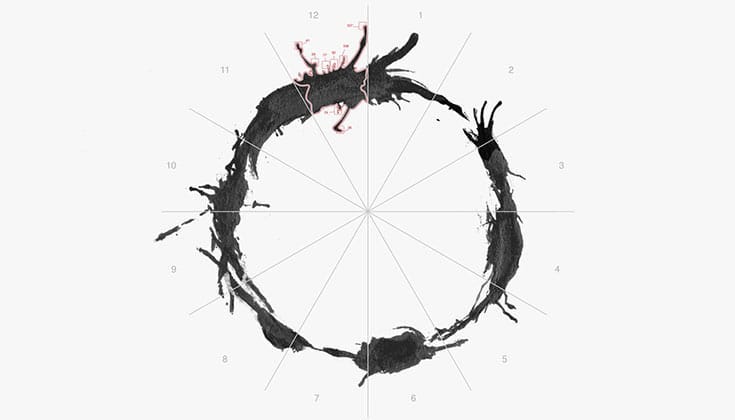
Below is the heptapod semagram for “time.”
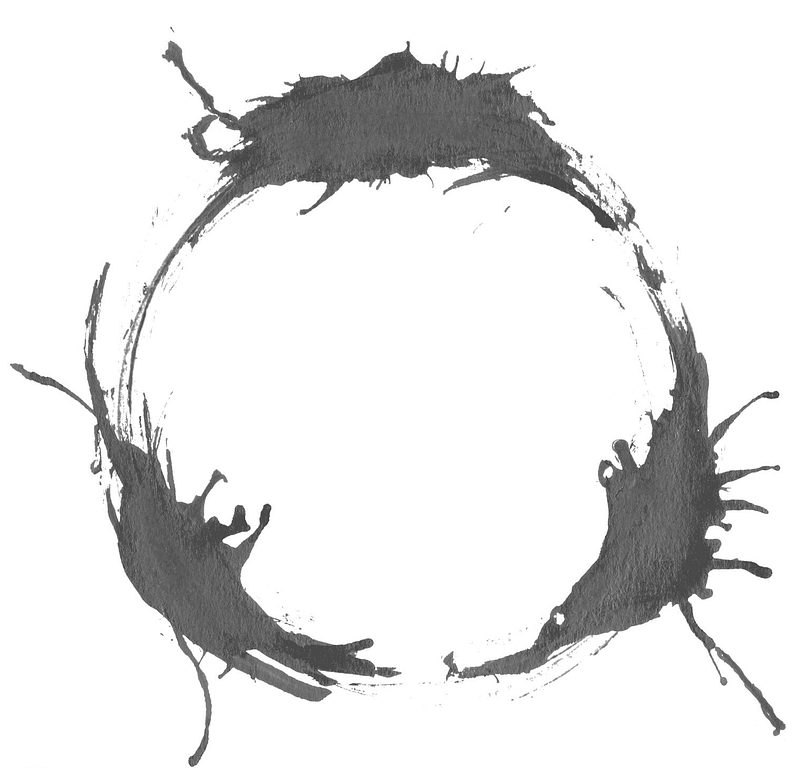

Daniela, my partner, was asleep by this point in the movie. She’d already seen it a few years back. I was so excited by the image that I woke her up.
“Babe, babe!” I said, shaking her awake.
“Hmm?” she mumbled with one eye open, still half-asleep.
“The alien language looks like an ensō!”
“What?” She went back to sleep.
I’m not the first person to notice the resemblance between ensōs and heptapod semagrams, of course. In Lion’s Roar, a Buddhist magazine, the Soto Zen priest Koun Franz wrote:
Like perhaps every Buddhist watching Arrival — or at least every Zen Buddhist — I had to smile the first time the aliens revealed their written language, which, it turns out, is the language of enso, the “Zen circle” you see everywhere from classical Zen art to various logos, Buddhist and not.
The resemblance, it turns out, was accidental. Neither Ted Chiang nor Eric Heisserer, the screenwriter who adapted Ted Chiang’s story for the big screen, drew inspiration from the Zen Buddhist symbol. But the heptapods’ language is more “Zen’’ than Chiang and Heisserer may have realized.
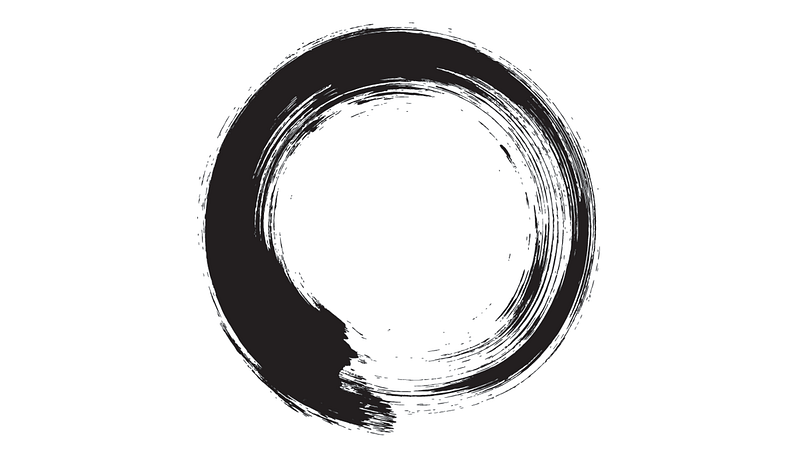
The Infinity Circle. The Circle of Enlightenment. The Zen Circle. The Ensō. The symbol has many names, and its interpretations are even more numerous. It is said to be a symbol of enlightenment, of elegance and strength, of emptiness and infinity, of creation and impermanence, of nonduality and the interconnectedness of all things.
At a glance, the ensō looks like nothing special. It looks like a half-completed circle; like the artist ran out of ink on her first stroke of the paint brush. In a sense, she did. The symbol is drawn with a single brush stroke (sometimes two), quickly and without hesitation. It is an expression of the moment, the very essence of Zen; of living right here, right now, and embodying one’s actions with all of one’s being.
In Zen, the ensō symbolizes a moment in which one’s body and mind are in perfect harmony, free to create and free to live without the hindrances of the overthinking, overanalyzing mind. It can be drawn in the air or in the dirt, but it’s most commonly drawn on a sheet of paper (called washi in Japan) made from the fibers of the bark of a gampi tree, a mitsumata shrub, or a mulberry bush.
In Zen, it is said that the quality of the artist’s mind is expressed in how he or she paints an ensō. Similarly, the quality of the heptaod mind is expressed in the semagrams they create. Love. Death. Humanity. Time. There is a unique and specific semagram for each of these concepts, some of which can be difficult to convey with words alone.
In the novella and in the film, the more Dr. Louise Banks studies this alien language — which she calls “Heptapod B” — the more she begins to think in semagrams. Heptapod B, Chiang writes in the voice of Dr. Banks, “was changing the way I thought.”
With Heptapod B…my thoughts were becoming graphically coded. There were trance-like moments during the day when my thoughts weren’t expressed with my internal voice; instead, I saw semagrams with my mind’s eye, sprouting like frost on a windowpane.
A picture, so the saying goes, is worth a thousand words. And so much of Zen practice is about experiencing the world within and around yourself on a level that is deeper than words. That’s part of the reason why calligraphy has become such an integral part of Zen practice. Calligraphy, in the Zen tradition, is a means of expressing in symbols what is difficult (if not impossible) to completely convey in words alone.
“Calligraphy,” the artist Kaoru Akagawa wrote, “is an art form that uses ink and a brush to express the very souls of words on paper.”
The way I see it, the same is true of Heptapod B, minus the brush and the paper.
There’s a scene around two-thirds into the movie that brought a tear to my eye. By this point, Dr. Banks was fluent in Heptapod B, and she was once again trying to communicate with the heptapods. One of the heptapods places its suction-cup like tentacles against the looking glass and expels some ink. Louise Banks places her hand against the heptapod’s tentacle in a high-five kind of way, on the other side of the looking glass, and her thoughts take the shape of a semagram. Then, the two heptapods — called “Abbot” and “Costello” in the film — release a massive blob of ink that is indistinct at first, but gradually coalesces to form thousands and thousands of little semagrams. Among them were semegrams symbolizing life, death, earth, humanity, and the notion of “choosing life.”
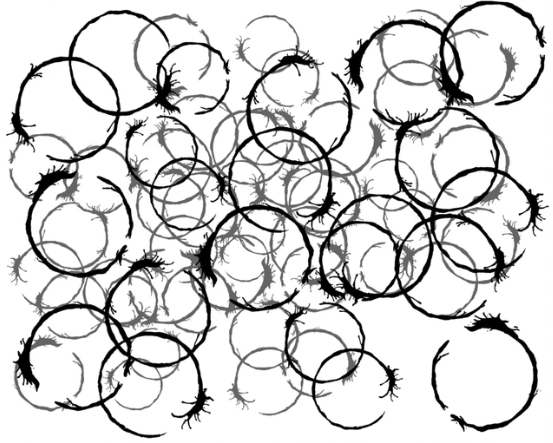
I didn’t know why this scene nearly moved me to tears as I watched it. (Thankfully, Daniela was sound asleep, and I didn’t have to explain myself, as silly and embarrassing as that would have been.) But I’ve been thinking about that scene for a few days now, and what I think I found so emotionally powerful about the image was this: It was a symbolic representation of the complexity of the human condition.
At any given moment of any given day, even the most mundane of moments, we are experiencing a nearly infinite set of thoughts and emotions, memories and dreams, hopes and fears. Something I’ve learned from my own Zen practice is that some of the deepest, most profound truths occur on this non-verbal, experiential level; that try as we might, we can’t express the full complexity of what it means to be a human being — what it means to be alive — in language either spoken or written.
And there it was, on the screen before me, a symbolic representation of life’s complexity — the good, the bad, the beautiful, and the ugly elements of what it means to be a living, breathing human being.