
WRITING
Of Eloquence and Handwriting
Writing by hand is more than meets the eye
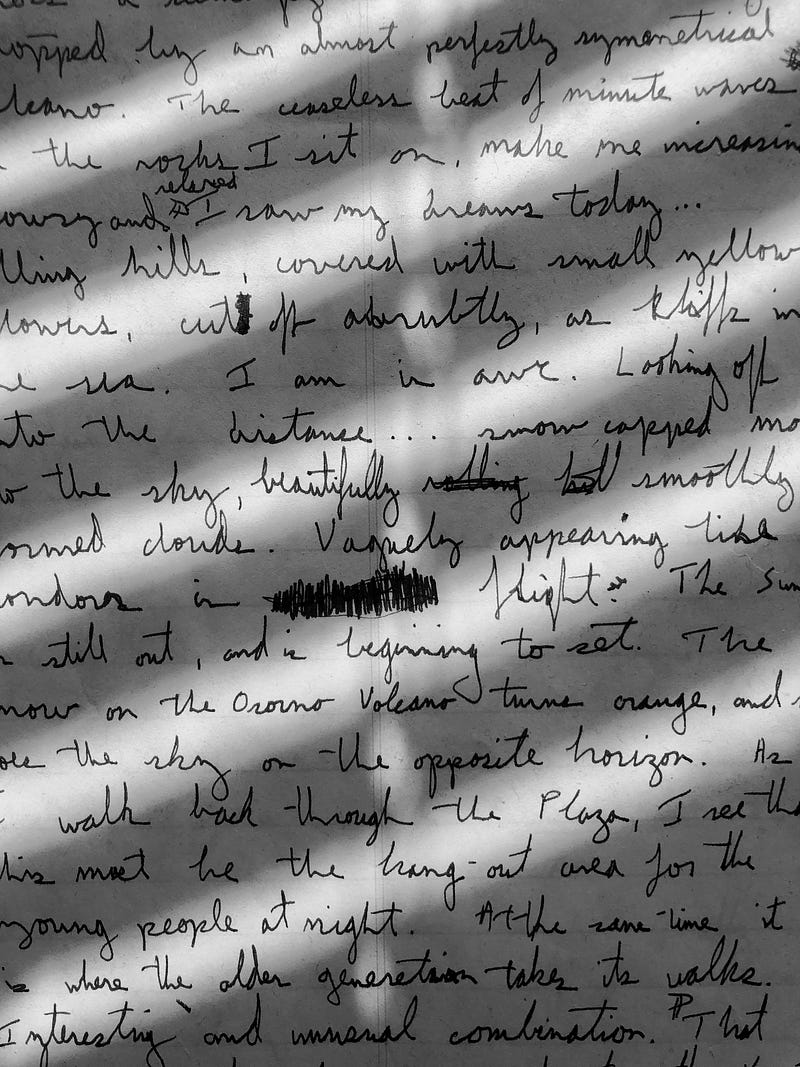
I once sat in a meeting when, out of the blue, a younger corporate executive took a swipe at me. He made fun of me for taking notes of our meeting by hand. He was a tall, attractive gentleman, unaware I was older than him (I knew his age), and he clearly enjoyed his lofty viewpoint over my petite frame.
The young man had an iPad and was writing and mind-mapping with a stylus pen. He made repeated comments directed at me, teasing me about dinosaurs.
“No one writes anymore,” he commented. “They type or use a tablet.”
I gave him a weak smile and resumed writing.
“You know if you type your points, you can save it and easily retrieve your documents whenever you want it,” the gentleman continued.
Aside from stating the obvious, I could detect him verging on being condescending.
I continued to ignore him.
“I have a spare device if you’d like to borrow,” he offered, smiling.
“I prefer to write, thank you.”
“No one writes anymore. That’s why the computer was invented,” the executive pressed further, sniggering.
“Writing is an artform. You seem to have a problem with it.” I looked at the man with a deadpan expression on my face.
“I just don’t get why you’re wasting your time and not being efficient by typing the points down,” he insisted.
“There’s a connection between writing and the wiring in our brain. Something to do with our hand-eye coordination.” I tried to keep my explanation as brief as possible.
“Same thing when you type. Here, let me show you.”
He was being sarcastic, of course, and pursued to give me grief throughout the discussion. He thought he was doing me a favor because in the room with eight people seated at the meeting, I was the only one — and the oldest — writing in my office leather journal.
In my formative years, I was fortunate to attend classes for calligraphy. I enjoyed cursive writing and to this day, I prefer writing with a fountain pen. I love how the tip of the pen glides smoothly across the paper. “The artistry of curves”, my teacher used to say to us in class. I never imagined in the future, I’d be mocked for this fascinating albeit dying skill.
The art of handwriting teaches you about comfort and cushioning. The broadness of the pen, the not-too-firm grip where the pen nestles in the crook of the thumb. If it’s a pencil, its lead has to be half blunt in the cone of wood. I love how the ballpoint pen has a variety of thickness. I enjoy drawing a line across a sliver of paper when deciding what pen to purchase. I always go home with a 0.2, 0.5 and 0.7. I have the felt-tip version used for drawing and outlining. But nothing beats a fountain pen where you dip, fill and shake vigorously, and then write.
I know I’m speaking in hyperbole, but you could almost see your soul reflected in the italics of thick and thin, diagonal joints and elegant serifs. There’s angularity, boldness, elegance and sophistication. Sometimes the dot in the “i” is a diamond.
It may be true that writing takes far more effort than tapping the keyboard, but as your fingers clench round the instrument, you feel more connected to what you’re writing.
What you write you remember well. It is science and observation. I notice that when I type, I am more distracted. I waste time deleting, retyping and making adjustments here and there. The editing options are generous but I can count with a few fingers what I use as opposed to what I’m not even aware of in the toolbar.
Today, teachers and professors are complaining that students are more preoccupied with messaging than listening to lectures. That probably explains why less learning is taking place.
Studies have found that writing on paper can improve recalling a random series of words to imparting a better conceptual grasp of complicated ideas. This has to do with the motor and sensory memory of putting words on paper when the fingers are forming shapes and arranging letters and squiggles on a piece of paper.
What you get is not just an arrangement of words, you’re witnessing a visual composition. You may remember a word from where you wrote it on a page and that can assist in memory exercises.
Many studies have confirmed the benefits of handwriting. In Sweden, there is a push for more handwriting and the usage of printed books to decrease the dependency of devices. Some schools are inculcating the rudiments of cursive to children as young as seven.
This may be countering the paperless movement but experts and educators are starting to see the need for a return of long-term focus. Social media and the excessive usage of devices have distorted and decreased the quality of reading, attention and memory. The immediacy of data and short articles are now seen as detrimental to learning. Reading, for one, should not be rushed. Reading requires processing: comprehension, sensemaking and synthesis. And now it seems to help with these, is through habituating handwriting.
It’s a lot to explain in a single sentence to a young executive who prides in his showcase of devices.
If left to my uneducated and emotional response, I was tempted to tell the gentleman to fuck off. But I was raised to think, and respect, that the pen is mightier than the sword.
I was raised with the finesse of a fountain pen. Cursive writing teaches you to be elegant and polished. It trains you to be patient, to endeavor to have a bit more class than to spit the four-letter word like fireworks on New Year’s eve.
And so I turned to the gentleman, and with a warm gracious smile, I said, “You really need to go and apologize to the tree that is providing you your oxygen. Look there’s a window. Kindly open it and jump out of it so I can continue to write in peace.”