
Of Cultures and Carrion: Tibetan Sky Burials and the Death of a Nation
It’s 5 am. It’s 20 below zero. And I am waiting for the corpse to arrive.
To be clear, this isn’t something I usually do — waiting in the frigid darkness for the dead body of a stranger. I am here to witness the Tibetan funeral rite of Jhator. A sky burial.
This ritual, for those who have never heard of it, is a traditional Buddhist alternative to interment or cremation and expresses in the most viscerally literal way possible, the belief that the physical body is unimportant and simply a vessel for the soul. A vessel, which after that soul has departed, is little more than meat and best used as an offering, as food for other living things. In this case, vultures.
To some, the idea that you might willingly dismember and feed the body of a loved one to scavenging birds might seem unspeakably gruesome and horrific. To Western sensibilities, it can suggest a detachment from emotion and familial bonds so unflinchingly cold as to be inhuman.
In reality, however, it is precisely this steely resolution, this absolute unwavering commitment to a belief in something greater, that makes the ritual and the resignation that goes along with it, such a remarkable and tangible manifestation of faith.
This wasn’t my first time in a Tibetan area. In the last two months, I had explored the Westernmost provinces of China, spending the majority of my time in Sichuan, Yunnan and Tibet. Whilst I kept thinking that there was so much of this country to see, that maybe I should have gone East or North, seen Beijing or Shanghai before my visa ran out, I somehow found myself pulled, always, inevitably, back to Tibet.
Why? I couldn’t say. Maybe it was the azure blue sky, that in its cloudless clarity, belied the steadily dropping mercury that was the true indicator of the bitterly cold temperatures outside. Maybe it was the air, so thin that managing to take a full breath and not feel lightheaded was an achievement, but which in contrast to the fog in other cities I’d visited, felt pure and clean. Maybe it was the beauty of the frozen Tibetan plateau, an expanse that stretched so far out to the horizon and beyond that the line between the land and sky seemed to underscore my own insignificance. Or maybe, as I suspect, it was the people. People who despite these icy temperatures, were as warm and welcoming as the wood stoves and fires around which they huddled.
Perhaps it was simply a traveller’s curiosity about people who were Buddhist like me, but who practiced their religion so differently and with such fervour that I began to wonder whether I really knew anything about Buddhism at all.
Whatever it was, it was irresistible. So, with only four days remaining on my visa, I found myself back in Litang, in Western Sichuan province. A place the maps call China but which the locals still call Tibet, enquiring about something I heard about but wasn’t entirely sure was possible.
When I first broached the subject of attending a sky burial with my host, I was nervous. I didn’t want to offend and wasn’t sure how the suggestion would be taken. I needn’t have worried though. Far from being offended, she told me that ceremonies took place three times a week in the early hours of the morning. Was it okay for outsiders to attend? She assured me it was fine and just like that, it was settled.
The following morning, the taxi driver my host had arranged picked us up at 4.30 am and drove my partner and I 20 minutes out of town and into the seemingly impenetrable blackness. He then switched off his engine and pointed into that same dark — apparently, that was where we had to go.
We stepped out and he drove away, the dim yellow of his headlights swallowed by the night.
And so, we found ourselves standing on the empty plain, in sub-zero temperatures, in the inky darkness. All we could do was wait.
Two months earlier, at the start of my trip, I had visited the Tibetan Autonomous Region (TAR) on an eight-day tour. As a rule, I hate tours, but if you want to visit the TAR, your only choice is to go on a tour. Otherwise, you don’t go at all.
I entered Lhasa on the famous Qinghai-Tibet railway, with train carriages that pump oxygen into your compartment as the elevation goes above 4000 metres so that you don’t pass out.
To some, the railway line is an engineering marvel on the Roof of the World — built on permafrost and over earthquake zones, the line connects once-isolated Tibet with the rest of China, providing a welcome boost to Tibet’s economy and tourism industry.
To others, this railway marks the death knell to the distinct Tibetan culture, as immigration and resettlement of the majority Han Chinese to the province is encouraged.
Getting off the train in the huge Lhasa train station, I was confronted by the first of many police checks. My permit, visa and passport were scrutinised meticulously by a stern-faced guard.
Outside on the main road, we were greeted warmly by our guide for the next eight days. He wrapped a white silk khata around our necks and welcomed us.
“Please don’t take any photos of police checkpoints or policemen when you are here. You will get us into a lot of trouble”.
We stand in the darkness and watch the shooting stars. It doesn’t seem like anyone is coming and we begin to wonder whether this is all part of an elaborate joke.
I stamp my feet to keep the blood flowing. I am wearing six layers on top plus a coat, two layers of trousers, three pairs of socks and two pairs of gloves. It still isn’t enough and somehow, the slithering fingers of stabbing cold, find a way inside. It isn’t long at all before my teeth begin to chatter.
Then, a light. After around 40 minutes of waiting in the darkness, we see the headlights of a car approaching. It pulls up and in the dim beams we can just about make out three figures pulling something out of the boot.
It takes us a few minutes, but we realise they are building a fire. At that moment, the crackling of the wood, the flying embers and soft orange glow are incredibly inviting but still, we keep a respectful distance. This is a funeral after all.
To our surprise, the three figures, still little more than shadows, wave enthusiastically and invite us over to share the warmth of the fire, an offer we gladly take them up on, smiling gratefully as we attempt to thaw our frozen limbs.
More surprising still, was our Tibetan companions’ demeanour. Far from showing the sombre melancholy we would expect at such an occasion, the men are in a cheerful mood: constantly laughing, jostling with each other, taking photos and making jokes.
With sunrise still an hour or so away, our new friends spend the time miming the flight of vultures, showing us how to effectively warm our backsides by the fire, making dick jokes (yes, really) and literally cuddling us under their super warm fur-lined robes (which are clearly much more effective than our coats).
We shouldn’t have been surprised. Whilst this isn’t what we would expect from a funeral, in Tibetan Buddhism, it is believed that laughter can help to guide the dead to reincarnation. Though it seems strange and unfamiliar, it also has the effect of making us feel completely welcome and part of the whole ritual.
As the sun starts to rise, a few more cars arrive and I watch as more fires are built. A man wearing a Stetson hat and a serious expression comes over and talks to us about the funeral. He explains that no photos are allowed during the sky burial ceremony itself but before and after is fine.
This seems obvious to me, but I also know that the man has a reason for emphasising this point. He knows as well as I do, that the creeping commodification I have seen in other parts of China is steadily making its way into even the holiest of Tibetan rites.
In Ganzi province, you can find the recently built mammoth ‘Seda Sky Burial Celestial Platform’ — a state-endorsed site for the ritual which has been adapted to make what is already a sobering spectacle, resemble something more like a circus attraction.
The newly installed platform, replacing the naked hillside on which the ritual is usually performed, comes complete with a huge demon-like head with steps leading into it and a pavilion made out of fake skulls. Sculptures of lions, elephants and skeletons abound. There is even a sculpture of a dead man.
Domestic tourists flock to the site, to see this pantomime of Tibetan culture performed as part of a one-day tour in the region. Officially, photos and videography are not allowed but on the ground, people sometimes don’t listen. A curtain recently had to be installed to shield the sky burial platform, so that the actual funeral can only be viewed by members of the family. Hardly surprising when one considers the disrespect and irreverence with which the ritual is sometimes treated by visitors.
Generally, Sky Burial tours receive five stars, but in some reviews, the conflation of this experience with a visit to a theme park is painfully obvious. Many complain about the waiting times to see funerals. Others bemoan the fact that the altitude is difficult to bear, whilst still others provide helpful tips for the funeral, advising fellow tourists to slather on plenty of sun cream if visiting during the height of summer.
Many complain that the burial platform stinks.
Two months earlier and dusk is steadily approaching in Lhasa. I watch in curious wonder the walking, kneeling and full-body prostrations of Tibetan pilgrims making the Barkhor Kora, the slow, clockwise circumambulation around Jokhang Temple. A process they will continue long into the night.
Beneath the scent of candles and incense, the evening air has a lacerating chill that at times makes my breath catch in my throat and forces me to retreat periodically to the comforting warmth of a teahouse, before I once again work up the courage to brave the cold.
In contrast, the icy air does nothing to deter the lines of hardy pilgrims, who chant mantras, spin prayer wheels and count prayer beads as they walk. Some people have travelled thousands of miles to make the Kora in Lhasa and I see Tibetans of all backgrounds taking part, from nomads adorned in elaborate traditional dress, to young men and women kitted out in smart modern work clothes.
The Kora is pilgrimage, meditation and merits for the next life all rolled into one. As I watch, a woman prostrates herself fully, face and belly down against the frigid ground. She regains her feet, takes another step, and lays down again, her forehead kissing the glacial earth. Over and over she repeats this process, laying on the ground, her arms stretched out above her head, one full-body prostration after the next. She moves in tiny increments on the pilgrimage circuit, indefatigable and determined, as others step around her.
A moment later, this vision of devotion is interrupted and I am distracted by the sound of marching. A group of heavily armoured Chinese policemen, in full riot gear, march in quick formation past the slow-moving lines of pilgrims. They hold not prayer wheels, but riot shields, not beads but machine guns.
I turn my gaze back to the continuous procession of worshippers to see that nobody has even stopped. No heads have turned. All are completely engrossed in their Kora.
My eyes search through the blur of devotees to find the woman who I had been watching earlier. She is lying down, body to the frozen ground, mouth murmuring mantras. How many circuits she will complete I do not know. What I do know, is that to enter the temple area she has been jostled through armoured checkpoints, has had her documents checked and her movements questioned by men holding guns. I know she will go through the same process when she leaves and that she is only permitted this observance according to the whim of the state.
She raises herself from the ground and continues, knowing that for now at least, permission has been granted.
In the growing daylight on the plain, the men start to burn juniper branches mixed with tsampa, the staple grain of Tibet. They do this, they say, to attract the vultures. Summoning the enormous birds to the area before the funeral ceremony begins. I squint and think for a moment that I can see some birds on the hills, but I am not sure.
Several men walk up onto the hillside to chant and pray in preparation for the ceremony. Their chants drift down on the air mixed with the scent of juniper and the wood burning on the fire.
Suddenly, our Tibetan friends tell us it is time to begin and everyone starts to congregate at the bottom of the hill. We hang back to keep a respectful distance but they gather around us and push us to the front. The philosophy seems to be “You’re here now and so you see it as we see it.”
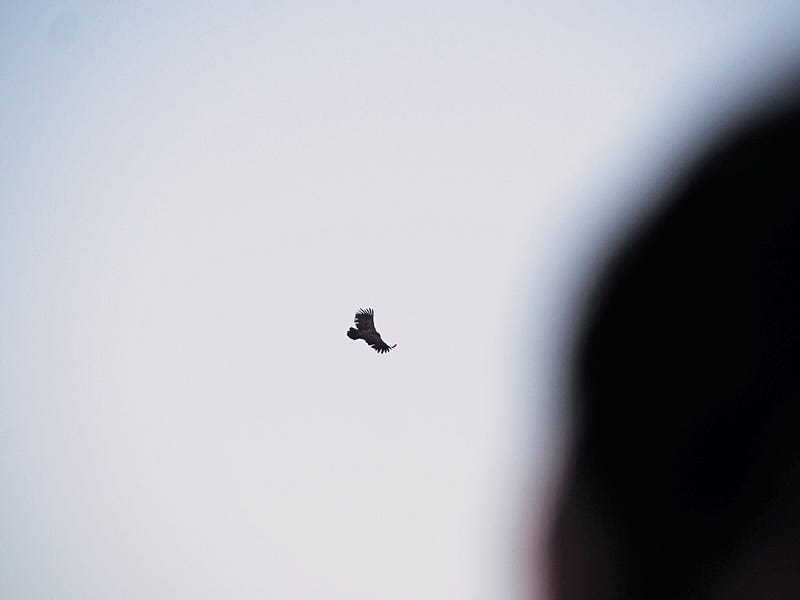
What I do see, is a large white bag being carried out. Almost simultaneously, there begins a beating of wings, as scores of vultures take off from the surrounding hillsides. The ground darkens with shadows and as I look up, I see what looks like a fleet of tiny planes, but which is in fact, the silhouettes of birds passing overhead.
They land on the ground close to us and gather together, waiting and looming in small, expectant groups. Now the hillside is divided into three distinct parts — the vultures on one side, us on the other and between us, the unvarnished fact of the body in the bag.
Finally, it is time for the rogyapa, ‘the body breaker’ to do his duty. He opens the white bag and the body pours out. The limbs are floppy, the skin a mottled greyish-green colour.
Instantly, I understand something about the whole ritual that I had struggled to get my head around in the days leading up to this. My eyes tell me that I am seeing the body of a woman, but at the same time, what is in front of me doesn’t look like it has ever been a person at all. It is just a shell, a container for the spirit, that has long departed.
It looks no more like a person than the bag that it was carried in.
The rogyapa turns the body over so it is face down and deftly cuts off the hair. Using a large knife and quick, practiced movements, he scores deep cuts all over the body in a criss-cross pattern, severing tendons at the ankles and wrists. Every laceration is designed to make it easier for the vultures to feed.
The hungry crowd of vultures grunt and hiss impatiently. They press forward and are beaten back by sticks until the rogyapa has finished his work.
He finally steps back and the vultures surge forward, descending on the body in droves until all I can see is a blur of brown feathers.
Before we leave Lhasa, we have one more stop — a tour of Potala Palace, formerly the winter home of the Dalai Lama and now a UNESCO World Heritage Site. Before entering the palace itself, our guide tells us there is a museum that we can visit in the grounds.
I ask him if he is coming in and he shakes his head. For a moment there is a fleeting expression of disgust on his face, quickly replaced by the regular warm smile we have become accustomed to seeing. He asks us to go around quickly — visits to Potala Palace are restricted to an hour and the clock is already ticking.
The museum isn’t all that interesting — it seems to just be dedicated to emphasising that Chinese and Tibetans have been inextricably joined throughout history. The walls are emblazoned with slogans about the ‘unbreakable blood bond’ between the two groups.
The words are printed in large font. The slogans repeated over and over like the mantras spilling from the lips of the faithful, ushered and harried through the checkpoints below. Somehow though, no matter how large they are printed or how often repeated, the words seem to lack solidity. Empty symbols, declaring a truth as thin as the mountain air.
We come out and our guide accompanies us on the palace tour, pointing out the rooms where the Dalai Lama studied and slept. The palace is opulent with thousands of rooms, only twenty or so of which are open to the public.
In the late afternoon, we drive to Shigatse, the next stop of our eight-day tour. As night falls, I see little red lights on the dashboard and I realise they are from a camera. I had seen it during the day, but it only dawns on me now that it is facing inwards and not out as I had initially assumed.
“Is that a camera?”, I ask our guide, not wanting to jump to any strange conclusions.
“Yes”, he says without hesitation. “It hears and sees. For our safety.”
Later on in the journey, our guide randomly asks us what we thought of the museum at Potala Palace.
Now acutely aware of the camera, we mumble that it was interesting to read about the shared history of Tibet and China.
He nods and then turns his back to the camera, offering us a wry smile.
“Yes,” he whispers, with a knowing wink, “Because, of course, we are all one people”.
Two vultures break off from the group and squabble over a sinewy piece of muscle and skin. The air fills with the sounds of rustling feathers as flesh is ripped from the bone.
I still can’t see the body, but now I realise I am crying. I don’t know why, it doesn’t make any sense. I don’t even know who the person was. I clearly still have a lot to learn about the Buddhist lessons of impermanence and attachment.
It just all feels so final.
One of the men nods at me, as if to tell me that it is okay, this is how it is meant to be. Another gives me a comforting look and a thumbs up.
After five minutes, the vultures move back and we see that they have completely stripped the body of flesh.
The rogyapa takes the skeleton to a flat rectangular rock and using an axe, breaks it up into several pieces. He uses the wooden handle of the axe to grind the bones into a fine, white powder which he mixes with tsampa and yak butter tea.
The skull is the last thing left. The rogyapa splits it open with precision, removes the brain and then repeats the process of grinding everything down, adding tsampa and butter tea at intervals, until there is just a white paste.
The family, one of whom we recognise as the man in the Stetson hat, huddle together and embrace at the side, closely observing the scene. Their faces are serious, lined with pain, but nobody looks away. Instead, they hold each other as they watch, their heads nodding in unison. A signal of approval, an affirmation of faith.
I look around and amidst the crowds of vultures, see crows landing and picking at the remnants of the body. Seemingly out of nowhere, three horses appear on the plain. They casually wander over and graze on the parched yellow grass.
The whole scene has a surreal, magical quality to it. Yet I am also overwhelmed with the feeling of being intensely alive.
Stoic acceptance in the face of death. Honouring what has gone, not what remains. That is the essence of the sky burial ritual. However, the sky burial is not the only brush with death that I experience on this trip. The other, larger death that I am witnessing, is not so dramatic or as cathartically final. This death is slower, less dignified and ongoing. It is also harder to accept.
We walk back down to where the fires are and join the family who are preparing tea. They shake our hands, invite us to sit down and share their bread with us. Everyone is laughing and joking and the mood is upbeat and celebratory, just as it was before.
For a moment it seems almost as if the last half hour never happened, our only pointed reminder coming from the young man in the Stetson hat, who with the help of a translation app on his phone, tells us that we should not fear death. He says this with a solemn, leaden authority, his words followed by a long pregnant silence, before he too flashes a smile and moves off to join the others, laughing and teasing by the fire.