
Of Course You Can Use Someone Else As Your Motivation To Change!
So many people today think that it is somehow wrong or bad to use a loved one as the motivation to change. Here are some of the most common statements I hear to this effect:
- He has to stop drinking for HIM, not for me
- We can’t use the kids as a reason to work on the marriage
- She has to start therapy because SHE wants to, not because I want her to deal with her trauma history
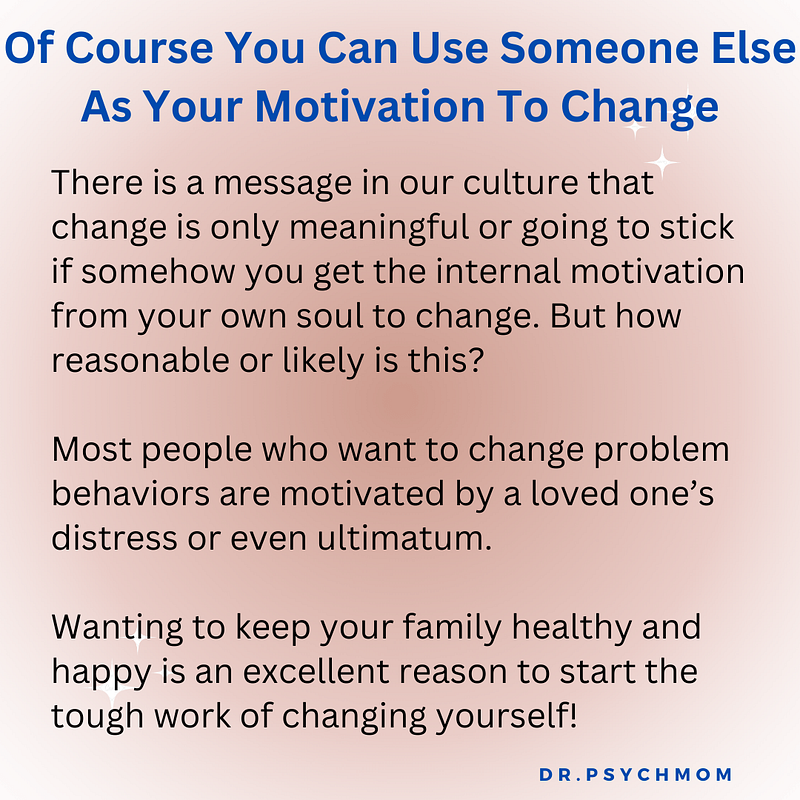
These are only a few examples, but you get the point. There is a message in our culture that change is only meaningful or going to stick if somehow you get the internal motivation from your own soul to change. But how reasonable or likely is this? When you are mired in addiction, depression, trauma responses, or anything else, the problem is literally an inability to feel capable of change. People with these issues feel stuck, trapped, and hopeless by definition. Where would they get some intrinsic motivator without wanting to do it for someone else?
There is obviously a huge difference between someone who goes to AA meetings and sits there silently, refusing to engage, because his wife said she would leave him otherwise, and someone who uses his wife’s anger and sadness as a motivator to deeply engage in treatment. The latter person should be commended, not looked down on. I know many people in decades-long marriages where one partner changed because the other was unhappy with their behavior, and even more people who work on themselves to be a better parent.
Intrinsic motivation can certainly come from wanting to be a better partner or parent. These are the main reasons that people come into therapy, and never have I said, “Well, we can’t work together because YOU need to want to change.” Instead, I praise these clients for listening to their partner’s or children’s complaints. Humans are social animals. Wanting to keep your family healthy and happy is a primary reason to start the tough work of changing yourself.
I think that the idea that people shouldn’t be the reason that other people change came from the Al-Anon focus on detaching with love and not enabling alcoholics by, for example, buying them alcohol. Certainly these are useful concepts, and nobody drinks because of someone else. However, if your partner is addicted to a substance, or is depressed, or angry, or anything else, it is okay to tell them that you want them to change and that a condition of you continuing your relationship is them seeking treatment. At that point, if they want to engage in treatment and use your relationship as a motivator, this is only natural.
Most people who want to change problem behaviors are motivated by a loved one’s distress or even ultimatum. Many of my clients come in to couples counseling because their spouse said it was either that or divorce, and many of these couples grow closer and repair their marriages. Ultimatums are only bad if they are dramatically wielded as part of a power struggle by a partner who does not follow through. Otherwise, they are really just boundary setting: If you continue X, I cannot remain with you. It is then the partner’s choice whether or not to stop doing X.
Now if you start therapy because your spouse makes you, and you find you are not engaging and the therapist notes that you are not really invested, this is a different story. Here, you are not allowing your focus on the relationship to be an initial motivator that then translates into deep internal engagement and motivation. Your focus on the relationship can be your starting place and even your guiding light throughout the entire process of change and growth, but if you never personally feel any benefits of this change, then you are certainly less likely to deeply change.
If you or your partner is in this situation, then it may be time to consider whether the relationship should continue. Partners can look at each other as a motivator or guiding light, but not a prison warden forcing them to change. Think deeply about whether you have prevented yourself from recognizing or encouraging a partner to change or even asking them to change because of this idea that change has to come ONLY from within. You may be ignoring the fact that you yourself would likely use or have used “being a better parent and partner” as your own motivation for any change!
This philosophy can be harmful when it becomes excessive. For instance, some people don’t even ask a partner to stop drinking, because they truly believe that even asking this should not be necessary. Only if the partner themselves wanting to stop drinking would it “count” or “stick.” Yet, asking this and talking about what the drinking does to you may be exactly what the partner needs to hear in order to start the process of self-awareness and change.
Also, obviously you can and should use kids as a motivator to work on your marriage! They should not be the only reason you stay in a loveless, lonely marriage. But I can’t imagine how kids would NOT be a healthy reason to work on your marriage, and to work on it as intensely as possible. Kids can be a wonderful motivator to be your best self in myriad ways, and wanting to be a better partner is just one of them.
Furthermore, kids can be a reason to work on every aspect of yourself. Personally, my kids are my main reason to work on my depression and my general health. I don’t know one parent who doesn’t feel this way about their kids. Then why should a partner be any different as a healthy motivator? After all, in a healthy marriage, you are reparented, and your partner acts as your parent, peer and your child.
Share this post with your partner if it applies to you! And till we meet again, I remain, The Blogapist Who Says, Deep Change Can Start For Any Reason!
For therapy, go here for Dr. Whiten and go here for other clinicians in her group practice Best Life Behavioral Health. For coaching with Dr. Whiten, go here. Order Dr. Whiten’s books, 52 Emails to Transform Your Marriage and How to Talk to Your Kids about Your Divorce: Healthy, Effective Communication Techniques for Your Changing Family, and listen to The Dr. Psych Mom Show on Spotify, Apple Podcasts, or anywhere else you listen to podcasts. Join The Dr. Psych Mom secret Facebook group for more discussion about these kinds of issues!
This blog is not intended as medical advice or diagnosis and should in no way replace consultation with a medical professional. If you try this advice and it does not work for you, you cannot sue me. This is only my opinion, based on my background, training, and experience as a therapist and person. Also, all examples involving people or clients are hypothetical amalgams, not actual people.