avatarComrade Morlock

Free AI web copilot to create summaries, insights and extended knowledge, download it at here

2185

Abstract

rg/wiki/Judean_mountains">Judean mountains</a> and the <a href="https://en.wikipedia.org/wiki/Jordan_Rift_Valley">Jordan Rift Valley</a>.<a href="https://en.wikipedia.org/wiki/Palestine_%28region%29#cite_note-FOOTNOTEJacobson199965-14">[10]</a><a href="https://en.wikipedia.org/wiki/Palestine_%28region%29#cite_note-15">[v]</a> Approximately a century later, <a href="https://en.wikipedia.org/wiki/Aristotle">Aristotle</a> used a similar definition for the region in <a href="https://en.wikipedia.org/wiki/Meteorology_(Aristotle)"><i>Meteorology</i></a>, in which he included the <a href="https://en.wikipedia.org/wiki/Dead_Sea">Dead Sea</a>.<a href="https://en.wikipedia.org/wiki/Palestine_%28region%29#cite_note-FOOTNOTEJacobson199966–67-16">[11]</a> Later Greek writers such as <a href="https://en.wikipedia.org/wiki/Polemon_of_Athens">Polemon</a> and <a href="https://en.wikipedia.org/wiki/Pausanias_(geographer)">Pausanias</a> also used the term to refer to the same region, which was followed by Roman writers such as <a href="https://en.wikipedia.org/wiki/Ovid">Ovid</a>, <a href="https://en.wikipedia.org/wiki/Tibullus">Tibullus</a>, <a href="https://en.wikipedia.org/wiki/Pomponius_Mela">Pomponius Mela</a>, <a href="https://en.wikipedia.org/wiki/Pliny_the_Elder">Pliny the Elder</a>, <a href="https://en.wikipedia.org/wiki/Dio_Chrysostom">Dio Chrysostom</a>, <a href="https://en.wikipedia.org/wiki/Statius">Statius</a>, <a href="https://en.wikipedia.org/wiki/Plutarch">Plutarch</a> as well as <a href="https://en.wikipedia.org/wiki/History_of_the_Jews_in_the_Roman_Empire">Romano-Jewish</a> writers <a href="https://en.wikipedia.org/wiki/Philo_of_Alexandria">Philo of Alexandria</a> and <a href="https://en.wikipedia.org/wiki/Josephus">Josephus</a>.<a href="https://en.wikipedia.org/wiki/Palestine_%28region%29#cite_note-Robinson-17">[12]</a><a href="https://en.wikipedia.org/wiki/Palestine_%28region%29#cite_note-18">[13]</a> The term was first used to denote an official province in c. 135 CE, when the <a href="https://en.wikipedia.org/wiki/Roman_Empire">Roman authorities</a>, following the suppression of the <a href="https://en.wikipedia.org/wiki/Bar_Kokhba_Revolt">Bar

Options

Kokhba Revolt</a>, renamed the province of Judaea “<a href="https://en.wikipedia.org/wiki/Syria_Palaestina">Syria Palaestina</a>”. There is <a href="https://en.wikipedia.org/wiki/Circumstantial_evidence">circumstantial evidence</a> linking <a href="https://en.wikipedia.org/wiki/Hadrian">Hadrian</a> with the name change,<a href="https://en.wikipedia.org/wiki/Palestine_%28region%29#cite_note-FOOTNOTEFeldman1996553-19">[14]</a> but the precise date is not certain.<a href="https://en.wikipedia.org/wiki/Palestine_%28region%29#cite_note-FOOTNOTEFeldman1996553-19">[14]</a></p></blockquote><p id="39f9">If you doubt any of that, click on the footnotes and continue your education.</p><p id="bee0">If you’ve spent any time discussing Zionism, you may have noticed that some people say the Romans renamed the area after the Bar Kokhba Revolt to insult the Jews. There’s no historical evidence for that. The Romans created a new and larger district that included most of what they knew as Palestine, so they named it Palaestina.</p><p id="bb5f"><b>PS.</b> Many examples of early writers using Palestine’s name for the larger region can be found at <a href="https://en.wikipedia.org/wiki/Timeline_of_the_name_Palestine">Timeline of the name Palestine</a>. Four examples seem especially important to me: Herodotus because he was first, Aristotle because he was so influential, and Philo of Alexandria and Josephus because they were Jews.</p><p id="509e"><b>PS #2.</b> Zionists often say there were no Palestinians before the 1930s. Thanks to the Oxford English Dictionary, we know they are off by at least 350 years:</p><blockquote id="df15"><p>1583 I am now constrayned to declare of the battaile that was begunne betweene the light of all knighthood and the furious Palestinian. (2nd Part Mirrour Knighthood ii. 264)</p></blockquote><p id="f75a">The OED also tells us that Josephus used the name Palestine to refer to the greater region:</p><blockquote id="892d"><p>1872 Josephus everywhere calls the Philistines Palestinians and their land Palestine, though he occasionally uses the word in a wider sense. (E. P. Barrows, Sacred Geogr. & Antiq. i. 30)</p></blockquote></article></body>

Jesus Was Palestinian — King Herod Would Have Agreed
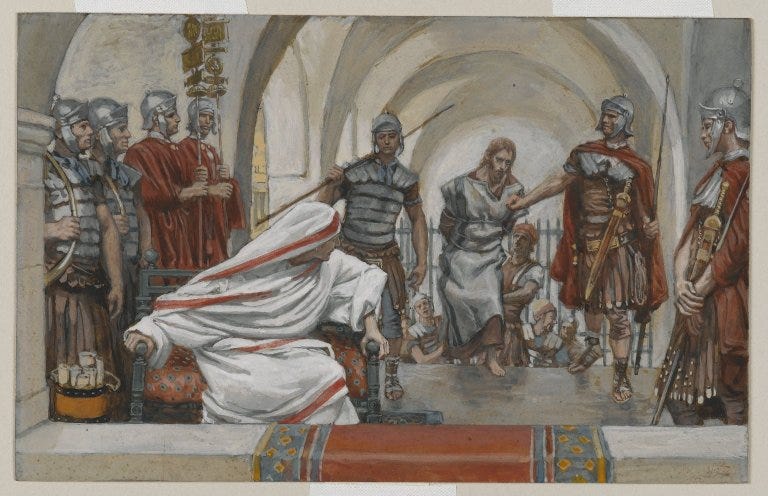
James Tissot, Jesus Led from Herod to Pilate, via Wikimedia Commons

If you used a time machine to ask King Herod whether Jesus was a Palestinian, he would have looked at you strangely for many reasons, not the least of which was that you came from a time machine, but after he got over that and after you explained who you thought Jesus was, he would still be looking strangely at you because Herod was an educated man of his time — he would have known what all educated Greeks and Romans knew, which was that their name for the region that included Judea, Samaria, Galilee and Idumaeia was Palestine. He would have been astonished that you, a visitor from the future, did not know what everyone he considered civilized knew.

People who say Jesus was not a Palestinian either don’t know or hope you don’t know the following easily-verified facts:

The first clear use of the term Palestine to refer to the entire area between Phoenicia and Egypt was in 5th century BCE ancient Greece,[iii][iv] when Herodotus wrote of a “district of Syria, called Palaistinê” (Ancient Greek: Συρίη ἡ Παλαιστίνη καλεομένη)[9] in The Histories, which included the Judean mountains and the Jordan Rift Valley.[10][v] Approximately a century later, Aristotle used a similar definition for the region in Meteorology, in which he included the Dead Sea.[11] Later Greek writers such as Polemon and Pausanias also used the term to refer to the same region, which was followed by Roman writers such as Ovid, Tibullus, Pomponius Mela, Pliny the Elder, Dio Chrysostom, Statius, Plutarch as well as Romano-Jewish writers Philo of Alexandria and Josephus.[12][13] The term was first used to denote an official province in c. 135 CE, when the Roman authorities, following the suppression of the Bar Kokhba Revolt, renamed the province of Judaea “Syria Palaestina”. There is circumstantial evidence linking Hadrian with the name change,[14] but the precise date is not certain.[14]

If you doubt any of that, click on the footnotes and continue your education.

If you’ve spent any time discussing Zionism, you may have noticed that some people say the Romans renamed the area after the Bar Kokhba Revolt to insult the Jews. There’s no historical evidence for that. The Romans created a new and larger district that included most of what they knew as Palestine, so they named it Palaestina.

PS. Many examples of early writers using Palestine’s name for the larger region can be found at Timeline of the name Palestine. Four examples seem especially important to me: Herodotus because he was first, Aristotle because he was so influential, and Philo of Alexandria and Josephus because they were Jews.

PS #2. Zionists often say there were no Palestinians before the 1930s. Thanks to the Oxford English Dictionary, we know they are off by at least 350 years:

1583 I am now constrayned to declare of the battaile that was begunne betweene the light of all knighthood and the furious Palestinian. (2nd Part Mirrour Knighthood ii. 264)

The OED also tells us that Josephus used the name Palestine to refer to the greater region:

1872 Josephus everywhere calls the Philistines Palestinians and their land Palestine, though he occasionally uses the word in a wider sense. (E. P. Barrows, Sacred Geogr. & Antiq. i. 30)

Jesus
Palestine
Israel
Zionism
Recommended from ReadMedium