
BONFIRE FICTION
Odysseus and the Little Man
Formerly — Chapter 1, Part 5 — The End of Achilles
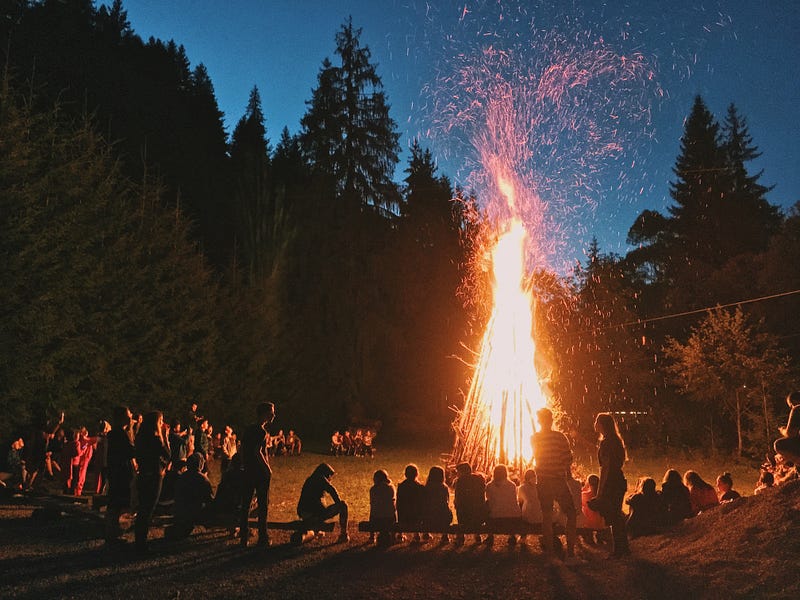
The gods can be cruel, without mercy. Was this a punishment for Odysseus cunning and deceit? I remember it all too well.
The day was glorious and the skies were bright blue, the color of gemstones, and not a cloud anywhere to be seen. The sand of the desert in the plains before Troy stretched out to the very horizons and shimmered in the bright light. Did the gods create such beauty only to host such horror?
There was always talk. we needed to talk on the long trips to the battlefield by the gates of Troy. Tired our troops were and the hike made them weary before the battle even began. The talking chatter helped. Men brag of deeds in war and bed.
And so the battle did begin. We faced them in the brightest of blue skies, and Achilles let us all lead, even Odysseus and Agamemnon. Achilles often led the charge in the brightness of his splendor, the majesty of his height and strength — he himself nearly a god.
“Chase the Trojans!” We chased Ajax around the walls until we finally circled him into a trap. We would have wiped out the very best of the Trojans on that day; but that was not to happen. That single arrow almost by accident pierced Achilles in the foot. Achilles tumbled from the chariot almost too quickly and was trampled by the horses that followed.
I saw this better than anyone because I ride in the back of Odysseus’ chariot, facing the rear — always a strategy with Odysseus to know what’s behind. This I wish I did not see.
It was all too sudden, too quick, and too painful. Is it worse to be eaten by dogs or trampled by running horses? The blood on the bright hair? The kicked in torso? The broken bones? There is no mercy from the Gods when their mind is firm.
It was Odysseus who picked up the shell of his body in its very last moments, hustling him into his own chariot. Odysseus held him as if he were a brother, as if he were a son. The spirit of Achilles traveled to the Elysian Fields in front of us and beside me as I raced back to our camp. I saw his face wither, his eyes retreat.
Even though Odysseus hated the self-willed and overproud Achilles, he moaned for him as for no other person. With the bloody corpse still laid out on the ground, Odysseus sat on the sand, his head leaned forward, and he keened.
“All men are mortal.” “All men are mortal.” “All men are mortal.”
Over and over again, even despite the screams of Brisies who interrupted the solemn goodbyes of Odysseus, Agamemnon, and Menelaus. We all were bereft.
What did we mourn? Why did we lament? His beauty gone, bloodied, trampled by the horses. His strength, seen so many times in war, now gone. His proud ways, the ways he dressed his hair before battle. His loves — both Patroclus and Brisies — either dead or now alone. Maybe just loss — a loss of all that could have been.
Not for nothing did he live. Proud, willful, and too engaged with this world. He found peace in the next. And walks across the Elysian Fields at last. Knowing now, but too late — “All men are mortal.”
But then again, everything must be used twice and so he was burned in a great pyre whose ashes finally were set on a boat and cast out to sea, but with a tall mast mounted so that the Trojans could see, and be bated by the death of Achilles. His death created a false pride for them.
“They think that they have won, Little Man.” “I fear they have only made you angry.” “Yes, they have made me want more revenge than any heart can hold. I am cold and bitter.” “I can see that.” “The Trojans will come to wish that this day had never passed. We will destroy the city and every person there.”
And it was after his death, and the funeral pyre, and sailing ship that even Agamemnon was surprised. Odysseus urdled about the evening fires.
Then the “men from dawn,” who had joined us on their own, of their own volition, taught all us Greeks more than we could fathom. They had come as soldiers seeking gold, seeking the plunder of Troy, only as redress for a history of hatred. They remained aloof from us, but joined us in battle and were tried and true.
On the evening of Achilles’ death, three of them strode into the camp of the western Greeks. They were followed by a troop of others — cleanly dressed in the best of linen and skins.
“We are all Greeks. You from the west, and we from the east where the sun begins.”
“And we bring relief to you, to us, for having lost noble Achilles. We too will miss those flinty blue eyes and that ever supple strength.”
“You fight with us, but we hardly know you.” said Agamemnon. “We meet with your general; you kill the Trojans, but we camp separately.”
“We are Greeks, just as you. We take orders from Agamemnon, just as you. We fight against them, just as you. We are you — but of different dress and custom.”
I piped up, “And what of that? We are many — what are you?”
“We moved to where there is room to build, fields to grow — places you have not seen — closer to where the sun rises. As far east as the next great range of mountains. We came as far from the east as you from the west.”
“But why visit us tonight then, tonight as we mourn?”
“You in the west have taught us much. You lifted us to the rational world — now we will lift you to the gates of Elysium.”
And the three unpacked from leather bags their instruments — each with their own. Two were air and one was strings, a lyre.
And then it began.
One man played a solemn steady note, and the other played a quiet tonal tune, and the third strummed the lyre. We had not heard this before — its haunting solemnity, almost magical.
They drained the moon, set all the sea to quiet and touched the Gods.
And then the other men formed a great circle, arms on shoulders and danced in measure to the music — weaving feet and stomping to the beat, all silently, all with head bowed low. They turned the circle with each step, one to the left and two to the right. Slowly. Some of the men wore ankle brass trinkets — setting the tone, the beat, the pace, always slow, deliberate.
Mournful Touching places we had not known. Separating light from dark. Merging dark to darker. Wafting like smoke upon the evening air. A dirge for Achilles. A reminder that we are all mortal. A warning that immortality is but a dream. Hollowing our souls, laying all to bare.
We all gathered round and sat on sand, leaning forward to hear this new and plaintive sound. For hours, into the night, and all without a word. And we joined the dance, linked arm to shoulder, learning the steps — all as one lost in grief for so great a man as Achilles. Oh, how we loved him. Gods have pity.
And then, as if by a signal we could not see, one old man stepped forward and sang for us, sang out in a deep but plaintive voice.
A Dirge for Achilles
Strophe All men want much — all men want fame And wealth and joy They labor to farm, labor to family Labor in the worst of times Joy in the best of times Each day a miracle Each day a task
To sail the sea To plant fields To harvest grain To fight for right To make family. These are the simple joys we seek.
Antistrophe All men want wedded bliss To find the god’s blessings To grow and prosper and multiply A good wife, a good son, a joyful daughter The blessings of the gods to find the path That leads to fortune’s blessings.
To sail the sea To plant fields To harvest grain To fight for right To make family. These are the simple joys we seek.
Epode
But all men are mortal. Life’s string runs out The goddesses snip the string, snip off life And few are knowing. No one knows.
And still, when all is done, Men stand at the river Styx and pray For easy passage to the world beyond Charon’s cargo gracefully carried Leaving behind a family to farm the land Grow and prosper with the god’s blessings.
To sail the sea To plant fields To harvest grain To fight for right To make family. These are the simple joys we seek.
At last they were done, and rose as they had come, quietly, and left. Packed up the instruments without a word, never having drunk the wine we offered. They trudged east, toward the approaching sun — the east where they camped, where they came from.
And not a man was without tears — as they had all seen their own mortality, knowing Achilles’ was too soon.
There was no fighting for a week.
Odysseus thought about it all.


