
Odds of Dying: What You Should Really Fear
We tend to underestimate serious risks and let minor threats loom ridiculously large
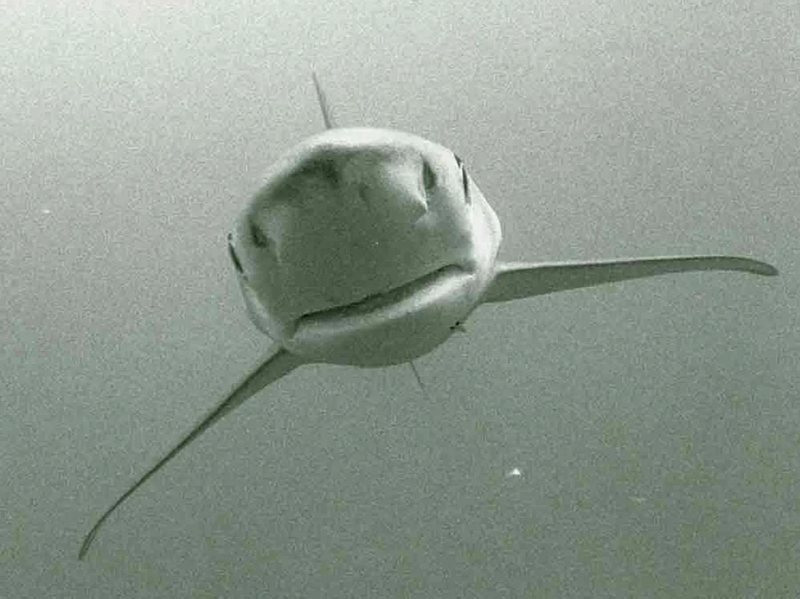
If you fear dying in a plane crash, a shark attack, a bombing or a violent home invasion — or some other statistically unlikely event — join the crowd. People all over the world harbor irrational or at least outsized fears over numerous ways of departing this world that are highly unlikely to ever befall the average individual.
The odds of dying are pretty high, granted. But the odds of dying by the things we tend to fear the most often border on infinitesimal.
Why do we obsess over the unlikely?
Dramatic, scary and deadly events garner big headlines, flood the evening news and clog our social media feeds. They often come with vivid images — whether real and conjured in our frightened minds — that stick with us far more readily than the thought of someone dying of heart disease or cancer, the two leading causes of human demise, or a simple fall — the leading cause of fatal injuries among older people.
“We are more likely to die falling in our bathrooms than by being murdered by terrorists or in an airplane crash, but people probably never see news about someone falling in their bathrooms and dying,” explains Sheldon Solomon, PhD, a professor of psychology at Skidmore College. “Moreover, crashes, terrorism and violence are more immediate, whereas high blood pressure and cancer happen more slowly over time, such that we might underestimate their frequency as a result.”
Recent research finds that irrational fear can also build when we’re fed a steady diet of scary information about something important to us, as happens with neighborhood apps like Nextdoor that keep you apprised of every real (or purported) criminal act.
What we remember most
Solomon and colleagues conducted a global survey on this back in 2020 — before the pandemic — in which people on average guessed that violence is responsible for about 8% of all deaths. The reality is closer to 1%. (See the chart below.)
Conversely, people guessed heart disease spelled the end for about 11% of humans, but it’s actually responsible for about one-third of all deaths.
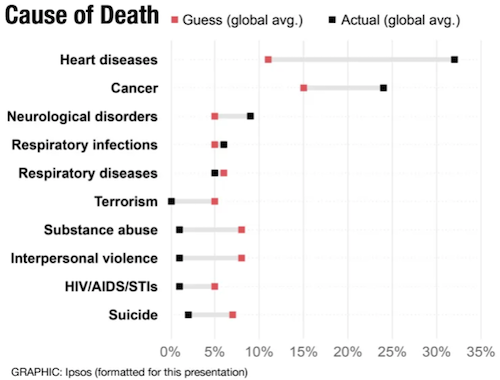
We are simply more apt to have many strong memories about car crashes, natural disasters, mass shootings and other violent events. “These likely come to mind more easily, and leads people to think it happens more often,” said Solomon’s colleague, Namika Sagara, PhD, a behavioral scientist who was with the Ipsos Behavioral Science Center in New York when the survey was conducted.
Psychologists call this availability bias: Making decisions based on what comes to mind quickly, or forming views based on what you’ve seen or heard without considering all the relevant information, which may not even have stuck with you.
It explains why someone like me, who saw Jaws way back in 1975, has an irrational fear of sharks — even when I’m swimming in a freshwater lake (I know, lame, but true).
Media consumption can generate inordinate fear, via availability bias, that affects your attitudes, emotions and behaviors, scientists say.
“Seeing is believing. Personal experience is easier to process than statistical information, so we often rely too heavily on our experiences and anecdotes,” says Adam Fetterman, PhD, an assistant professor of psychology at the University of Houston. “When the science does not match our personal experience, we will be more likely to deny the science.”
Fetterman and colleagues recently tested the concept via two studies, including a survey of people in 43 states, to gauge the effect of neighborhood app use on perceptions of local crime.
“We confirmed our hypothesis that those who use neighborhood apps would perceive local crime rates to be higher in their communities than those who do not, independent of the actual crime rates,” Fetterman said.
The real odds of dying
So what are you afraid of? Odds are you will die. Of that we can be pretty sure. But your most likely death sentence doesn’t include sharks, snakes, subways or even drowning or burning to death, nor being shot in your home or bombed on the streets. Go ahead and fear all these things — or at least develop a healthy respect for their deadly potential and the sometimes scary world we live in — but unless you are in a situation highly prone to such events, don’t expect them to do you in.
Here’s how most of us are most likely to die: In the United States, the lifetime odds of dying by heart disease are about 1-in-6, and 1-in-7 for cancer, according to the latest data from the National Safety Council. The chances are similar globally. For comparison, here are the odds of dying for selected other causes that might be keeping you up at night:
Guns: 1-in-89 Falling: 1-in-98 Motorcycling: 1-in-747 Drowning: 1-in-1,006 Fire or smoke: 1-in-1,287 Choking on food: 1-in-2,659 Bicycling: 1-in-3,546 Dog attack: 1-in-53,843
The odds of dying in a plane crash or by lightning strike were deemed too small to calculate but have previously been put at 1-in-188,364 and 1-in-218,106, respectively.
If asteroids are your big fear, rest easy. The odds one will erase you are between 1-in-700,000 and 1-in-1.6 million, based on wild guesses by two different experts (they’d be more astronomical if not for the fact that if a really big one ever does strike, it’s bye-bye humanity, not just you).
If you are inordinately afraid of sharks, then you should probably watch out for elephants.
Sharks are responsible for only about five human fatalities per year worldwide, on average. Elephants are thought to trample to death or otherwise dispatch somewhere between 100 and 500 humans annually. Crocodiles thin our species by about 1,000 a year. Scorpions around 2,600.
Snakes deserve some of our fear. They kill up to 100,000 of us every year. But no creature compares to mosquitoes, which through infections slay more than 600,000 people globally every year.
Put the odds in your favor
You can sway your odds of death greatly, should you choose to do so. If you walk with elephants, the likelihood of being squashed to death by a pachyderm goes up considerably compared to when you’re watching a Netflix documentary about elephants. Jumping off a cruise ship will certainly up the odds of drowning. Wrangle a rattlesnake while riding a motorcycle and, well, you get the idea.
Still, you can’t control everything about the world around you, and shutting yourself forever indoors would invite a visit from a psychiatrist.
But in reality, most of us skew our odds of dying from certain causes every single day. And I’m not talking about crossing the street. I’m talking about drinking alcohol, smoking, eating highly processed food, and sitting on our asses. Short of flying an airplane that’s running on fumes or swimming in a literal shark tank, those are the easiest ways to up your odds of dying—you know, like, soon.
Additional sources: Discover Wildlife; GatesNotes; Statista; CDC
Make your days better with my book: Make Sleep Your Superpower. If you’re a writer, sign up for my Writer’s Guide newsletter. And thanks for your support, which makes my reporting and writing possible.