
Obtaining/replacing a driving license in Germany
You won’t believe it, but I have been obtaining a driving license in Germany for over 1.5 years. At the same time, it has cost me much more to replace my Ukrainian support than I had initially expected. Why did it happen, and how to avoid it?
A small digression
If you follow the news, you know that on 29 June, the European Union granted Ukraine “transport visa-free travel”. As part of this, Ukrainian driving licenses will be fully recognized within the bloc for a year. This will significantly assist temporarily displaced Ukrainians who need a license to work in the EU.
And for those planning to stay longer in Germany, my experience may be helpful too. Therefore I am going to share it.
Choice of driving school
Before introducing the ‘transport visa-free,’ it was only possible to use a driving license without restrictions for six months. After that, you had to change them and take additional tests.
Since in Germany you cannot buy a driving license or agree to learn the theory by yourself: you have to pass the idea and practice driving in a driving school and pass the exam in independent experts, I started with choosing a driving school.
There are several types of courses in Germany — accelerated and ordinary. Fast-track courses provide one week’s worth of theoretical and practical training, but you must study from morning to night. Standard methods take several months to six months. At the time, it was vital for me to find a driving school with a regular schedule but with a Russian-speaking teacher. This is probably one of the reasons why I overpaid for the course considerably.
What is usually included in the tuition fee:
- basic theory fee — Grundgebühr,
- training materials,
- driving practice fee,
- extra practice hours: first, I practiced with a manual gearbox, then I paid extra for driving with an automatic gearbox, + I took lessons before my exams.
You have to pay for exams (theory and practical) separately. But it is not all expenses. Below is a more comprehensive list.
How much does it cost on average to obtain a driving license in Germany if you pass the exams on the first try?
The costs may vary from one German federal state to another. Here is one example:
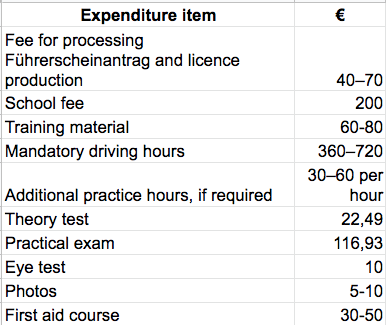
Usually, you pay around 1,500 euros for getting/changing your driving license in Germany if you pass the exams the first time.
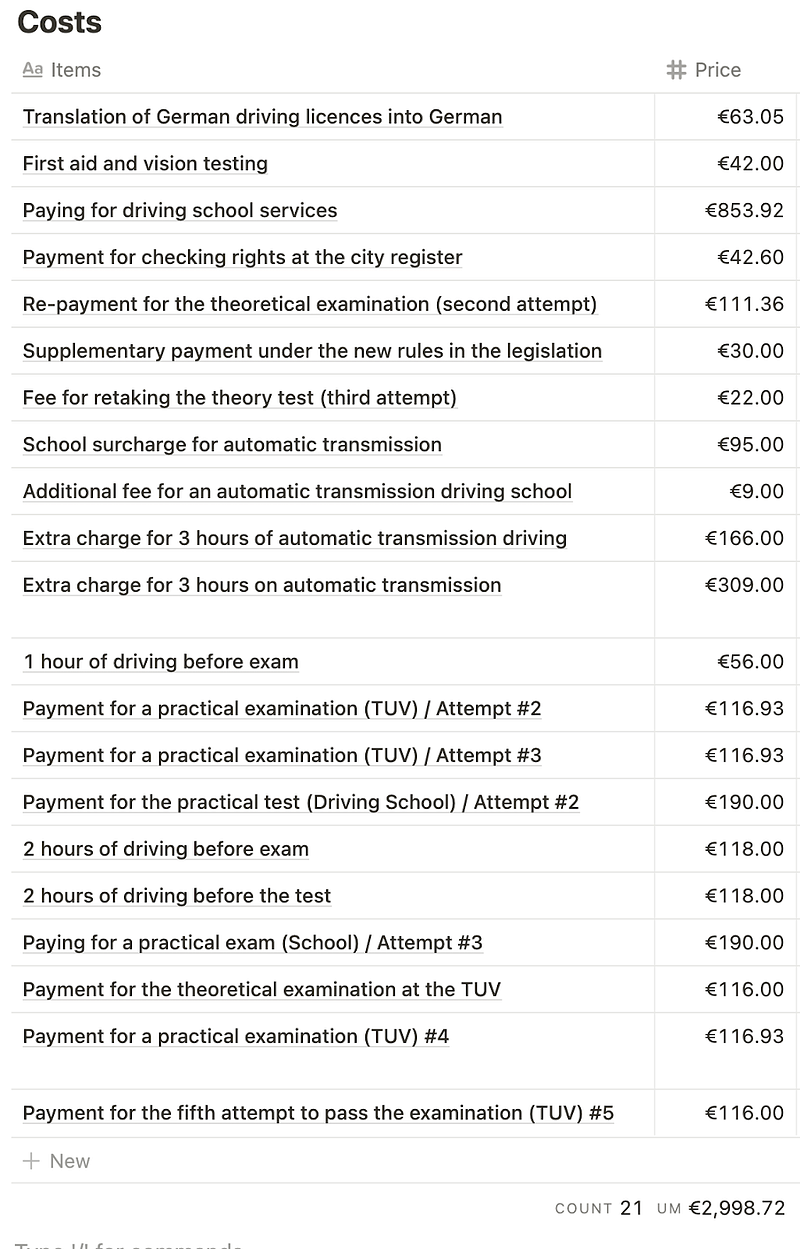
How much did I pay to get my license?
Considerably more than €1,500.
Here are the main reasons:
- the need for a German translation of the driving license,
- checking the permit at the registry office,
- choice of school with a Russian-speaking teacher,
- the nuances of obtaining documents and attending classes because of the coronavirus epidemic,
- extra charge for the fact that I decided to change from a manual transmission to an automatic transmission,
- two retakes of the theory test. The first time I was just late due to objective reasons. As a result, I got a fine and could not retake the exam until two weeks later,
- payment for five practice tests (TUV) of 116 euros each because I had to adjust to the traffic in Germany. I have to say that if I were learning to drive from scratch here, it would have been easier. As it was, my previous driving experience got in my way on the streets of Augsburg.
My cost items for getting/exchanging a Ukrainian driving license for a German one:
Nuances with terms of getting a driving license
You have 12 months to pass a practical exam in Germany. But as it took me so long, I had to solve the problem of getting the exam. I applied in writing for an extension of the deadline for taking the exam because of a coronavirus epidemic and the situation in Ukraine. I was granted an extension and was allowed to retake the exam.
I now have a driving license which is valid until 2036. I am now planning to obtain an international driving license.
Driving tips to help you save on retakes
As I have mentioned above, the manner of driving in German cities is very different from that in Ukraine. After each lesson and failed exam, I analyzed my mistakes and derived the following rules:
- You need to adjust the seat position and mirror yourself when getting in the car. Do not just check that it fits, but change the seat, steering wheel, and mirrors.
- The seat belt must be fastened on automatic.
- When driving from a place, always switch on the left turn, even if you move straight ahead.
- Always turn your head while maneuvering and look in mirrors. But even this is not enough for picky examiners. Look over your left shoulder, and make sure you don’t interfere with anyone. If you fail to do this several times in the examination, the examiner will think you are inattentive and will find you have forgotten.
- Keep both hands on the steering wheel, except when you change gear.
- On the autobahn, drive at a maximum speed of 140 km/h, even if there is no limit.
- If the instructor is silent and does not admonish, all is well. Just drive straight ahead without interrupting.
- It’s not allowed to exceed the speed limit, but it’s forgiven, e.g. 52 with a permitted 50. The main thing is to slow down immediately to the permitted speed.
- You can’t drive unreasonably slow either. Minus 5 km/h of the permitted speed is acceptable.
- Pay particular attention to roundabouts.
- In “Zone 30”, where there are many unseen intersections, you must stop at every street and check that there is no obstruction on the right.
- Narrow alleys with parked cars should be driven carefully and slowly, particularly for pedestrians and cyclists.
- On a one-way street, drive in the center of the road. Keep to the left before you turn left and to the right before you turn right.
- Be careful; houses or trees may hide the prescription and prohibition signs.
- Drive in first gear at minimum speed with your foot on the brake. In residential areas, the maximum speed is 7 km/h. Make it clear that you have put your foot on the brake pedal.
- Pay attention to passing in industrial areas. If there is an obstruction on the right, the permitted speed of 50 km/h must be quickly reduced to 20 km/h.
- Learn all terms, e.g. in one of my exams, I simply did not understand the phrase “emergency braking” in German.
Observations and some statistics
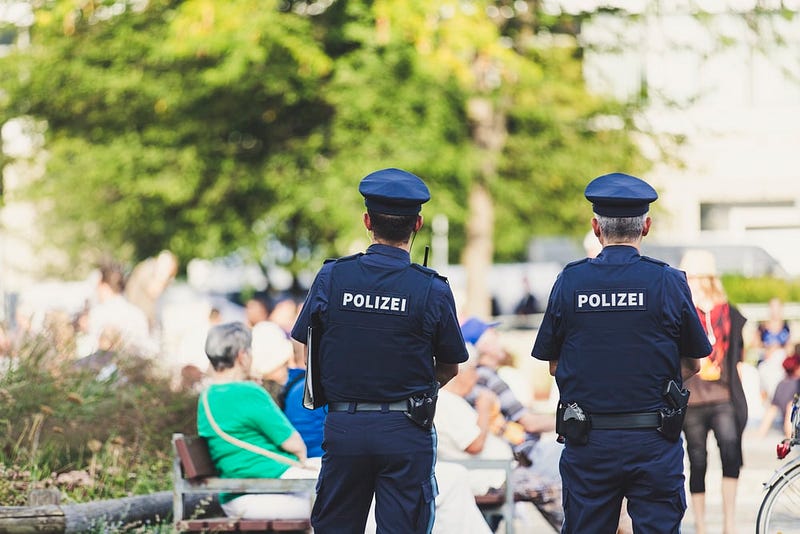
In general, drivers in Germany are very polite, attentive, and patient, and for them, safety is paramount. That is why the number of fatalities and injuries is steadily declining. In 2020, for example, the number of deaths on German roads reached a minimum of 2,719. And if we compare the number of fatalities from accidents between 2019 and 2021 2021, it has dropped by 16%. The number of people injured in road accidents also decreased by 2% in 2021 compared to the previous year. The figure was around 321,000.
If we take Ukraine, there was a significant increase in road accidents in 2021. During the ten months of 2021 alone, there were 154,480 traffic accidents, which is 13.9% more than for the same period in 2020. The positive trend is that, at the same time, the number of casualties has decreased significantly. As for the 2022 statistics, because of the war, the number of accidents has dropped by 50%…
Where am I going with this? If not to take data for 2022, the approach to training at German driving schools, exactingness of examiners, pupils’ attitude to lessons — all together strengthens safety on roads. And consequently — it is worth time, effort, and spent money. And to reduce the training time and not overpay, those planning to change/receive a driving license should carefully study all the nuances.
So, before you close the publication page, please subscribe to my updates or visit the other pages I run: