Politics & Perspective
Obscuring Faith
The Struggle for Righteous Politics

Can being devoted to your religious faith be in conflict with being American? Can you be both an American and be truly devoted to your faith?
Faith is obviously very personal and can shape our individual values but it illogically conflicts for many with the constitutional politics of the U.S.
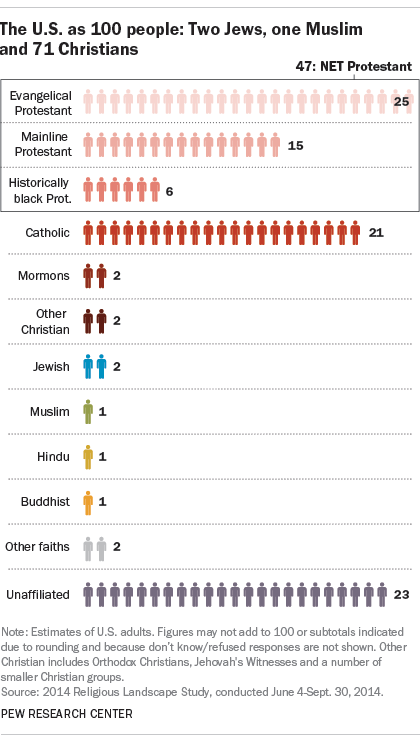
In the U.S., when we talk about religion or one’s faith, we are contemplating the majority of Americans who are Protestant Christian (no surprise given the obvious historical arrival of 16th century European Reformed Protestantism of the explorers of the North American New World), attested also according to the 16 Nov 2016 Pew Research analysis (If the U.S. had 100 people: Charting Americans’ religious affiliations) of their 2014 study conducted by phone interview with 35,000 participants from all 50 states:
Just less than 50% identify as Protestant Christian:
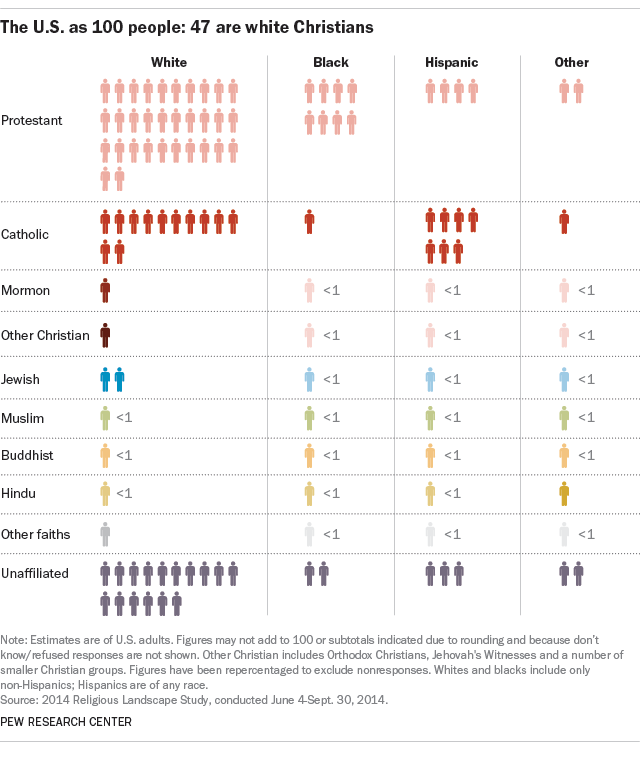
By race, the vast majority are White Protestant Christians or White Catholics:
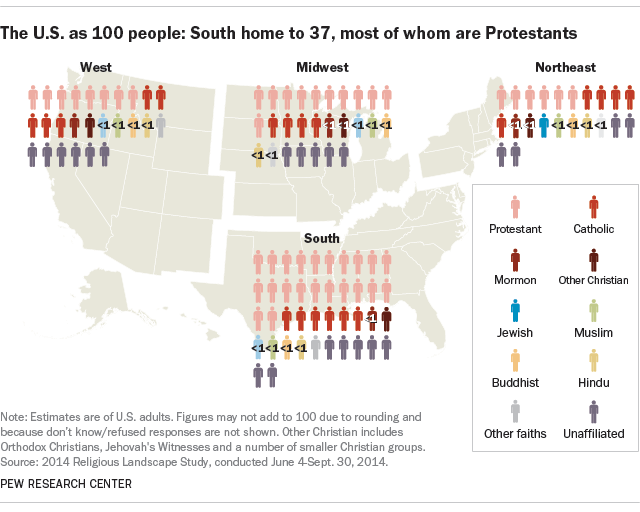
By region in the country, White Christians and Catholics are primarily located in the South and Midwest:
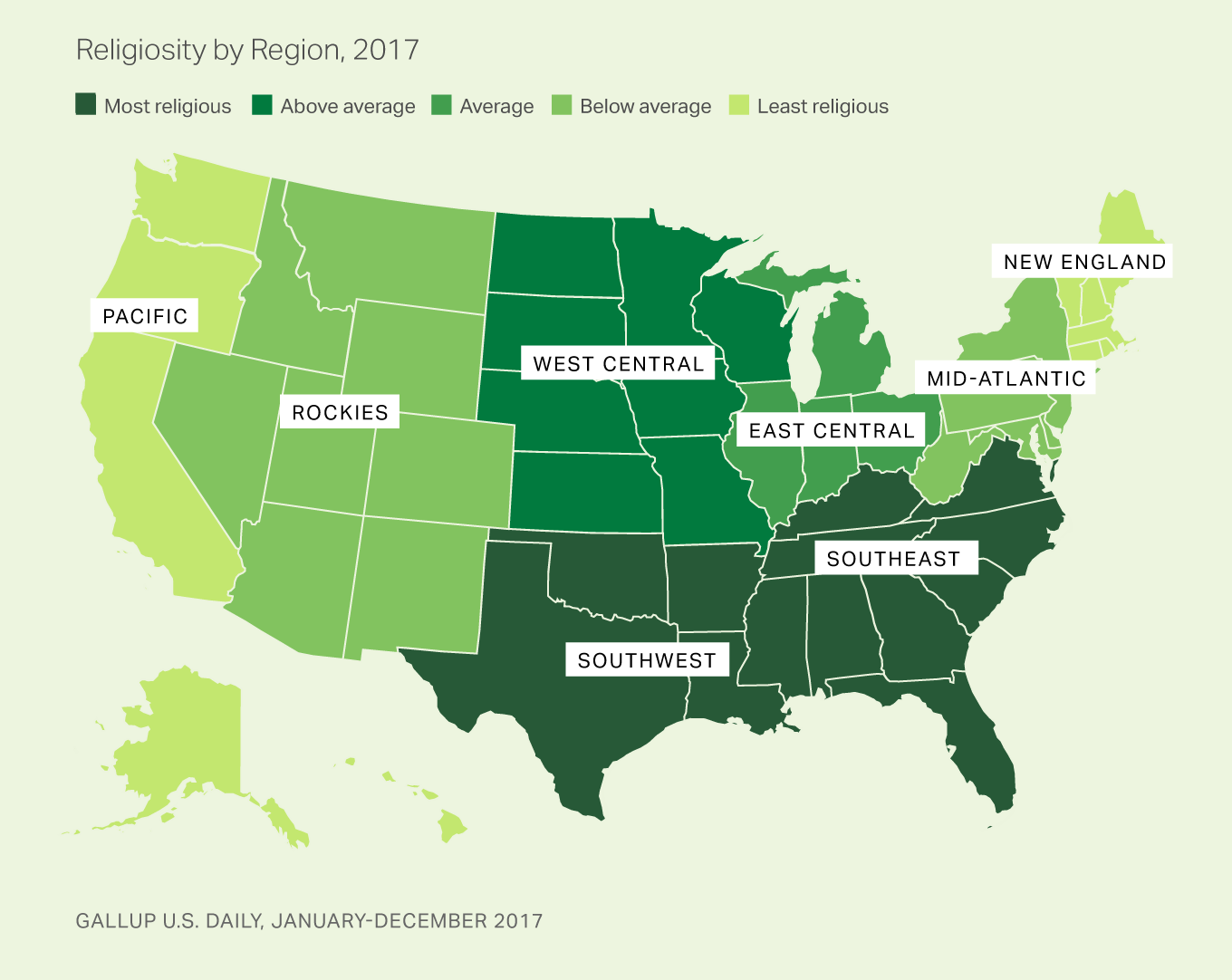
Three years later by a 2017 Gallup poll, the most religious regions of the country remained the Southeast and Southwest and the least religious regions were the Northeast (New England and Mid-Atlantic) and the West (Pacific and Rockies):
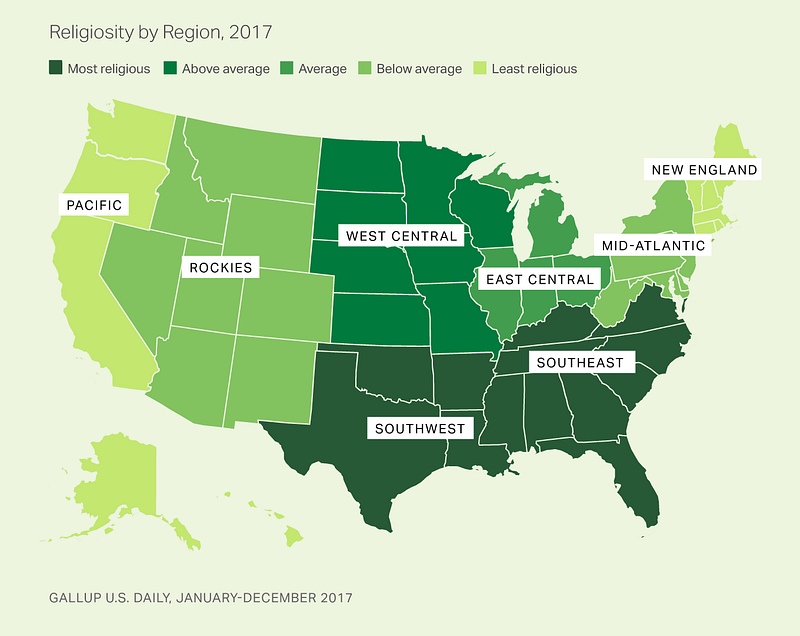
So, that is to say that even within the country, the national debate on racial inequality and the commingling of religious worldviews on the issues brought to light by the BLM movement will expect to vary greatly based on the makeup of American religious affiliation in each area.
The Black Lives Matter movement, which originated in 2013 over the upsetting 13 July 2013 acquittal of Trayvon Martin’s killer in the 26 February 2012 shooting and emerging ever pertinent in the wake of the 2014 Ferguson uprisings over Missouri’s Michael Brown’s wrongful death by a White policeman on 9 August 2014, has most recently garnered such national and international attention borne out of the multiple 2020 brutal murders by White police or vigilantes of Blacks as Glynn County, Georgia’s Ahmaud Arbery on 23 February, Louisville, Kentucky’s Breonna Taylor on 13 March, and Minneapolis, Minnesota’s George Floyd on 25 May, that maybe for the first time since the Civil Rights Movement that ended in the 1960’s has compelled many non-Blacks to publicly recognize the reality of the ongoing ‘systemic racism’ in policing, as well as in our institutions (as in healthcare and in education), in our legislations, past and present, in housing, and even in the movies for Black Americans.
Yet, some conservative Christians are unsupportive of the Black Lives Matter movement because of their disapproval of its origins from feminism and transgenderism and specific statements made on their ‘What We Believe’ page on their website. However, they do not appear to further engage in discussions with anyone directly from the movement nor with the founders regarding thus and interpret those specific proclamations from the site as wholly anti-Scriptural and neo-Marxist; for example, an op-ed by Peter Heck on a right bias news platform, Discrn, asseverates the group’s basic impurity and evil on the basis of its intermixing of the freedoms of transgenderism and feminism with the late Black Theologian James H. Cone’s controversial ideology of Black Liberation Theology which asserts their foundation in Jesus’ teachings as fundamental as it is in Christianity for Whites in which serving the poor and down-trodden is in fact caring for Blacks who make up the majority of our poverty in America today (20.8% poverty rate which was the highest based on the 2018 U.S. Census data, second only to Native Americans at 25.4%).
Such conservative Christian voices as Peter Heck, Alyssa Daniels of Falkiri Center, Providence Magazine, and Freedom Journal’s Institute, firstly, ignore the context in which both the backgrounds of each of the founders and their further remarks made on interviews and other media that speak to their social agenda not a religious one, thus measured against Biblical morals, the BLM principles will indeed be irreligious; such as feminism which defies Scriptural patriarchy; LGBTQ+ existence which challenges gospel condemnation of such; and, community families, which contradicts traditional White American Christian nuclear families with the union of a man and a woman — part of Peter Heck’s opinion — while anything focused on the love of family above Jesus himself is idolatry per Freedom Journal’s Institute’s evaluation.
Only 2 of the 3 original founders of the Black Lives Movement identify as queer, and all are well-educated, with deep personal discriminatory experiences, are actively committed, and indeed do not have a traditional relationship with the Christian church. Therefore, the BLM is not attached to any Black church, and, subsequently, the Black church is not visibly at the forefront of the movement as it was in the Civil Rights Movement of the mid-20th century.
Moreover, not all three co-founders are the very narrow definition of Black Americans. Patrisse Khan-Cullors is African-American, while Alicia Garza is mixed race (her father being a White Jew), and Opal Tometi is Nigerian-American (however, there remains the question, for my edification, of the circumstances surrounding her parents’ illegal immigration). Secondly, the trio’s stated rationale behind their controversial BLM creed is absolutely secular by their own definition — Opal Tometi saying in a 2015 interview with Truthout.org,
‘…Black Lives Matter was always conceived of as a strategic response to white supremacy’
rather than being measured by Christian critics as declaring them as some completely false doctrine actively against Christian principles.
At the top of their ‘What We Believe’ page on the BlackLivesMatter.com site, their goals do indeed have a strong feminist bent, but it includes an overall gender and racially inclusive tone:
‘…Black Lives Matter began as a call to action in response to state-sanctioned violence and anti-Black racism. Our intention from the very beginning was to connect Black people from all over the world who have a shared desire for justice to act together in their communities. The impetus for that commitment was, and still is, the rampant and deliberate violence inflicted on us by the state.’ [and a few lines down]: ’We acknowledge, respect, and celebrate differences and commonalities.
We work vigorously for freedom and justice for Black people and, by extension, all people…To love and desire freedom and justice for ourselves is a prerequisite for wanting the same for others…We are guided by the fact that all Black lives matter, regardless of actual or perceived sexual identity, gender identity, gender expression, economic status, ability, disability, religious beliefs or disbeliefs, immigration status, or location.
We make space for transgender brothers and sisters to participate and lead. We are self-reflexive and do the work required to dismantle cisgender privilege and uplift Black trans folk, especially Black trans women who continue to be disproportionately impacted by trans-antagonistic violence.
We build a space that affirms Black women and is free from sexism, misogyny, and environments in which men are centered. We practice empathy…We make our spaces family-friendly and enable parents to fully participate with their children. We dismantle the patriarchal practice that requires mothers to work “double shifts” so that they can mother in private even as they participate in public justice work.
We disrupt the Western-prescribed nuclear family structure requirement by supporting each other as extended families and “villages” that collectively care for one another, especially our children, to the degree that mothers, parents, and children are comfortable.
We foster a queer‐affirming network. When we gather, we do so with the intention of freeing ourselves from the tight grip of heteronormative thinking, or rather, the belief that all in the world are heterosexual (unless s/he or they disclose otherwise).
We cultivate an intergenerational and communal network free from ageism…We embody and practice justice, liberation, and peace in our engagements with one another. [Bold added].’
All the main issues taken by rejecting Christians in the BLM’s agenda of equality for transgenders and women power (including right to abortion which has so far been upheld by the Supreme Court 1973 ruling in Roe vs. Wade), the changing of the traditional family structure, and the right to the form of self-defense (the Greater NY chapter of BLM leader vows to create Peace Officers in protection against police forces) are also secular and invoke the review of the pertinent rights or not referenced by the U.S. Constitution and as interpreted by law. The Supreme Court ruling of the 2015 Obergefell v. Hodges case, extending the rights of marriage by the Fourteenth Amendment to also apply to same-sex marriages, and the concept of ‘family’ as examined by Cornell Law School is not set only to the traditional ‘nuclear’ family because the constitutional right extends also to ideas of single family homes inclusive of grandparents, foster children, and the like. It is also notable to consider the March 2020 issue in The Atlantic on The Nuclear Family Was A Mistake by David Brooks with data supported findings that he summarizes as below (added bold mine):
‘We’ve made life freer for individuals and more unstable for families. We’ve made life better for adults but worse for children. We’ve moved from big, interconnected, and extended families, which helped protect the most vulnerable people in society from the shocks of life, to smaller, detached nuclear families (a married couple and their children), which give the most privileged people in society room to maximize their talents and expand their options. The shift from bigger and interconnected extended families to smaller and detached nuclear families ultimately led to a familial system that liberates the rich and ravages the working-class and the poor.’
Regarding the accusation of BLM supporters as Marxists or neo-Marxists, this political belief does thematically refer to a kind of oppression created by the rich and the educated onto and maintaining the poorer working class but strictly through capitalism and the categorization of only 2 classes (business owners and workers), followed by the belief of the ousting of the capitalist owner class to control the economy, but this narrow view does not truly classify the clearly racially feminist-centric and transgender-inclusive underlining aim against White supremacy which thwarts the flourish of Black communities and families in the BLM’s ultimately apparent goal to achieve equal and consistent U.S. constitutional rights as Whites.
Some Christian churches, as in the United Church of Christ, intrinsically support BLM by the broad definition of human equality in the eyes of Jesus. Meanwhile, specific Biblical passages as in 1 Corinthians 6:9 and Romans 1:18–32 as pointed out by some Christians assert that the reality of the existence of the LGBTQ+ community cannot be inclusive to their faith without full condemnation.
Therefore, the application of religious views on all significant sociopolitical issues that affect all Americans cannot be evaluated by the sometimes contradictory or esoteric religious views and rights of the majority but instead must be considered by the rule of law, logic, according to the U.S. Constitution; and no law should endorse the imposition of one’s religious view over another. The Founding Fathers were not Christians but Deists who believed in an overall Creator but a hands-off one thus the firm requirement of man to utilize reason and logic (how the U.S. Constitution was formed) and the same basis we would use science and not religion to guide our national decisions for any legal measures in defeating a viral pandemic.
If there were not for the separation of Church and State in our executive, legislative, and judicial branches of our government, we would then be a theocracy, like modern day Saudia Arabia, Iran, or The Vatican, nor could even the conservative Republican Supreme Court Justices (Neil Gorsuch and John Roberts) have ruled based on interpretation of law in the milestone decision this week in favor of LGBTQ+ rights in the workplace against gender discrimination.
The dramatic fundamental stay-at-home orders for the past few months during the COVID-19 pandemic has certainly allowed us inadvertently to focus our attentions on matters of real priorities in our homes and at home in our nation, which in any other unprecedented time may not have otherwise awakened us so readily to the causes and debates over social injustice, racial inequality, and gender discrimination.
While many religiously fear the potentially dangerous or hidden agenda of the BLM, in the words of one of the co-founders, Alicia Garza, during the Lesbian Tech Summit on her view about power as quoted by Quartz.com in 2018, it reveals more of an American view than of any one or antithetical religion:
For me, power means getting to make decisions over your own life. Power means being able to determine where resources go, who they go to, where they don’t go, and who they don’t go to.
For me, power is about the ability to shape the narrative of what is right, what is wrong, what is just, what is unjust. But most importantly for me, power is about making sure that there are consequences when you’re disappointed. When the people who you elect don’t carry out the agenda that you elected them to carry out.
I think, I know, that black people deserve to be powerful. Time and time again we have challenged this country to live up to its values, freedom, justice, democracy for all. Our grandparents, and our parents, and now many of us have put our lives on the line to be free, and they didn’t intend to turn back, and I don’t think we should turn back either. But that means we’ve got to get serious about building power. The power we need for all black communities to live well.
And I don’t know about you, but I personally am tired of being talked to and not having my concerns, my needs, and my dreams, addressed. I’m tired of being told what I should care about, when I should care about it, rather than being engaged about what I care about, and being asked what I want to see in order to address the challenges that we face every day. [Bold added].
The concerns of religious leaders and Americans of any movement must be tested through the examination and lens of the U.S. Constitution rather than by one’s personal faith alone. The practice of each of our faith in private and in public is indeed protected by our First Amendment rights, but in a country in which our enviable freedoms are built on secular laws, we owe our American allegiance for the proper functioning and indulgence of our democracy by the adherence to logical laws built on reason and not by theocracy.
Here is another story you might like:
If you are not yet a Medium member and would like to show your support for me and my content, please consider becoming a member through me, here:
A portion of your membership fee directly supports my efforts in continually writing here but at no additional cost to you and without any changes to your membership — you still get full access to every story on Medium besides mine. But your support would make a real difference for a writer.
Thank you for reading!
© 2020 The Secret Aspirant. All rights reserved.