
Obesity and Its Extremes: Problems with Simple Acceptance
In Greek mythology, Atlas is known to be the one who holds the planet on his shoulders, and humanity is giving it more and more work. We know that obesity is characterized by the excessive accumulation of fat in the individual’s body, at levels that compromise his health, causing losses such as metabolic changes, motor difficulties, and the increase in its incidence in the world, is commonly attributed to changes in lifestyle and eating habits. According to the World Health Organization, obesity would be today one of the biggest and most visible, but most neglected, public health problems in the world. Concomitantly, its setbacks are not limited only to the physiological but also the psychological, depression and anxiety resulting from a negative view of body image, are examples of adverse conditions linked to obesity, as evidenced, obesity is a disease that has a complex and multifactorial etiology, therefore, its treatment is also complex and delicate.
Society standards, two extremes.
Beauty standards have been built for centuries in our society, we are influenced by magazines, television, cinema, among other artistic and communication media, such standards can lead to stigmas for those outside of them. On the other hand, there is the other extreme that is more current and is also problematic, the simple acceptance, I will use the adjective “simple” to differentiate from the “acceptance” that is approached in science in a deep and complex way as a good method to fight obesity and its stigmas. What I want to cover with “simple” is the way that society, in general, approaches the theme of the stigma of obesity, there are scientific studies that show a positive secular trend of BMI, which means that people are weighing more as the time passes, this corroborates with the fact that due attention is not given to obesity and its consequences. It is important to make clear the difference between acceptance as a purpose and acceptance as a means to achieve other goals. There is also evidence that shows from a large sample of Americans a distorted perception of their weights and that this misperception leads to a lack of interest on the part of individuals in losing weight.
It is not your fault
I work as a researcher in a group that studies obesity, one of the most important things that we see, is that those who are affected with obesity are likely to feel guilty, for not being able of losing weight, not being able to adhere to physical exercise or to eating less, but I must say, this is not your fault! We do not have control over our instincts, and those who think that obesity is about nutrition and exercise, are wrong, psychological intervention is one of the most, if not the most important weapon to fight obesity.
Hypothetical Model
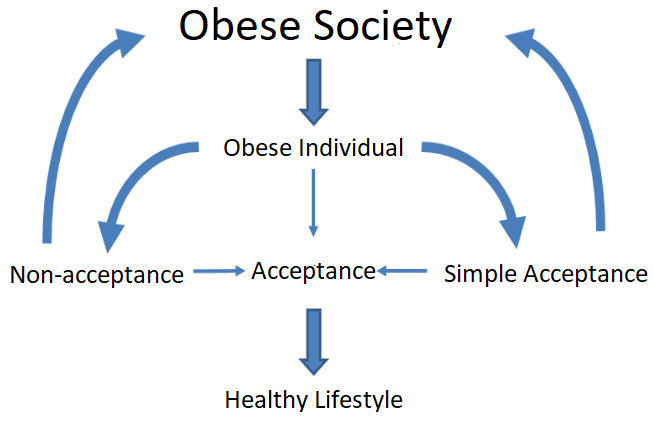
We live in an obese society, we are surrounded by various stimuli that lead us to unhealthy lifestyles, from the great amount of advertising of fast food chains and ultra-processed foods to the immense amount of technologies that make us physically inactive. I made an illustration of a hypothetical model, which is the attempt to understand the problem of the two extremes of the same subject, following the logic of the image, society “creates” obesity in individuals, these individuals have three possible paths, remembering that most of the time this path does not depend on an individual choice of the subject.
- The path of non-acceptance (rejection), the person has difficulty accepting his condition and image, the individual, in addition to bearing the metabolic complications resulting from obesity, will also suffer from his psychological problems.
- The path of simple acceptance, which was the focus of this study, can also be seen as ignorance or neglect of obesity and which differs from the acceptance that will be addressed below, the simple acceptance of the condition of obesity, as well as non-acceptance, entails in problems to the individual.
- The last and least frequent path is that of acceptance as a means to an end, which would be towards a healthy lifestyle.
It is possible to see the difference in the size of the arrows, the intention is to represent the percentage of specific populations, the percentile of people who head for the “negative” paths of non-acceptance and simple acceptance is greater when compared to the “positive” path in the middle, of acceptance. The arrows that go from negative to positive paths show the possibility of reversing adverse conditions. Based on what was discussed throughout the article, it is possible to see that society is unable to deal with the obese population, generating health expenditures much higher than what would be spent on prevention, the side arrows that go from the negative paths of acceptance back society represents this exhaustion and inefficiency to deal with this problem, in addition to showing a feedback system, in which an obese society will generate obese people.
In conclusion, at all times I tried to differentiate the types of acceptance, one being part of an important process in search of improvements, while the other is the simple abdication, remembering that such acceptances most of the time do not belong only to individual decisions when it comes to from special populations, there is a lot of vulnerability involved, so they cannot be neglected.
If you want to receive more content about science, like riddles and questions that humanity could answer yet, just click here and subscribe.


