

Nutrition: At the Root of Inequality
Food insecurity, nutritional inequality, and why we should act
Children are told “an apple a day keeps the doctor away.” Cute, true to an extent, but criminally understated. Children should instead be told “an apple a day keeps the doctor, the police officer, the social worker, and the payday lender away.” While not quite as digestible, perhaps then the importance of one’s diet would be appropriately understood.
It’s not entirely our fault we don’t take nutrition seriously enough. We know that humans struggle with delaying gratification, although on the aggregate we appear to be improving gradually. Those who demonstrate a greater ability to consider long-term trade offs benefit from “academic competence and higher SAT scores, healthier weight, effective coping with stress and frustration, social responsibility and positive relations with peers,” but when faced with a choice between utilitarian lump sums and annuities, we often opt for just one more french fry and the promise of a diet that starts tomorrow.
The waters are muddy; your Church of Crossfit, paleo hardliner friend might insist one thing while your ketovangelist co-worker insists another, and intuition might tell you they’re both wrong. The food pyramid many are familiar with from grade school seemed to be an attempt to standardize healthy nutritional advice, but it phased out of prevalence for good reason as it turned out to be extremely off-base.
We’ve been burned so many times by the bloated fad diet industry that it can often feel difficult to separate fact from fiction, but poor nutrition is the trunk off which innumerable social ills branch. Nutrition alone can’t explain away complex social phenomena, but it can set us down the path towards greater equality of opportunity. By targeting positive health outcomes nutritionally, society can take what amounts to a preventative care approach to addressing high healthcare costs, low quality of life, poor educational outcomes, and the perpetual cycle of inherited poverty leading to incarceration and often recidivism, frequently referred to as the “cradle to prison pipeline.”
The Benefits of Healthy Living
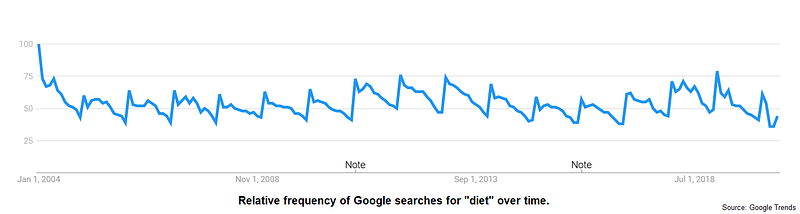
Healthy eating’s benefits extend beyond vanity, though a quick look at the relative frequency of Google searches with the word “diet” over time suggests it’s a primary concern for many — at least for the better part of January and April.
Nutritious diets lower one’s risk of chronic disease; epidemics like obesity (shared by over one in three Americans), heart disease, and type 2 diabetes are often exacerbated by poor nutrition. Cognitively, nutritious diets offer pronounced benefits. Researchers commonly claim that the Flynn Effect, the substantial and continued increase in absolute human intelligence scores observed since the 20th century, is in no small part explained by advances in increasing access to nutritious diets. This effect is ongoing and on average more pronounced in less-prosperous parts of the world, suggesting diminishing returns but substantial room for improvement nonetheless. Studies show massive gains across the world in performance on standardized intelligence tests; for example, Japan showed average gains of 7.7 IQ points per decade from 1940–1965, a period including rapid economic development. These widely observed leaps in average IQ suggest there’s considerable public benefit to increasing nutrition standards and access to healthy foods.
Behaviorally, healthy eating also presents significant benefits. A 2014 study by Dr. Bernard Gesch observed young prisoners’ diets, finding that most prisons gear their eating regimens to promote cardiovascular health rather than optimal brain function. After reintroducing key nutrients into select prisoners’ diets, he observed a staggering 26.3% decline in offenses committed by them, declining still another 11% after 2 weeks. A replicated study by the Dutch Ministry of Justice observed an even-more-impressive 48% decline.
The United States is, by a substantial margin, the world leader in incarcerated populations. At 655 incarcerated people per 100,000, the United States boasts Gold over El Salvador’s Silver (618 per 100,000) and Rwanda’s Bronze (464 per 100,000). This epidemic of mass incarceration produces a crippling effect on disproportionately low-income, minority communities that has been an ongoing subject of intense debate as the United States’ incarcerated population has shot up by over 500% during the past 40 years. But if poor nutrition can mean the difference between incarceration and civic society for some potentially significant portion of the population, it’s worth considering why so many Americans, living in such a prosperous nation, are still so nutritionally deficient.
Nutritional Inequality
The burden of poor nutrition is not evenly carried, as one might expect. Households from the top quartile of the income distribution buy groceries that are over half a standard deviation healthier than households from the bottom quartile (as measured by the Healthy Eating Index). Moreover, large supermarkets with healthy food options are more densely concentrated in high income neighborhoods while drug and convenience stores without such options are more densely concentrated in low income neighborhoods. This suggests that by addressing these disparities, we can begin to root out unequal educational outcomes, healthcare costs, and crime rates, problems that calcify existing class immobility.
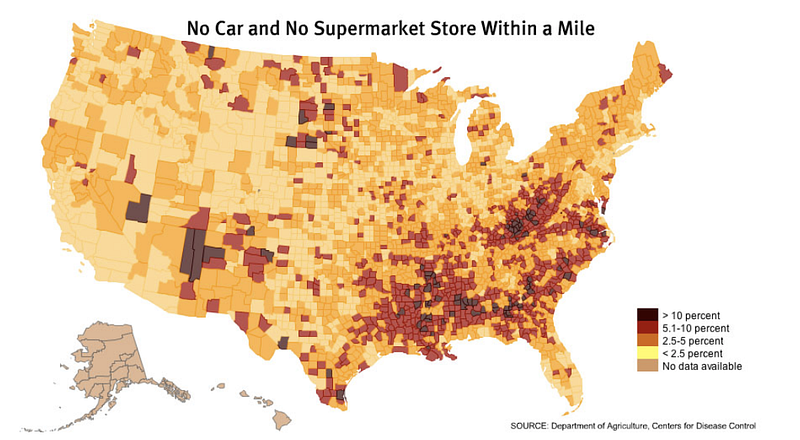
Interestingly, however, research published in Oxford’s Quarterly Journal of Economics last year estimates that exposing lower-income families to the same products and prices as high-income families would equalize only 10% of the nutrition gap, indicating 90% of the difference comes from the demand side (household income, education level, knowledge of nutrition) and complicating the appealing but overly-simplistic food desert hypothesis. The reality is that most families are willing to drive farther distances for groceries than this explanation would require, though time and money spent on transportation does exacerbate wealth inequality on the margins. While increasing access to nutritious foods is important in addressing nutritional inequality, broader interventions that are mindful of intersecting issues like income, educational inequality, and, perhaps most-importantly, food-insecurity, are still more important.
Food Insecurity
Many families experience, whether chronically or intermittently, experience some form of food insecurity, defined by the USDA as “a lack of consistent access to enough food for an active, healthy life”. In the United States in 2016, roughly 28.3 million adults (11.5%) and 12.9 million children (17.5%) lived in food insecure households.
The stakes are high. Food insecure adults are more likely to suffer from chronic diseases like cancer, diabetes, and coronary heart disease. They’re also more at risk of being forced to stretch their budgets in unhealthy ways like rationing prescription drugs, postponing necessary medical care, diluting infant formula, and, as one would expect, purchasing cheap, high-energy but low-nutrient foods. Further research has shown that food insecurity is associated with lower nutrient intake and lower frequency of fat-reducing behaviors.
Even in the mildest of cases, food insecurity significantly predicts how often a child will get sick, how quickly they will recover from that illness, and how frequently they will have to be hospitalized. It predicts that child’s ability to focus and do well in school, and how severe their behavioral and emotional problems can be. Not only does food insecurity in kids lead to between 2 and 4 times as many health problems and suffering academic performance, but children born to food-insecure women are more likely to be low birthweight and delivered preterm, with additional risk for gestational diabetes. Unfortunately, they don’t make bootstraps sturdy or small enough for prenatal poverty.
The Policy Approach
Policymakers have attempted for some time to address food insecurity and encourage better health outcomes in low-income communities, implementing stabilizers like the Supplemental Nutrition Assistance Program (SNAP) and positive health incentives like the Food Insecurity Nutrition Incentive Grant Program (FINI). Despite estimates showing that SNAP helps approximately 40 million low-income families afford adequately nutritious diets every month, the program has come under fire during the Trump Administration.
In 2019, the Department of Agriculture (USDA) proposed ending what they describe as an enrollment “loophole,” by which households already enrolled in programs like Temporary Assistance for Needy Families (TANF) are automatically eligible for SNAP benefits, thereby bypassing an existing form of means testing that places upper limits on the household’s savings. A concept known as “categorical eligibility” also qualifies households that receive SNAP benefits for free or reduced-price school lunches.The proposed cut would move 3.1 million beneficiaries off of the program, a move that would prove devastating for vulnerable communities.

Critics of categorical eligibility cite welfare fraud and abuse as the rationale, typically citing the case of Rob Undersander, a Minnesota millionaire who was able to enroll in the program. While his case serves as polemical fodder, Undersander is not representative of the program broadly; roughly 92% of benefits paid out through SNAP go to families below the poverty line (the cutoff for enrollment is 130% of the poverty line) and SNAP is cited as one of the assistance programs that’s most effective at generating economic stimulus in times of hardship. In December of last year, the USDA finalized a rule preventing states from allowing work-eligible adults without dependents to claim SNAP benefits. The USDA estimated 688,000 individuals would lose benefits from this change, which the administration moved forward with on April 1st, amidst the COVID-19 pandemic that has produced more than 30 million initial unemployment claims.
Still, there inevitably exists a vocal voting block, critical of social spending of nearly any type, that would be happy to see such a program go. The inevitable harm done by failing to address these disparities, however, is the core reason why the conversation is best framed as cost-saving preventative care rather than confiscatory redistribution. Left unsolved, society will bear these costs eventually in one form or another. Combined with the stimulative effect of increasing the incomes of low earners, who have a high propensity to spend any new additional funds they can get, this is why the USDA found that the multiplier effect of SNAP spending is 1.73. That is to say, for every $1 spent on SNAP, the economy grows by $1.73.
The benefits of SNAP spending extend beyond simple Keynesian stimulus, serving additionally as a cost-abatement for America’s exorbitantly expensive healthcare system, which spends more than twice as much per capita as many economically comparable nations. While Americans don’t appear to be outliers in how much healthcare they choose (or often, are forced by circumstance) to spend their money on, there are billions to be saved in improving health outcomes through nutrition and food security.
Diseases associated with poor nutrition and food insecurity lead to a lower quality of life and an average of $1,800 in additional medical expenses by food insecure Americans every year; that’s $77.5 billion in annual added health care costs nationally, incurred most often by the communities that can least afford it. These direct costs produce wider and greater economic costs to the tune of $160 billion nation-wide. Whether one believes taxation is theft somehow seems irrelevant when comparing the shared costs of poor nutrition and food insecurity to the $11 billion price tag (15% of the SNAP budget) on a subsidy that would allow for nutritional parity between low and high income households.

Conclusion
Weighed against the social injustice of cyclical poverty and inequality, an ounce of prevention in public policy is worth a pound of cure in criminal justice infrastructure, healthcare expenditures, and outreach programs. These patchwork solutions are not only costly while failing to address the root causes of many of the social ills they claim to treat, but also completely fail to account for the irrecuperable losses in human potential that otherwise talented and promising children may have realized under a more equitable system.
There’s certainly a structural component when it comes to cost-cutting in both public and private prisons, the latter having far more of an incentive not to support, or to lobby against, innovations that may curtail the flow of new prisoners (from which they derive their revenue) or contribute to behaviorally-adjusted sentence reductions. Indeed, any social programs that threaten to expand nutritious food access to low-income communities come at the cost of America’s robust, $5 billion/year private prison industry, which grew in prisoners five times faster than the total prison population between 2000 and 2016.
One need not be morally concerned with structural inequities or feel empathy for the less fortunate to see the personal benefits that come from increasing access to nutritious foods, though. Left unattended to, just as in the case of poor diets, these inequalities will only deepen in severity and cost to society at large, slowing growth, increasing social turmoil, and stratifying society in a way that sets the stage for political opportunists to seize on the fears and frustrations of those whom public policy has left behind.
Misers may drag their feet, insisting against the boogeyman of an unjust, zero-sum tax and spend scheme, but if placated, will never witness the selfish benefits of modest social spending. Moreover, which society is more unjust: one in which children born in poverty suffer from compounding, inexorable, intergenerational disadvantages, or one in which everyone benefits from chipping in to level the playing field?
In an era defined increasingly by outsized attention to the national debate stage and disproportionate amplification of particularly extreme voices online, it can be convenient to focus on attention-grabbing policy packages that stretch the limits of imagination, gaining the attention of voices eager for radical change but constraining the path to passage in a gridlocked legislature. What is true as ever is that even comparatively humble proposals, provided they target deeper, underlying inequalities, can produce ripple effects that mitigate tremendous human suffering.
A policy like SNAP expansion, that targets nutritional inequality and food insecurity, helps society’s least fortunate stand a fighting chance at competing in a dynamic economy and begins to chip away at the conditions that have left so many feeling outside generations of growth. By no means is it a silver bullet answer to society’s problems, but for a nation so deeply pained by class stratification, it seems a no-brainer to try. In the case of addressing nutritional inequality, the choice between personal financial freedom and public policy seems largely to be a false one. That is to say, we can redistribute some cake and eat it too.