
NuScale SMR Gets Regulatory Approval. But Can The Future Of Nuclear Power Live Up To The Hype?
All is not quite as it seems.
Small Modular Reactors (SMRs) have been hailed as the future of nuclear power. In theory, they are more compact, cheaper, faster to build, better at producing low-cost energy, and safer than traditional nuclear power plants, while still having insanely low carbon emissions. But, as is always the case with these things, reality never quite matches up with theory, given that it turns out actually developing an SMR that meets these desired characteristics while still being sound enough to pass governmental scrutiny is damn near impossible. Despite this, NuScale’s SMR just became the first SMR ever to get US government approval, making the world of SMRs finally possible. But is there a catch?
Before we dive into NuScale’s SMR, let’s first recap what an SMR is and how it achieves these brilliant properties.
A regular Light Water Reactor (LWR) nuclear power plant is made of several giant reactors. These atomic behemoths are so vast that they need to be painstakingly constructed onsite with incredibly high precision. This not only makes construction prohibitively expensive but is also an extremely lengthy process. What’s more, because each reactor contains a large amount of nuclear fuel, there is always the risk of a gigantic nuclear failure occurring due to a single man-made or technical error (although, admittedly, the chances of this happening are practically zero).
In comparison, SMRs are comprised of multiple smaller reactors, all working together. Their tiny size means they can be constructed offsite in a specialised factory and then shipped to the power plant’s location. Not only does this reduce construction time dramatically, but thanks to the economies of scale — where companies experience cost advantages due to the efficiency of mass production — the price of the reactors should be significantly lower than those of LWRs. Each reactor also works as its own individual unit and contains far less nuclear fuel than a typical reactor. This means that if there were to be some kind of nuclear mishap, it would be on a much smaller scale and, therefore, be less of a threat to people and wildlife in the surrounding area.
Unfortunately, you can’t just shrink our current reactor designs down to create SMRs, as the technology would malfunction. Instead, SMRs require unique architecture, fresh layouts, and sometimes even specific kinds of high-enrichment nuclear fuel to operate.
Fortunately, NuScale was able to create a design that closely resembles today’s LWR reactors, which not only makes it easier to train personnel who likely have previous experience operating LWRs but also means there are fewer barriers to their SMRs getting regulatory approval, given that no new technology (which requires extensive testing to prove its functionality) is required.
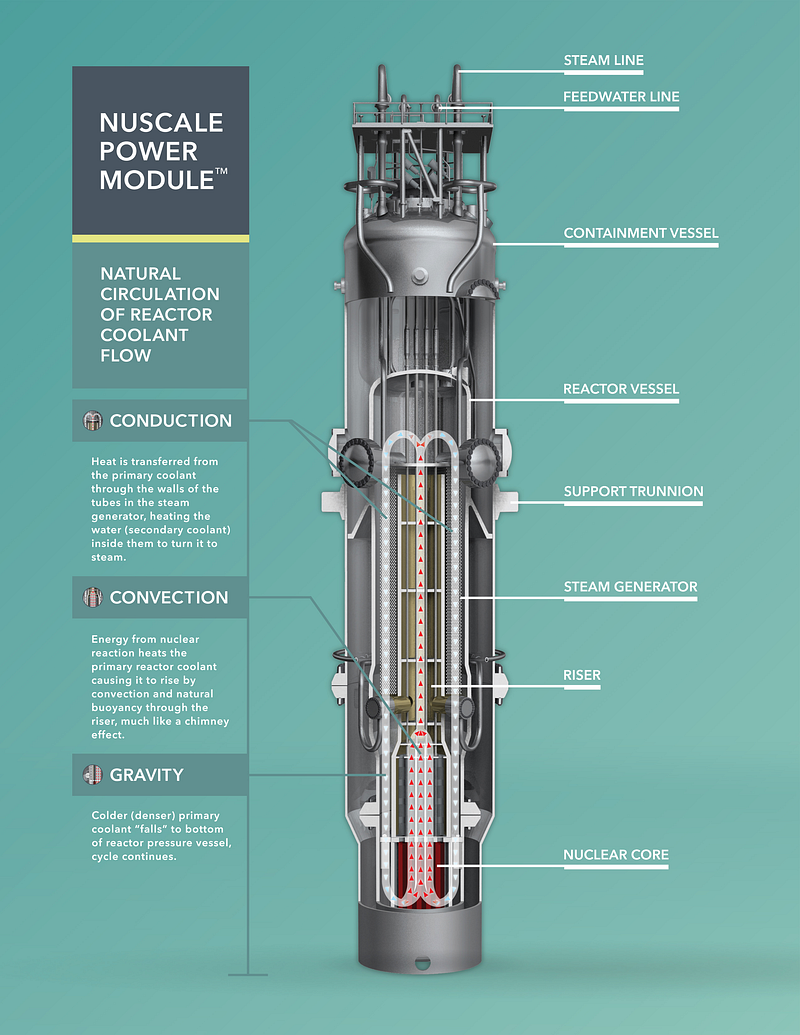
NuScale’s design looks like a tower. At the base of the reactor resides nuclear fuel, which undergoes controlled fission and heats up the water within the base until it boils and turns into steam. Due to the building pressure, this steam then shoots into the upper part of the tower via a steam turbine, which spins and generates electricity. At the top, the steam cools, condenses into water again, and flows back down to the base, ready to be boiled into steam for a second time. To enable the cooling process to work, the entire reactor tower must be submerged in a vat of cold water. The vat and the SMRs within it are also encased in a heavily reinforced building that is capable of containing the resulting nuclear pollutants should anything go wrong.
Overall, this design is utterly genius. It is incredibly compact, at only 1% the size of a conventional reactor; it manages to use regular, 5% enrichment nuclear fuel, which is great for NuScale given that fuels with higher enrichments are both more tightly regulated and more expensive than those with lower enrichments; it only needs to be refuelled every two years, which is standard for nuclear reactors); and it has all the necessary safety features built in.
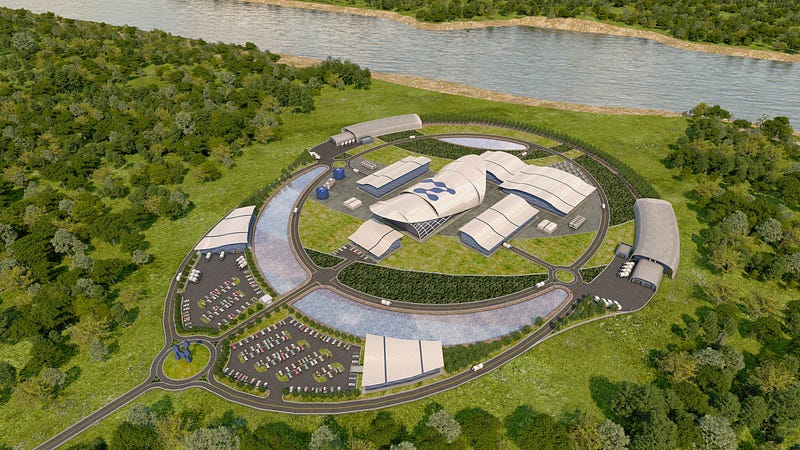
So it was no surprise that on January 1, 2023, NuScale was granted approval by the US Nuclear Regulatory Commission (NRC) for its VOYGR-6 SMR power plant design. As the name implies, VOYGR-6 uses six of NuScale’s SMRs, giving it a total output of 462 MWe, or about half the average output for a nuclear plant. However, don’t forget that this design is modular, meaning that NuScale still has plans for a VOYGR-12 with twice the number of reactors and twice the output, which is also likely to get approval soon, given that it uses a nearly identical power plant design.
Furthermore, the Department of Energy (DoE) is currently working with Utah Associated Municipal Power Systems (UAMPS) and the Carbon Free Power Project (CFPP) to set up a functional NuScale VOYGR-6 plant at the Idaho National Laboratory. With this latest NRC approval, work will soon begin on the site, and the benefits of SMRs can finally be demonstrated on a commercial scale!
Right?
Well, yes and no. NuScale will likely show the world how fast, flexible, and safe SMRs can be, but their design still isn’t perfect. When NuScale began working on the construction of their SMRs, they estimated that the cost per MWh of energy from a VOYGR plant would be around $50. This would make it slightly more expensive than solar or wind power but far cheaper than current nuclear power, which costs around $97 per MWh. However, as NuScale’s SMR project underwent development, the cost steadily rose. Now they are predicting it will cost $89 per MWh.
This gigantic price increase means that while NuScale might be the first SMRs sent to market, they also have undone one of the technology’s key benefits. Half the reason people are so excited about the development of SMRs is because these reactors should, in theory, offer a significantly lower cost of energy and, in doing so, help kickstart a nuclear power renaissance. But NuScale’s rapidly snowballing price has missed that mark. After all, why would you use SMRs if they are going to cost the same amount as regular LWRs?
But does that mean the SMR dream is dead? Not quite. As I explained in my Holtec SMR-160 article (read it here), one of the most significant hurdles nuclear power faces is the sky-high initial costs and lengthy construction times of building nuclear plants. This is why very few new nuclear reactors are under development, despite the fact that they have lower carbon emissions per kWh than solar. So while NuScale can’t lower the price of nuclear energy, they can solve this crucial problem and allow nuclear to expand and finally become the climate-saving technology it deserves to be.
So I guess I’m saying, watch this space — NuScale’s SMR isn’t perfect, but it could still be the thing to revolutionise nuclear power and save the world.
Enjoyed this article? Then check out my latest book, “50 Ways To Save The World,” on Amazon here or my YouTube channel here!


