
Now is the Time to End Racism in Environmental Education
A re-evaluation of the field

For years now, many environmental and outdoor education organizations have made commitments to fostering equitable, inclusive, and culturally understanding workplaces. This movement comes from various study sources that point towards the workforce of environmental educators being predominantly white.
These commitments may seem like a step in the right direction. However, in the wake of recent police killings, protests, and civil unrest — it’s time for organizations to re-evaluate their supposed equitable and inclusive work environments.
Perspectives from the field
A 2019 study from the Lawrence Hall of Science at the University of California, Berkeley in collaboration with Youth Outside found a stark contrast in equitable and inclusive workplace perceptions and expectations between environmental education organization leaders and environmental educators of color.
The study consisted of a survey done of 51 organization leaders across the United States and through focus group interviews of 26 participants who self-identified as an environmental educator and a person of color.
When asked about what equity, diversity, and inclusion mean in the workplace, the organization leaders and educators had differing thoughts. Organization leaders focused on accessibility for everyone and implementing a safe and welcoming environment where individual differences are respected. Educators focused on understanding and answering to systemic oppression, sharing narratives, and exploring the “intersectionality of identity.”

Many organization leaders cited that equity, inclusion, and diversity was a recurrent topic in their field. However, upon further analysis, many of the structures put in place to address these topics are not done so meaningfully. Educators state that when equity, inclusion, and diversity are addressed — they are doing so for the benefits of the participants in the environmental education programs and are not being addressed for the employees in the workplace. After all, it’s easy to push an initiative to recruit more employees of color for the benefit of your learners, but this doesn’t address the equity and inclusivity for the employees themselves.
Educators of color have had positive experiences in their profession, but many feel as if they can’t bring who they are to the workplace and must consistently handle “white fragility.” When the educators raised these issues, they were often met with backlash statements such as they are “making people uncomfortable.”
Perhaps the most powerful and poignant words from the field come from the educators themselves with accounts such as:
“[Diversity, equity, and inclusion is] this white-savior complex that is… really creating a separatist movement where there is still a form of “other”… [People of color] are still an “other” and [white leaders] still have dominance… [Diversity, equity, and inclusion] always come from the top down… They are never from the grassroots… or from the community.”
–Focus group participant
Or those educators who contemplate leaving the field:
“I feel like, for me, I’ve only been doing environmental education for two years and I’m over it, I don’t want to do it anymore… I feel like my job would have been ideal if I didn’t feel so marginalized in the space. I feel like I have two jobs: I feel like I have to go do my job and also exist in a really really white space… I’m the only black male on staff… I’ve been a professional for a long time, [and then] I started working in environmental education and it is the most racist space I’ve ever been in my life. Oh my gosh, it’s just like so much work to be done. Racist burnout is real.”
–Focus group participant
While these sentiments may not reflect every organization, it’s clear that many environmental educational organizations still have a way to go to be truly equitable and inclusive. Now is the time to take in this information, recognize what hasn’t been done right, and candidly take action
Standing up now and forever
Organizations need to take a clear stance against the racism of people of color. Statements should be honest, unifying, and followed up with action.
The University of Southern California’s Race and Equity Center recently held a National Forum on Demonstrating Care for Black Employees.
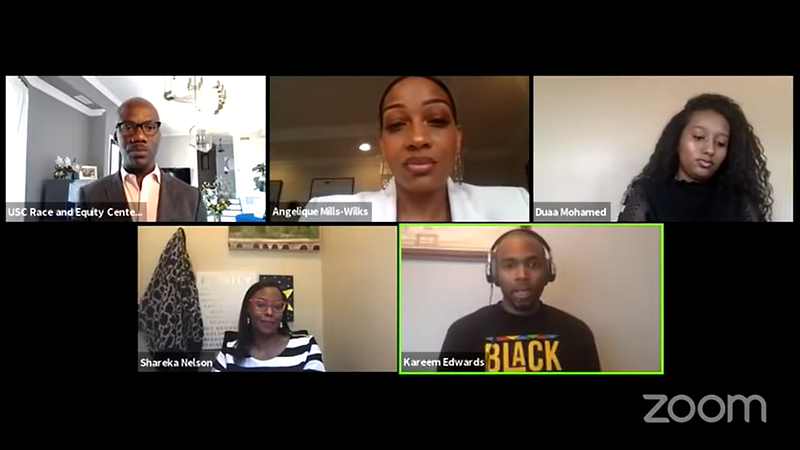
In this forum, employees of color from an array of disciplines shared their thoughts on how organizations can help show compassion and forethought during these times of social injustice. These ideas are an excellent starting point for not just environmental educators, but all organizations to seriously consider what it means to be truly equitable and inclusive in the workplace environment.
One point discussed during the forum is that statements from organizations are great, but what is needed now more than ever is action in a timely manner. Organizations cannot and shouldn’t expect their black professionals to “take on the labor of sharing their experience.” Stories can be told, but don’t assume your employees of color want to relive any trauma.
These conversations and energy to abolish racism not only need to happen today, or this week, or this month, they need to happen forever. Thinking of these kinds of things throughout the future is the only way to make long-lasting change. Often diversity, equity, and inclusion are scheduled towards the end of a companies meeting and are usually forgotten about when the meeting runs out of time. Instead, this topic needs to be at the top priority of the meeting agenda and followed through on consistently.
The biggest take away is that instead of pity and passiveness, our black colleagues need action. Organizations will need to re-evaluate their current practices to make sure we truly are fostering that equitable and inclusive environment we were striving for, but likely never acted upon. Do the research, make the appropriate action plans, and cultivate an affirming space for employees of color.
Important Resources:
- Examining Equitable and Inclusive Work Environments in Environmental Education from Lawrence Hall of Science and Youth Outside
- Building a Multi-Ethnic, Inclusive & Antiracist Organization from Safehouse Progressive Alliance for Nonviolence
- Diversity — The Dangerous 9-Letter Umbrella from Youth Outside
- Large list of resources about Equity, Inclusion, and Cultural Relevance in Outdoor Science and Environmental Movements by jforeman