
Nothing Will Ever Truly Change
Unless we move towards a social system not centered on violent domination

We’ve certainly come a long way since the 1960s. That was a time when racial inequality was just a given, supported by both laws and custom. Women were also looked upon as inferior, not capable of handling their own financial affairs well enough to get a credit card or a home loan in their own name. They weren’t considered intelligent enough to be worthy of attending Ivy League colleges. Homosexuality was considered not only immoral but a form of mental illness.
We’ve made a lot of progress around equality since the time when all of those beliefs were widely held, but there are also many places where equality has stalled, and glaring examples of oppression and discrimination continue. Some might say, “Well, it’s only been about 60 years. These things take time.” However, I think the primary issue is not time, but the fact that a truly egalitarian culture is antithetical to the sort of social system that we live in — one which is based on a patriarchal dominance hierarchy. There is only so much progress that can be made without dismantling a lot of the elements of our culture, where social stratification is not only ubiquitous but a key element of how it is designed.
A dominance hierarchy (which is what patriarchy actually is, not just a dynamic between men and women) is about maintaining traditional power through displays of aggression, coercion, and artificial barriers to true competition. Police brutality is a symptom of living in this sort of system, as is sexual harassment and violence against gay and trans people. Those are all examples of using violence to dominate others who are seen to be lower down the pecking order.
Our social system revolves around clawing your way to as high in the pecking order as you can get, by any means necessary, including violently holding other people down or erecting barriers to them being able to compete — all the while telling yourself that you’ve earned your place fair and square. This is how a dominance-based hierarchy functions and it dovetails nicely with the rather brutal brand of capitalism that is practiced here in the US. It’s the complete antithesis of a merit-based system, and it requires an underclass to support the base of the pyramid of power and privilege. Without underclasses, there is no apex — a large part of why a flatter playing field feels disruptive. People aspiring to the top of the pyramid understand this, albeit largely subconsciously.
Hierarchy itself isn’t the problem. That word simply means a system or organization in which people or groups are ranked one above the other according to status or authority. How that status or authority is conveyed is the issue. Not everyone has the same skill or is equally capable of the same achievements, and we don’t need to live in a world where everyone has equal say about everything, but a dominance-based hierarchy isn’t a good way to reconcile that. We can still support excellence at the same time that we support basic human dignity.
In a patriarchal dominance hierarchy, rankings and status are often artificial, based on immutable traits like gender, race, and sexuality, or in life situations that confer inherent disadvantages right from the start, such as being born into poverty. It’s also maintained through a kind of might makes right ethos that justifies and even approves of ruthlessness in order to rise in the pecking order.
In the face of that, racial, gender, sexual, or other kinds of equality can never be achieved, because that is so deeply incompatible with the framework that our society is built on — one of violent domination of others in order to achieve power and position. This is something that our nation knows well, and believes in at its core. Manifest Destiny, the 19th-century cultural belief that America had not only a right but a duty to settle, annex, and claim all the land in the West (no matter who else was already on it) was a reflection of this sort of mindset. Might Makes Right and the fittest, i.e., the most ruthless survive. (Interestingly, actual evolutionary fitness refers to who is the most adaptable in any given environment, not who is the tallest, strongest, or most cold-blooded.)
The United States was founded by and for the interests of white men, who for the first hundred years were the only ones allowed to vote, and even when Black men were ostensibly granted voting rights in 1870, these were effectively curtailed through things such as poll taxes and literacy requirements. Women didn’t gain the vote until another 50 years after that. This is a hologram of the larger cultural context.
Even with all the social progress that we’ve made, white men are still considered the normative citizen, because they still sit at the top of the dominance hierarchy. Not all white men sit at the tippy top to be sure. Wealth, prestige, heterosexuality, being a Christian — those are the things that automatically bump up your status, but nonetheless, others with less rarified position still benefit from the historical as well as current dominance of white men in all areas of American society.
If aliens were to try to learn about our country through our media, including news broadcasts, they would conclude that white men make up the vast majority of our citizenry, rather than the 30% of the population that they do. A lot of “white male identity politics” has gone into keeping things that way. White women would prefer to keep their slot closer to the apex of the dominance hierarchy as well, even if only through their association with white men. Unlike any other demographic of women, white women overwhelmingly vote for the interests of the men in their lives over their own personal interests.
Black men often flex their dominance hierarchy muscles at Black women, one of the few demographics who is lower than they are in the stratification pyramid. Feeling better by making someone else feel worse is one of the hallmarks of this kind of social hierarchy. It’s a zero-sum game, where if you don’t win, you lose. In order to win, somebody else has to be put in their place, lower down the hierarchy than you are. This is not a social system conducive to equality.
As long as we have a culture that is steeped in these sorts of beliefs, it is going to be impossible to ever have anything approaching a level playing field. We can have sexual harassment and diversity, inclusion, and equity (DIE) training up one side and down the other but it will never make the kind of impact that is truly needed unless we first address the prevalent and often subconscious belief in a stratified system — one where someone else needs to lose in order for you to win.
That is the ocean that we have all grown up in and continue to swim in. The fears that this system might be challenged or truly flattened out was a huge driving factor in the election of Donald Trump, a man with little to actually offer the electorate other than a promise of a return to a time when this dominance-based patriarchal hierarchy was again in place. Millions of people jumped at that chance, and Trump was declared “the chosen one of God.”
In this system, we must have a pyramid-shaped dynamic, with a few elites at the top and a broad base of lower-status people whose main function is to support and prop up the apex. Since this hierarchy is a zero-sum construct, where if you don’t win, you lose, it’s difficult for many people to view others gaining rights as anything other than a loss of some kind to them. A more interdependent hierarchy rocks the boat. “Hey, what happened to our pyramid?”
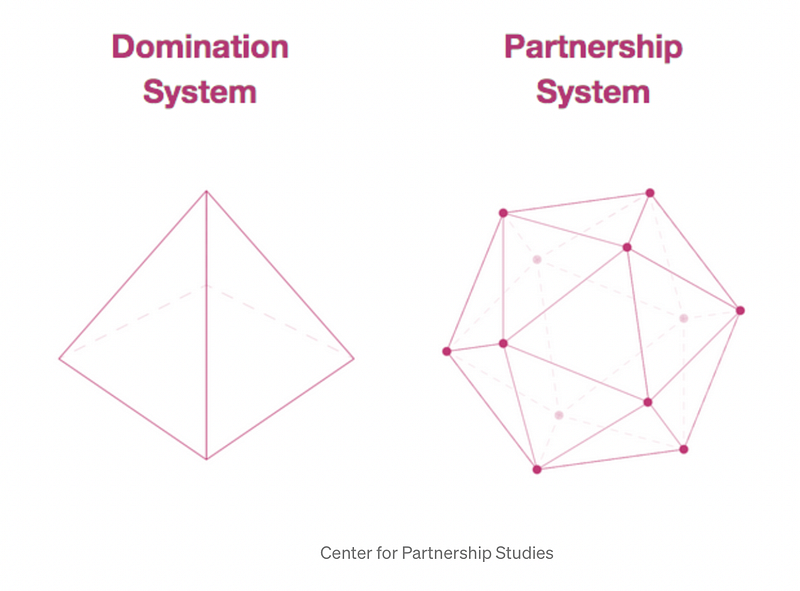
Most people have probably been in very few structured situations that didn’t involve some type of hierarchy of domination — from the playground bully to the overbearing father to the narcissistic boss. You do what you are told to by the people above you, or you suffer the consequences. But hierarchies of domination aren’t the only kind of hierarchies or the only kind of leadership. Nor are they the only way to be in relationship with others. The establishment of some kind of pecking order is not necessary in order for society to function.
Hierarchies of actualization are employed in partnership-oriented structures to create cohesion and order in a way that is not based on intimidation or for the purposes of maintaining top-down rankings. This allows people to emotionally invest in a way that they cannot when they are treated as merely a cog in the wheel or a functionary to be bossed around by someone with more authority.
“Egalitarian and equitable adult relations are the norm. Parenting is not authoritarian but authoritative. Beliefs and stories present empathic, mutually beneficial, nonviolent relations as normal, moral, and desirable.” This is in contrast to the domination stories that “justify and idealize domination and violence, which are deemed inevitable, moral, and desirable.” Such is the case in the state, the family and the workplace, as well as all other aspects of society. The Center for Partnership Studies
This type of organizational dynamic is already taking place in some business, organizational, and cultural contexts, as well as in some families. Denmark, the world’s 36th largest economy, teaches many elements of a partnership-oriented model in school, as a way to improve empathy, but also as a business and managerial skill.
In slower moving and less complex business environments the old hierarchical model that depended mostly on only a few people at the top for leadership simply doesn’t work anymore. In today’s more volatile, uncertain and ambiguous business battlefield, decentralized controls and leadership through networks of people at all levels is imperative for success.
The US could move more fully in this direction, but it would be a long process simply because so much of our culture is deeply steeped in beliefs that are diametrically opposite. We are taught from a young age to compete against our peers rather than against ourselves and to constantly rank ourselves in relation to those around us. It’s a large part of what drives our economy — this keeping up with the Joneses outlook.
Shifting away from that will be no small task, but until we get serious about at least trying to do so, gross inequity, discrimination, and artificial barriers to opportunity will continue. They cannot begin to be adequately addressed while so many people subconsciously feel that there is only win/lose and that win-win social scenarios cannot exist.
© Copyright Elle Beau 2021


