AL FRESCO PROMPT RESPONSE
Nothing Cosy Or Romantic About This Campfire
It wasn’t the holiday season and we weren’t on holiday
In an article called “Tell me a camping story,” Ellie Jacobson opened with this quote:
“Wherever you camp in the world, the campfire will be one of the things that sticks in your memory the most!” ― Mehmet Murat ildan
Oh boy!! That campfire! Yes, it’s seared indelibly onto my memory.
One autumn night in 1987, I was in a small caravan with my spouse and youngest son, parked in a corner of an otherwise deserted campsite near the coast. I won’t go into why, I covered that here:
It had all been rather last minute, but we had managed to secure a new gas bottle so that the caravan could provide cooking facilities. For lighting, we had a lacklustre torch and a small gas lamp. Other than that, we only had the glow from our radio. The moon was waning. We were out of range of any street lights.
We’d arrived late that day, and by the time we had set things up and got settled, our isolated field corner was pitch black. It was the night of the great storm, not that we knew it at the time. Indeed most people had no idea what was on its way. Although the Met Office saw fit to warn the Ministry of Defence in advance that “the anticipated consequences of the storm are such that civil authorities might need to call on assistance from the military,” no one warned the public.
However, in our relatively sheltered corner, it was not the storm that made that night memorable for us.
We had borrowed the caravan from a friend who had just had it serviced. It had been declared in good order except for the fridge, which had been disconnected from the gas supply because it was not working. Fair enough, we thought, and we used it as a cupboard.
We didn’t realise that the man who called himself a “caravan service engineer” (a term we have used ever since to denote delinquent idiocy) had not turned the tap to prevent gas from getting to the fridge. Instead, he had simply pulled the gas pipe off the bottom of the fridge. This meant that while we were cooking, gas was leaking unrestricted from a hidden pipe.
None of us noticed a smell of gas, but all the time the gas bottle was turned on, gas (heavier than air) was leaking out under the fridge and creating a sea of gas at ground level.
We were more or less sorted for the night. Everything was packed away, the awning secure against the ever-strengthening winds. We were having a last cup of tea before turning off the gas bottle and settling down to sleep. While we still had light from the unenthusiastic torch, I decided to change the mantle on the gas light so that we would have at least one efficient means of lighting should we need it.
As I removed the old mantle, a fragment broke off and floated towards the floor. It was hot enough to ignite the sea of gas that had accumulated.
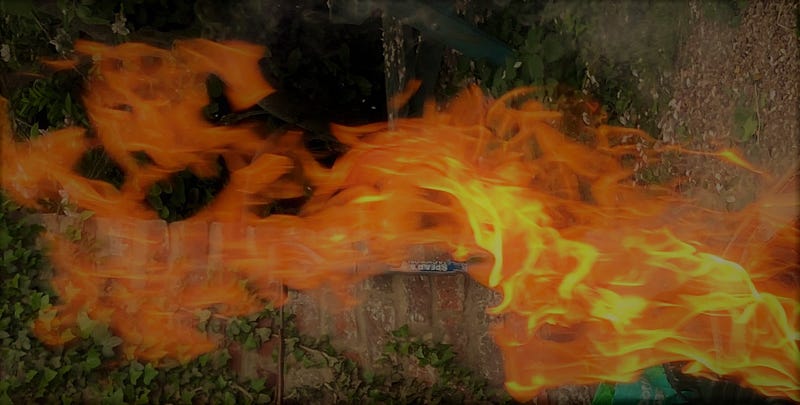
A swooshing sound! And in one heart-stopping flash, we were up to our knees in flames. They came from nowhere and lit up every corner of the caravan.
Son — about 10 years old — was sitting up in bed drinking tea. The spouse, who has always had a talent for quick thinking in a crisis, kicked open the door, swept up Son, bedding, and tea all in one movement, and hurled him out into the night.
With a similar instinct, Son’s first reaction was to throw his tea at the flames. My abiding memory of that night is an image of Son, in sitting position wrapped in his bedding, startled expression on his face, in the act of throwing tea, but in midair and sailing backwards through the caravan door.
I dived after him to scramble around the back of the vehicle to turn off the gas bottle while Spouse — who had seen a caravan fire before — beat down the flames while throwing out everything he could get his hands on. I’ve since seen a caravan fire and understand more about how they work. The initial flash fire was not at inferno heat — none of us suffered burns despite being partly engulfed in flames — but it only needed to catch onto something else and everything would have gone up. One sheet or towel, a box, a bit of paper, an article of clothing. It can take no more than seconds before the fire takes hold and the whole vehicle is engulfed. I don’t think that can be the case today — at least I hope there are some robust regulations in place about how caravans are built — but in the 1980s they could be fire traps.
While Spouse fought to beat down the flames and empty out anything that might be flammable, I don’t have a coherent memory of what Son and I did. There was no room inside for more than one firefighter. I think we pulled stuff away from the door, and got it outside the awning in case the worst happened. We dragged the water carrier from the car. And I remember thinking about going for help — no mobile phones back then — it would mean a scramble across dark fields at night to try to find a house with a phone. I quickly dismissed the idea. If the caravan was going to catch, it would be ash before I could get to a phone.
Spouse saved the day and the caravan. There was nothing left of our neatly packed away belongings — leastways not the neat bit. Our belongings survived but were scattered across a dark field. We gathered them in as best we could, and completed the search and rescue in the morning when we could see what we were doing.
Once the last vestiges of fire had been crushed, we found the gas pipe flapping free and realised what the delinquent idiot had meant by “disconnected from the gas supply”. We could all have done with a cup of tea by then, but no one was inclined to risk the gas until we’d checked it in daylight, so we just went to bed.
I remember waking that night to feel the caravan rocking in the wind. But it wasn’t thoughts of being blown over that worried me, it was the sound of low voices. There were people close by — in the field. No other campers were expected. It wasn’t the holiday season. We were there by special arrangement and, we hoped, temporarily. It was unsettling because the storm was raging by then and who creeps around an isolated field at night in a storm?
I mentioned it in the morning. Spouse said that yes, he thought he’d heard something too. It was when I ventured outside that I realised I could still hear people talking. Close by — too close not to be able to see them. Yet we were on our own in the middle of a field! Then I realised.
I followed the sound of the voices, just as they stopped talking and began to sing. It was the radio. Hurled free of the caravan along with everything else, it had lain forgotten in the grass all night.
All in all, it was one of those occasions where, in starting a new chapter of our lives, we hoped we’d got the worst of it over with and weren’t starting the way we meant to go on.
The campfire will be one of the things that sticks in your memory the most!
Yes, you can say that again!


