
Notes on Revisiting “Saved by the Bell” in My Mid-Thirties
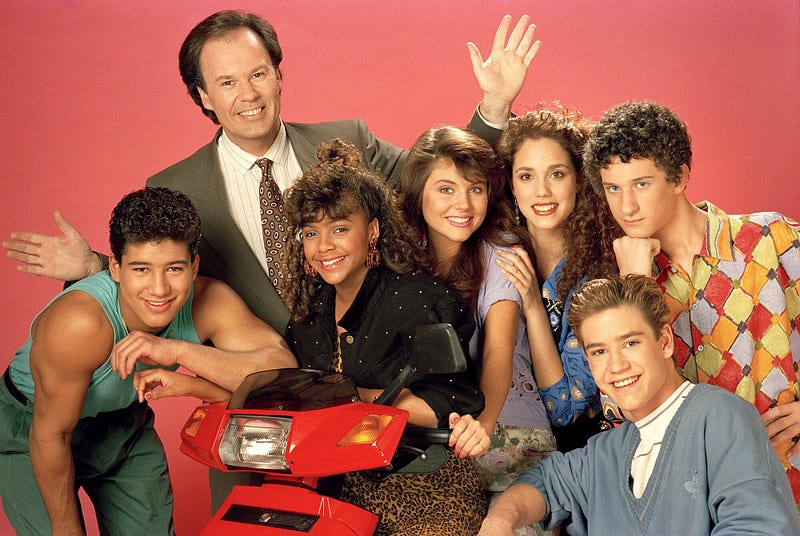
A sequel to the iconic Saturday morning sitcom Saved by the Bell, which centered on the antics of preppy schemer Zack Morris and his friends at Bayside High, launches this coming Wednesday on NBC/Universal’s new streaming platform Peacock. In preparation (and out of a desperate need for comfort and nostalgia during the pandemic) I rewatched the entirety of the original series this year. As it turns out, revisiting a childhood obsession after 25 years is a wild and thought-provoking ride.
I spent nearly 48 hours rewatching the entirety of Saved by the Bell in 2020. Why on earth would a 36-year-old man subject himself to this, you ask?
Well it was a combination of four factors. First, I was primed for some Saved by the Bell nostalgia during my epic summer 2018 visit to the delightfully clever West Hollywood pop up restaurant devoted to it (Saved by the Max). Second, there was the intriguing news in fall 2019 that a sequel to the series was going to be a flagship component of NBC/Universal’s new streaming service Peacock. (The fact that it had a ridiculously clever premise and was created by Emmy-winning 30 Rock writer Tracey Wigfield gave me hope that it could actually be watchable). The other two factors were mere happenstance. I impulsively bought the collection of the entire series when it was discounted to $19.99 on iTunes (that’s only 16 cents per episode!). Finally, and perhaps most importantly, the pandemic hit and I found myself with lots of time on my hands and very few mental and emotional resources to devote to entertainment. So something that was familiar, nostalgic, and mindless was exactly what I needed.
Read about my visit to Saved by the Max and the strange history of Saved by the Bell here.
Over the course of 9 months I watched Good Morning Miss Bliss (the initial version of the series with Hayley Mills that aired on the Disney Channel), the five seasons of the series that are most well known, the short-lived College Years, and both feature-length primetime television movies. During the journey I cringed frequently, I guffawed occasionally, and even came close to shedding a tear once or twice toward the end. I also found myself doing a lot more thinking than I ever expected to (or frankly hoped I would). Revisiting something that I loved so much at a very early age got me thinking about how the series shaped my world view and identity development, what the popularity and content of the show reflected about the time period in which it aired, and what ways society as a whole (and Hollywood in particular) have — and have not — evolved over the last three decades.
My Nine Key Takeaways from Revisiting Saved by the Bell in my Mid-Thirties
1) The show is the definitive time capsule of the late ‘80s/early ’90s. Watching Saved by the Bell transported me back to the era more than any other series from that time that I have ever revisited (and I have revisited a lot). First there’s the fashion and style, with acid washed jeans, big perms, pleated pants, and neon galore. Then there’s the pop culture references, with George and Barbara Bush, Margaret Thatcher, Mikhail Gorbachev, Princess Diana, Michael Jackson, Paula Abdul, Madonna, Kevin Costner, Roseanne, George Michael, and ALF being particularly popular. But perhaps even more importantly is how prominent the era’s ethos are in the series, with the values of “Just Say No,” “Greed is Good,” and “Family Values” being deeply interwoven into the series.
2) The show was the epitome of television’s pre-continuity era. Once upon a time, before shows were released on DVD and long before streaming, there was an era when episodes were released weekly and then only seen again out of order in syndication. One of the byproducts of this was that attention to plot and character continuity was something that could successfully be ignored for many series. Even great shows from the 20th century like The Golden Girls and Friends have notable continuity issues, but it’s hard to think of any that match Saved by the Bell in this regard. After the initial thirteen episodes, half the cast (including the main character, kindly teacher Miss Bliss) disappears and is never heard from again while four characters (Zack, Screech, Lisa, and Mr. Belding) are inexplicably relocated from suburban Indiana to the Pacific Palisades area of Los Angeles. And these continuity issues lead up right through the end of the series when the gang’s college plans that are clearly established are completely upended by the college-set sequel. Along the way, there are massive inconsistencies in what we know about the character’s families and histories (with surprise siblings being a particularly popular trend) and even the status of the character’s romantic relationships differ from episode to episode. (Although, the latter may be more of an issue about the episodes often airing out of production order than a fault of the writers.)
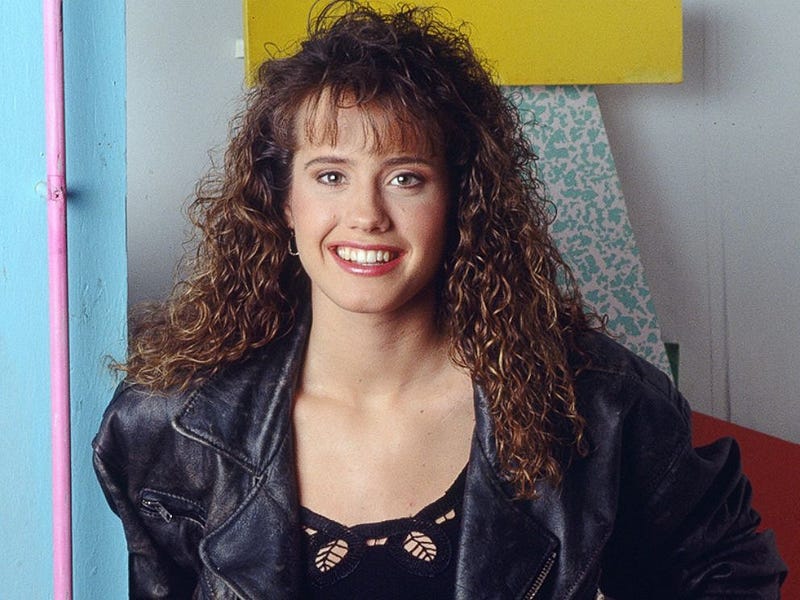
3) The arrival of Tori Scott was the first time I experienced gaslighting. I can forgive the disappearance of half of the Good Morning, Miss Bliss cast, the fact that the characters played a different sport each week, and Slater’s never-before-mentioned sister showing up nearly 100 episodes into the series. But I can never forgive the infamous swapping out of Kelly Kapowski and Jessie Spano for biker-chick Tori Scott near the end of the show’s run. During the 1992–1993 season, NBC decided to order extra episodes of the series to make some extra bucks. Mark-Paul Gosselaar, Mario Lopez, Dustin Diamond, and Lark Voorhies agreed to do the extra episodes, while Elizabeth Berkley and Tiffani-Amber Thiessen did not. (Whether they were unable or unwilling to is still unclear to me.) So rather than scrap the idea of extra episodes they decided to just pretend Kelly and Jessie did not exist for ten episodes and introduced a new female character, tomboy Tori (played by Leanna Creel). The fact that these episodes aired intermingled with the Kelly and Jessie episodes only added to the confusion and frustration. Did they think viewers wouldn’t notice? (I was only 8 and I certainly noticed.) Did they think viewers wouldn’t care? (I, for one, cared deeply about this issue at the time.) In hindsight, I realized that this was the first time I experienced gaslighting and the first of many, many times Hollywood producers, writers, and executives would infuriatingly underestimate my intelligence.
4) Yes, the show was disturbingly regressive in some ways (particularly the sexual dynamics). There are many aspects of Saved by the Bell that would not — and should not — play well today. Paramount among these are the sexual dynamics. There are multiple (as in, over a dozen) episodes of the show in which one of the teenage characters romantically pursues or is pursued by someone who is wildly inappropriate in terms of age or power dynamics. (Think of when Zack wanted to leave Kelly for the sexy school nurse or when Kelly had an affair with her professor as a freshman in college.) It’s not that these things don’t happen in real life, it’s that through their nonchalant presentation, these situations were tacitly endorsed as acceptable and appropriate. Perhaps even more problematic was the show’s encouragement of toxic masculinity, which was evident in virtually every misogynistic statement made by Slater, every single time some vicious scheme of Zack’s was forgiven, and Screech’s endless romantic pursuit of Lisa even after she repeatedly and unequivocally tells him to stop. These elements reinforced a generation of boys’ beliefs (particularly white boys) that they could get away with anything and that if a girl rejected them, they should just pursue them harder.
5) But, the show was surprisingly progressive in some ways. Despite these very real problems that I described above, the show was also progressive in unexpected ways. Even though it did reinforce toxic masculinity, it gave equal screen time to female characters that were fully developed and who frequently stood up for themselves. Although there was rampant romantic tension between the characters, some of the foundational dynamics between male and female characters were refreshingly platonic (for example, it is established early on that Zack and Jessie have been best friends since they were toddlers and no one teases Zack for having a girl as a best friend). It was also more racially and ethnically integrated than most other shows of the era, which were exclusively white (Full House, Seinfeld) or black (Family Matters, Living Single). The sextet included a black woman and a Latino man alongside four white characters. The show explored sensitive issues related to race and culture on a few occasions, with an examination of white guilt and the legacy of slavery (in an episode where an assignment to research their family trees reveals that Lisa’s ancestors were slaves and that Jessie’s were slave traders) and the emergence of cultural identity (when Slater becomes conscious of his Chicano identity in college). And then there’s the much-maligned instance where Zack dresses up as a Native American. Virtually everyone uses this as an example of how dated and culturally insensitive the show was, but they miss the mark a bit. The episode is actually about how Zack fails an assignment for not being respectful of Native American culture and he is sent to go learn from a Native American man who he forms a deep bond with and respect for. It’s still problematic, but less so in context. The show also compassionately (if heavy-handedly) delved into a number of other sociopolitical issues, including poverty, global warming, substance use, ableism, and divorce.
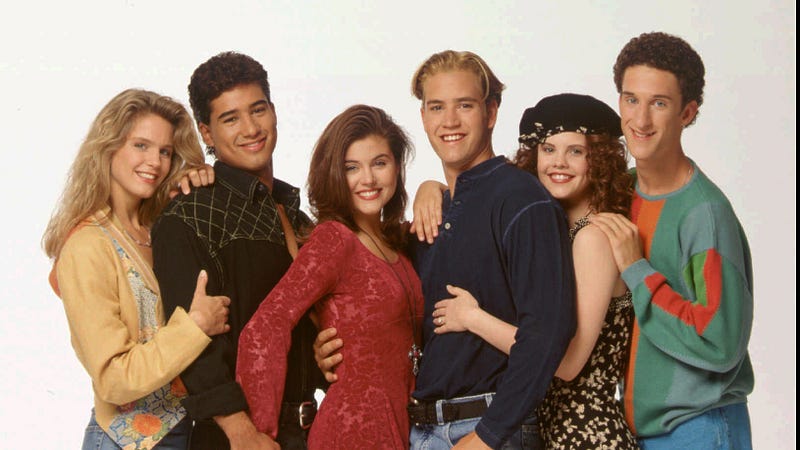
6) The show gave me wildly unrealistic expectations about high school. Bayside was a high school where boys and girls could be friends without teasing or bullying. It was a place where extracurricular activities like student council, theater, and political activism were just as important as playing sports. It was a place where cliques existed, but they were fully functioning ecosystems with their own sense of identity and ample support. (No one was all alone at Bayside.) It was a place where you fell in love with your best friend. And, perhaps most importantly, it was a place where friendships were lasting and resilient. Even when betrayals, fights, and falling outs occurred, they always made up and recommitted to one another. It was a beautiful fantasy, one that was replicated on my subsequent pop culture obsession Friends and one that all but broke my heart when I realized how far it was from reality (at least my reality).
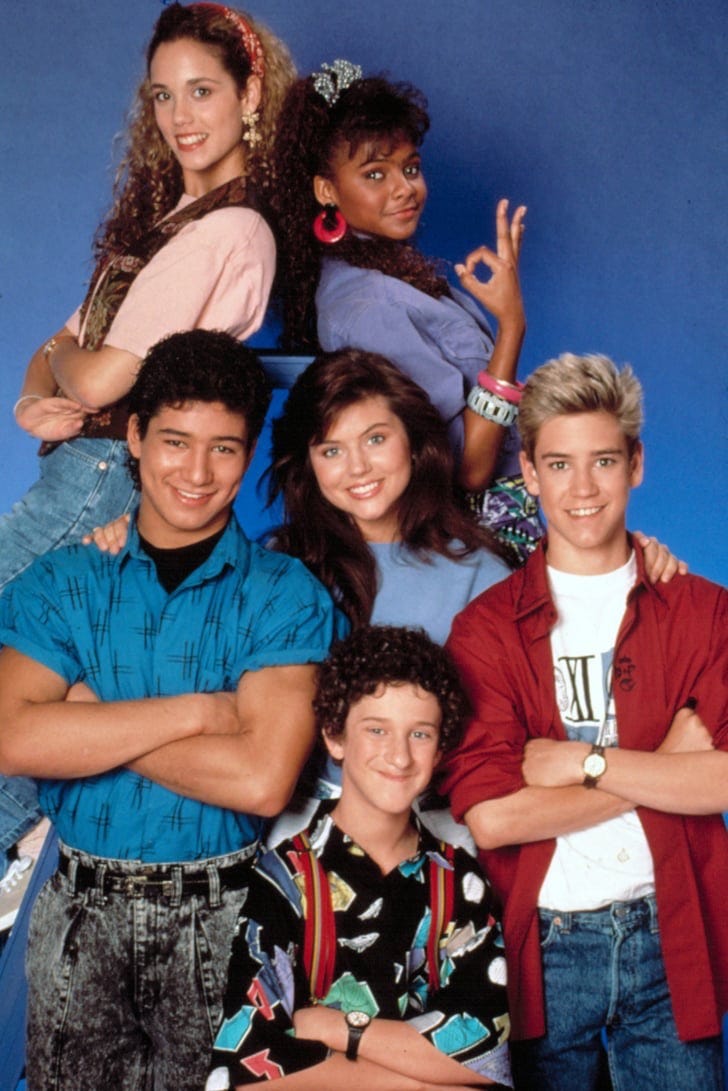
7) The casting on the show was top-notch. One of the things that made Saved by the Bell unique was that all of the cast was actually age appropriate. This wasn’t Grease where thirtysomethings were masquerading as teens. All six of the main cast members were between the ages of 12 and 17 when the show began and all underwent remarkable transformations over the show’s brief run, both in terms of appearance and skill. And all six of them actually turned in genuinely good performances from time to time. Even the weakest link, Dustin Diamond (Samuel “Screech” Powers), had episodes where he was genuinely charming and funny. It’s not that Diamond couldn’t act, it’s that the writers reduced him to a grotesque caricature the vast majority of the time. Mario Lopez (AC Slater) rarely got substantive material but when he did he proved adept at both comedy and drama. Tiffani-Amber Thiessen (Kelly Kapowski) started out fairly one-note as a ditzy cheerleader but grew in depth and complexity, ultimately becoming the most interesting and nuanced performer on The College Years. Lark Voorhies (Lisa Turtle) is perhaps the only one on the series that never hit a false note and upon rewatching the series, she clearly emerged as the most underrated and consistent cast member. My rewatch of the show, however, revealed that for me the two most valuable players were Mark-Paul Gosselaar and Elizabeth Berkley. Although they had their fair share of episodes where they overacted or otherwise missed the mark, they had terrific comic timing, were quite adept at the more dramatic moments, and had a luminous star quality. There were a number of other memorable performances on the show as well, including Dennis Haskins (who was always better and more restrained than he needed to be as Mr. Belding), Hayley Mills (whose charm and elegance made the Good Morning, Miss Bliss episodes watchable), Leanna Creel (who did the best she possibly could have during the Tori arc), Kiersten Warren (who was the undeniable comic highlight of The College Years), and Holland Taylor (who joined The College Years late in the game and elevated things immensely). Few would argue that Saved by the Bell featured revelatory, award-worthy acting, but it featured much better acting than I remember. The problem was the writing and the directing, not the skill of the actors. There’s a reason why all six of the main cast members continued to work after the show wrapped its run (a rarity for a Saturday morning series aimed at pre-teens).
8) The show had some truly charming and iconic episodes. Even the biggest Saved by the Bell fans would have a difficult time arguing that it was a truly great sitcom. Nevertheless, the show did produce a number of episodes that were great for what they were. I have listed the best (or at least the most watchable) episodes below, ones that cohere tonally and feature competent writing, effective performances, and memorable moments.
The 25 Best Episodes of Saved by the Bell:
“Dancing to the Max” (Season One). The first episode set at Bayside High features legendary radio host Casey Kasem showing up to the Max to host a dance contest in which the gang competes.
“Fatal Distraction” (Season One). Zack resorts to a brainwashing scheme to convince Kelly to ask him to the Sadie Hawkins dance and it backfires spectacularly.
“Jessie’s Song” (Season Two). The infamous “Jessie gets addicted to caffeine pills” episode needs no further description, but it’s worth reminding you that it also includes the girls’ fabulous ’80s music video during their brief stint as the girl group Hot Sundae.
“1–900-Crushed” (Season Two). Zack tries to profit off of teen angst by starting a teen advice line run by Lisa, but he unintentionally ends up wreaking havoc at Bayside.
“Breaking Up is Hard to Undo” (Season Three). There are a sextet of broken hearts when Zack and Kelly, Slater and Jessie, and Mr. and Mrs. Belding all experience relationship troubles simultaneously.
“The Last Dance” (Season Three). Kelly gets a job at the Max to help her family out financially, but she ends up falling for her new boss and breaking up with Zack.
“The Aftermath” (Season Three). As the title suggests, this surprisingly powerful outing features the aftermath of Zack and Kelly’s breakup.
“Date Auction” (Season Three). The gang does a date auction as a fundraiser and ends up delving into issues related to feminism, pseudo-intellectualism, and stigma against overweight people.
“Boss Lady” (Season Four). The best of the sextet of episodes where the gang spends the summer working at the Malibu Beach Club resort, this one features the romance between Zack and Stacy (Leah Remini) heating up as they have to figure out how to deal with a double booking.
“All in the Mall” (Season Four). A surprisingly complex and successful farce, the gang (inexplicably sans Jessie) finds themselves embroiled in a complicated scheme while they camp out at the mall trying to get U2 tickets.
“Rockumentary” (Season Four). Casey Kasem returns for this faux documentary (revealed later to be a dream sequence of Zack’s) in which the gang’s garage band — named The Zack Attack — has a spectacular rise and fall.
“Mystery Weekend” (Season Four). The gang goes to a mansion for a murder mystery weekend after Lisa wins a radio contest and it turns out to be more than they bargained for.
“Screech’s Spaghetti Sauce” (Season Four). When a school assignment reveals Screech’s amazing recipe for spaghetti sauce, the gang tries to mass market it with disastrous results.
“The Bayside Triangle” (Season Four). A love triangle unexpectedly develops between Zack, Lisa, and Screech when Zack tries to help Lisa impress the college of her dreams by putting on a fashion show.
“The Senior Prom” (Season Four). Zack tries to win back Kelly, Lisa takes pity on Screech, and Jessie and Slater get locked in the boiler room during Bayside’s ho-down-themed senior prom.
“Graduation” (Season Four). This highly emotional finale finds Jessie learning that she lost the valedictorian honor to Screech and Zack finding out that he might not graduate.
“Masquerade Ball” (Season Five). One of the show’s most elaborate farces, this episode finds Zack and Slater betting on who can kiss the new girl at school first.
“Drinking and Driving” (Season Five). The most successful of the show’s many “very special episodes,” this one does a surprisingly effective job at examining DWIs when Zack, Slater, and Lisa get into a car accident after a party.
“Earthquake” (Season Five). Mrs. Belding finally appears after 96 episodes and she promptly gives birth in an elevator during an earthquake with only Zack and Tori to help her.
“School Song” (Season Five). The gang decides to write a new school song for the senior class gift, but Zack naturally tries to sabotage it.
Saved by the Bell: Hawaiian Style (Movie). This primetime movie, set in the summer before senior year, finds the gang going to visit Kelly’s grandfather who runs a small hotel in Hawaii. There is romance and comedy galore, a surprisingly complex plot, and some truly beautiful visuals.
“A Question of Ethics” (Saved by the Bell: The College Years). The sole episode from the problematic college-set spinoff that could be considered great, this features television legend Robert Guillaume as an ethics professor who teaches the gang a valuable lesson through very unorthodox means.
Saved by the Bell: Wedding in Las Vegas (Movie). The primetime movie that ended the series features the cliched antics you would expect from the gang going on a road trip and causing trouble on the Las Vegas strip, but it is book-ended by strong emotion with Zack an Kelly’s parents refusing to support their wedding and ultimately pulling through for a lovely ceremony full of surprise appearances.
9) Despite my initial skepticism, the upcoming revival could just work after all.
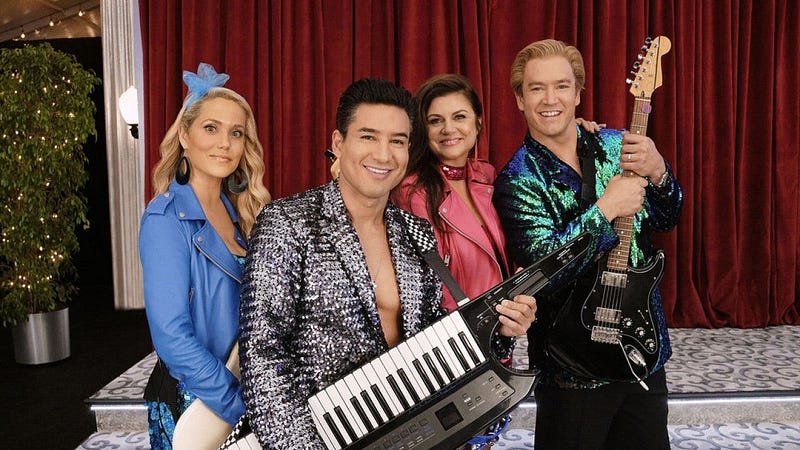
When I went to Saved by the Max in summer of 2018 and my nostalgia for Saved by the Bell was rebooted, I got thinking about what it would look like for Saved by the Bell to be rebooted. It didn’t seem that far fetched given the massive trend of reviving classic ’80s and ’90s sitcoms like Will & Grace, Roseanne, and Murphy Brown over the past few years. But I quickly concluded it was a terrible, terrible idea. I could conceive of no way that the gang could return without it being a cringe-inducing disaster.
And then Tracey Wigfield came along.
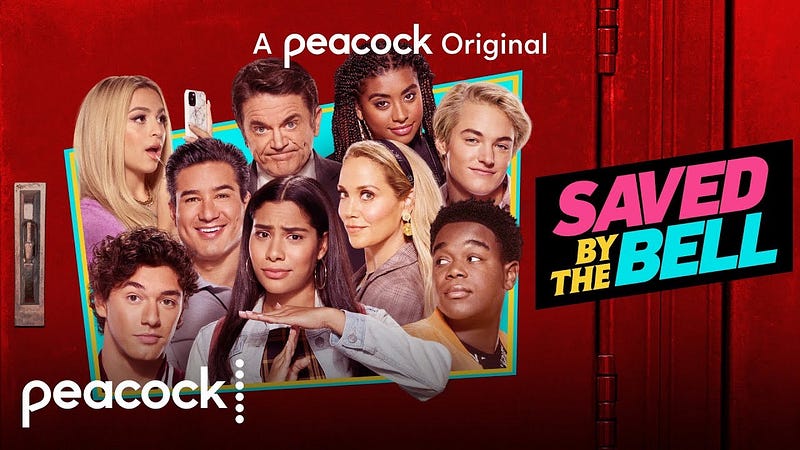
The Emmy-winning 30 Rock writer concocted a genuinely inspired setup for a sequel. The series she proposed would bring the series into the 21st century by featuring a new crop of diverse, social media-savvy teens who attend Bayside and are connected to the original characters in unique ways (such as being their children or students). It is an inspired and innovative mix of freshness and nostalgia, a way to bring back characters that are well known and loved but to de-center them — and presumably allow them to poke fun at their younger selves.
Check out my review of the divisive but inspired sequel series here.
Early buzz on the show, the 10-episode first season of which drops on NBC/Universal’s new streaming service Peacock on November 25th, is surprisingly positive. Despite my initial misgivings, I will certainly be watching because — as it turns out — Saved by the Bell means a bit more to me than I realized.
Follow the author of this article on Medium or Twitter.
Check out recent articles by this author about classic television:


