
Not Your Platform, Not Your Followers
There’s more than one way to make them yours.


Not your platform, not your followers, has been my mantra since writing on Medium when I started over a year ago.
Have this attitude, because it’s true.
If you don’t own the platform you’re writing on, you don’t “own” your followers. Don’t put all your writing-income-eggs in one basket (platform).
Platforms change.
You want to own your followers, or at least their email addresses — they’re actually human beings behind those addresses, treat them well. Those readers made the conscious choice to follow you.
Those who do, like what you have to say and your writing, they make up your true fans.
One of the best decisions I made since writing here was to add a call to action at the bottom of each article. Nothing big, just, “if you want to join my list, follow me here.” Keep it simple. I set up a ConvertKit account (full disclosure, this is an affiliate link), as soon as I published my first article, took a weekend, and created a freebie to entice readers to join, and my list has grown — by a lot.
I did this because I know that platforms like Twitter, Facebook, and others are not mine, so I don’t get to set the rules.
Man, I wish they were mine.
If I created Facebook, I wouldn’t allow hate speech, misinformation, or conspiracy theories. Or Donald Trump. I wouldn’t want to be complicit in spreading lies that lead to people — even people I don’t agree with — being shot and killed. I also don’t care about power and money the way Zuck does.
Is that guy a robot? Anyone check him for a pulse.
Now that Facebook has changed the way we communicate and is a thing, in retrospect, why didn’t I think of a platform like Facebook, where people humblebrag, make stuff up, publish photos to convince “friends” their lives turned out great, organize to overthrow a government and bash others for their political views. It’s high school all over again with a greater negative impact. Global ramifications. One big world-wide popularity test.
I lived in SF in 1998. I should have been more creative then, made a pitch for VC money, and wrote some code. Facebook seems like a no-brainer in retrospect.
Even that is disingenuous. I use Facebook to promote my writing. If I had any moral conviction, I would delete my Facebook account, I think about it often. They’ve got me though. Where else can I send out one photo of my daughter in under 30 seconds to all twenty family members plus 300 of my nearest and dearest “friends.” (I would never buy stock in Facebook. There are more ethical tech companies to invest your money in.)
I digress.
The upshot — I don’t make the rules on Facebook or Twitter or here.
Where ever you fall on the argument about whether it was a “boom” or “bust” to free speech when Twitter et al. banned the bullshitter-in-chief doesn’t matter for this piece. There are great arguments on both sides. I like to argue both sides. Because I know myself, and if Twitter had banned some peaceful-ganja-smoking-vegetarian candidate who spread nothing but love and unity, I’d be pissed. What matters for our purposes here is that it’s a reminder that we don’t own our followers when playing on others’ platforms.
Another reason to own a blog, or at least a landing page.
Image if right-wing conservatives started dot coms, were techie nerds one with code, and were running Silicon Valley. I shudder. They aren’t, not that I can tell. The four centibillionaire (Jeff Bezos, Elon Musk, Bill Gates and Mark Zuckerberg) are left-leaning and liberal, as far as I can tell. Except for Zuck, because I’m not sure if he’s human.
These four centibillionaires, Jeff Bezos, Elon Musk, Bill Gates and Mark Zuckerberg, now have a net worth of about 550 billion combined.
Centibillionaire (a word not in the dictionary yet, but will be) describes a billionaire who has a personal fortune exceeding a hundred billion dollars.
The term has to be invented for Bezos.
What you do have control over.
If this platform changes, and it will, (because it runs on an algorithm/a different set of functions determined by people running the platform) it does about once every few months by my watch, you can’t depend on the earnings you make here, and you don’t own your followers.
Unless..
Two Ways:
- Add a call to action (you don’t need a publication for this)
- Start a publication
Add a call to action and build your email subscriber list. And/or become an editor by starting a publication so you’re in charge of your newsletter list.
If you run a publication, those who follow it give their email address attached to their Medium account. This is the email that goes on your publication’s list.
This is perhaps the best reason to start a publication of which you are the editor. When you’re the editor of a publication, that is the second way to have access to emails of those who follow your publication.
I have two publications, The Write Path, and The Happy Spot.
When you own a publication, you can send out a Newsletter attached to the publication reaching your followers. Publications are built over time. Be patient. Mine have grown steadily with regular publishing to them. My two have over 3,000 followers. Once you export your Medium email list (you have to click a button to agree to terms and conditions). Once you do, they are now on your email list (OFF Medium) and have nothing to do with the platform.
As the editor of a Medium Newsletter, you have direct access to a list of subscribers.
Newsletter subscribers who choose to share their email addresses are added to a mailing list, which editors can export at any time.
I’ve exported mine and added them to my ConvertKit email list.
So, if Medium goes out of business tomorrow or the owners decide to sell it or just cut the cord, you would lose your income and your followers. Just like that. If you are dependant on this platform for a full-time income, that would be a real bummer. It can happen. Unlikely, but possible.
I wrote about how to set up a publication here.
I wrote about the upsides of running your publication here.
So if you have a publication and followers to that publication, you can own them. Below is how you export them onto your list.
Here is how:
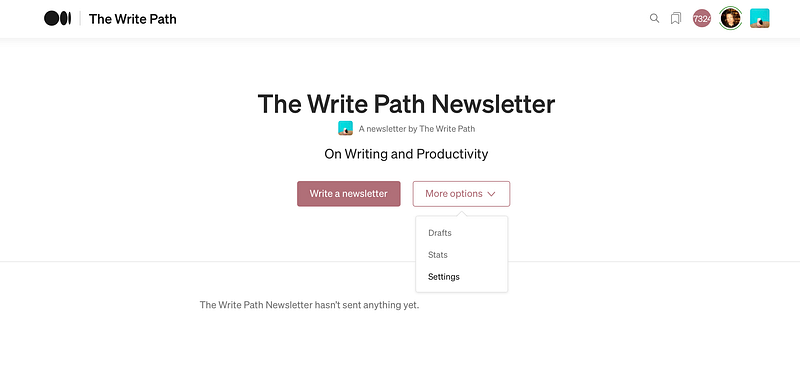
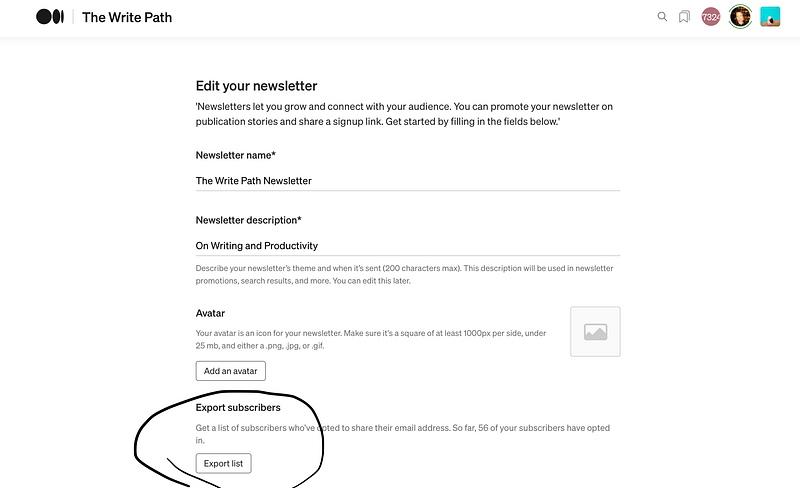
- Go to your newsletter settings and select Export List.
- Agree to the terms, and Medium will email you a link to download the list of subscriber email addresses. (only newsletter subscribers who have opted to share their email addresses are included in the mailing list.)
Step one. Go into your publications newsletter, hit ‘Settings.’
Step two. Export list.
Step three.
Medium will email you the list. Add them to your email service provider, like ConvertKit, Mailchimp or Substack.
This way, you can keep your most loyal fans — those readers who have chosen to follow your publication and who want updates — that you’ve built on Medium. Engage with those fans on and off the platform.
“Creators have full agency over their newsletter audience and the value that they can deliver to readers’ inboxes.” — Medium blog
Summary
If you don’t start a publication and gain subscribers and then export them to a list — off Medium — or you don’t add a call to action connected to an email subscriber list off the platform, then, “not your followers.”
Do both, yesterday.
Today is good too.
Jessica is a writer, an online entrepreneur, and a recovering type-A personality. She lives in Los Angeles with her extrovert daughter, two dogs, and two cats.