
Not Old Enough To Vote
A man rises at 4.00 a.m. to catch a train to London. He will complete his work and return on the noon train to Bradford.
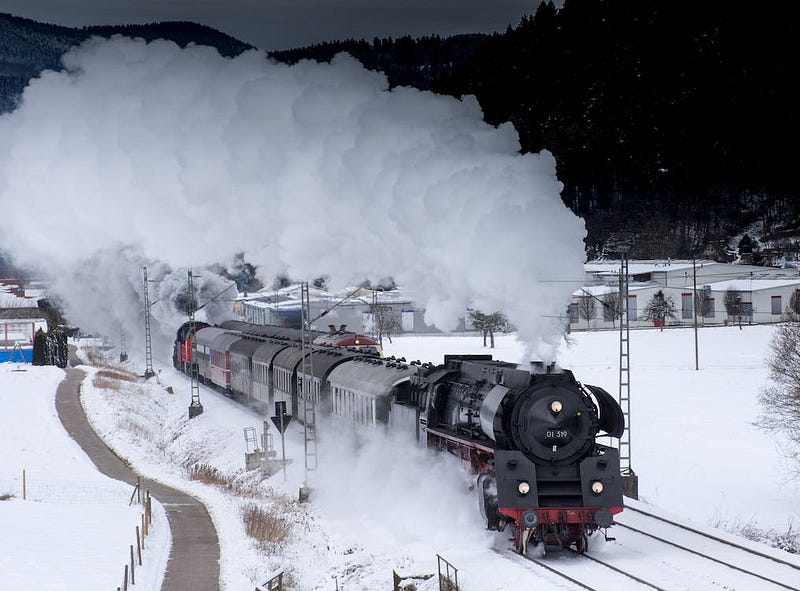
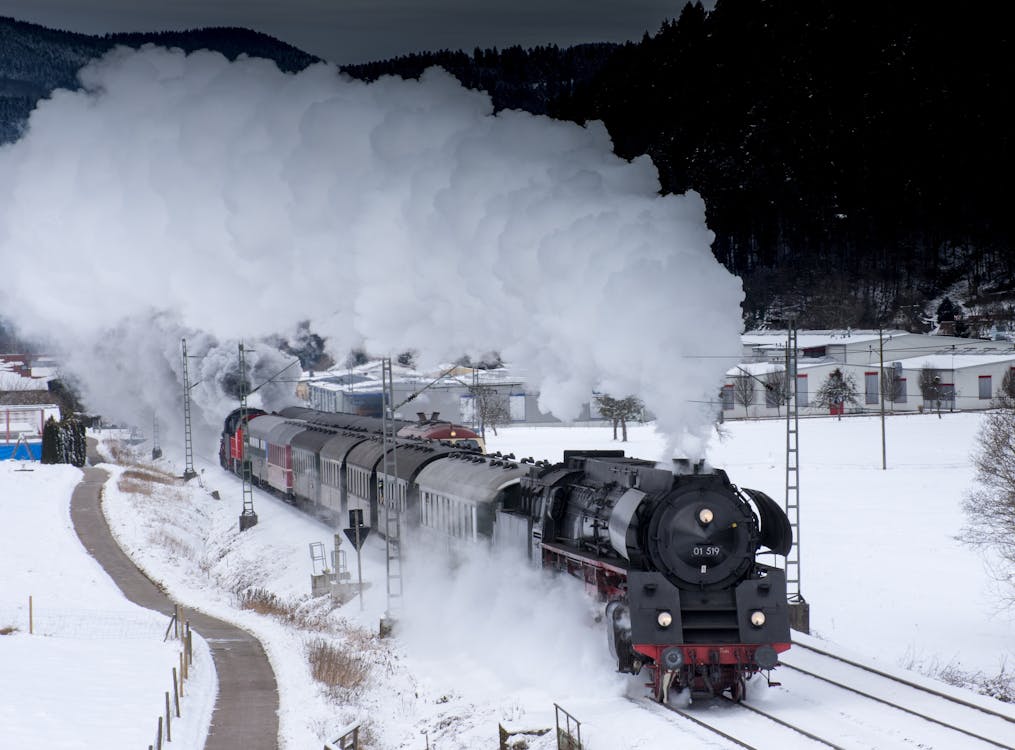
Albert’s day begins in no particularly special way. It has, in fact, begun the same way every working day has begun for the past ten years; waking at 4.00 a.m., spending twenty-three minutes in the bathroom, fifteen more at the breakfast table, and three putting on his overcoat, collecting his briefcase from the safe at the back of the store and starting out on a nineteen-minute walk to the train station where he boards the 5.00 a.m. Pullman train, leaving Bradford for Euston.
The steam train thunders through the early January morning dark, its smoke sensed in discernible whiffs of gray seen through the window, down which rivulets of rain stream. Albert occupies himself reading the headlines on the newspaper held wide open by a man sitting opposite.
Were he to concern himself with its headlines he would be unable to carry out his duty.
The carriage smells of Brylcream and other overpowering decoctions of old perfumes, mingling with the vestige of stale tobacco ash. Albert assumes, at this ungodly hour of the morning, everyone is traveling with a purpose in mind.
There is no intoxicating success to consider as Albert rocks in his seat to the rhythm of the train, listening to the rasping of newspapers, and the intermittent coughing of fellow travelers. He absorbs himself in his usual practice of trying to ascertain what is on the minds of other commuters in close proximity, in particular, a woman sitting across from him. She is shivering slightly, wrapped in her ethnic clothing, clutching her purse, and her undoubtedly beautiful face is, Albert notices, wet with tears.
He wonders what might be so serious that she should weep in public. It is not his place to interfere.
Another man, one sitting across the aisle, a serious man, perhaps a doctor on his way to perform a difficult surgery, is wearing a fine pair of brogues. The train plows on, clickety-clack, clickety-clack, and Albert finds himself humming to the sound of the great steel wheels pounding on the rails, causing the man opposite to rasp his newspaper, seemingly irritated by Albert’s humming. The rather pompous toff offers Albert a discourteous glance before hiding his disgruntled manner behind newspaper headlines; clearly a lawyer, Albert decides.
The train pulls into its final destination at 8.16 a.m., Albert checks his watch.
Wearing a ponderous black overcoat and carrying his many times repaired briefcase, Albert is absorbed like a thief into the commute, jostled along in a wave of peevish people entering the vast city through Euston Station. He listens to the irritated mutterings as the confraternity shoves sluggishly toward the exit, where a large, florid-looking man, puffy-faced with strangely colorless eyes, collects tickets.
Albert walks briskly across the precinct of the station’s crowded hall, striding with purpose to a seating area beneath the great clock. It’s here he sits, again checks his watch, and opens his briefcase. From it, he removes two brushes wrapped in a yellow cloth and a tin of Cherry Blossom black shoe polish. These things he places on the bench before bending forward to untie the shoelace of his right shoe, which he then removes. He opens the can, dabs the brush precisely into the polish, and begins the ritual of cleaning his shoes, scuffed by the feet of irritable and impatient people, all trying to beat the clock.
Wrapping up the brushes and closing the lid on the can of polish, he again checks his watch. 8.28 a.m. He sits for a further three minutes to gather his thoughts. Then, with trained practice, he shuts out the noise of the rush hour, and takes another moment to enjoy the aromas wafting in curls through the air, singling out the smell of fried sausages being cooked over hot coals by a vendor.
At 8.32 a.m., he leaves the station precinct into the Wednesday morning frigid air. People, he observes, move cautiously, leaning forward against the fall of fresh snow, hats held fast with gloved hands, scarves covering misting mouths. He walks upright and proud and at 8.37 a.m. collects his morning paper from a ruddy-cheeked, cloth-capped seller, which he folds before opening the briefcase against his lap and places the newspaper neatly inside.
The newspaper seller cheerfully voices an opinion that today is not a day for the living. Albert smiles, lifts a hand to salute his departure, and continues toward the taxi rank. The driver tips his hat in recognition. Albert climbs inside but there is no mention of a destination. The driver honks his horn and pulls away from the curbside.
Albert opens his briefcase on his lap, removes the newspaper, and sits it next to him before removing a whisky flask. After closing the briefcase and brushing the melting flakes from his shoulders to the floor of the cab, he turns off the screw. The sensation of taste on his tongue teases his need. He savors the warmth falling into his belly before taking another longer sip and screws the top back before placing the flask reverently back in the briefcase, lying the newspaper flat on top and closes the briefcase.
When the cab comes to a halt, the driver turns to him. Albert pays over sixpence for the journey and steps out. He stands beneath the gate, straightening his coat beneath the notice: ‘H.M.P. Wandsworth’.
Albert checks his watch. 8:47 a.m.
At 8.55, the cell door is opened. Albert stands behind a burly prison guard, two more at his aside as they enter.
“Good morning, my name is Albert.”
The prisoner is lying on his bed, breakfast untouched.
“I’m Derek,” the prisoner says, clearly nervous and quiet, blank eyes staring up at Albert.
The guard, not unkindly, asks Derek to stand, which he does without hesitation. Albert places the pinioning-loop upon his wrists and makes it tight.
Quietly, but reassuringly, Albert whispers to Derek.
“Just follow me, lad, everything will be alright.”
The nineteen-year-old prisoner looks his teenage years. It is 8.58 a.m.
Two hours later, the train rattles and steams its way back to Bradford through the late grey morning. Albert is sitting upright, absorbed in the game of wondering what people are thinking. An hour later, disturbed by the clattering of a train passing in the opposite direction, he stirs from a nap, opens his briefcase, removes the chrome and leather-bound whisky flask, and drinks the remnants.
Lying flat among the shoe cleaning materials, a calf-leather strap, a white cotton hood, some government papers, and three crisp five-pound notes.
He places the empty whisky flask back into his briefcase before snapping shut the brass clasps.
Across the aisle, a woman is holding wide the Daily Newspaper.
The headlines are in large ominous black print.
‘Derek Bentley Hangs Today.’
Albert turns his stare back to the window, gazing out across the English countryside.
My editing thanks to: Christine Schoenwald
Postscript:
Derek Bentley received a ‘posthumous pardon’ granted in 1993, and then a further campaign for the quashing of his murder conviction, which occurred in 1998. He was old enough to be hanged, not old enough to vote.
During his tenure Albert Pierrepoint hanged 200 people who had been convicted of war crimes in Germany and Austria, as well as several high-profile murderers — including Gordon Cummins (the Blackout Ripper), John Haigh (the Acid Bath Murderer) and John Christie (the Rillington Place Strangler). He undertook several contentious executions, including Timothy Evans, Derek Bentley and Ruth Ellis and executions for high treason — William Joyce (also known as Lord Haw-Haw) and John Amery — and treachery, with the hanging of Theodore Schurch.
In 1956 Pierrepoint was involved in a dispute with a sheriff over payment, leading to his retirement from hanging. He ran a pub in Lancashire from the mid-1940s until the 1960s. He wrote his memoirs in 1974 in which he concluded that capital punishment was not a deterrent…
Hello, this might be of some interest. If you would like to join Medium as a Member, giving you access to every story I write, and the whole shabang of talented writers on Medium, and you want to join up, read, or earn yourself a few coins writing, please think about using this LINK to become a member. Cost $5. You’ll be gifting me a cup of coffee, and treating yourself to the wonderland of Medium.com💜✍️
More of Harry Hogg: