
Not into “life-goals” and “legacies”? Consider a role-based life system instead

I never used to read any non-fiction. It was always Sci-Fi or Thriller stories. Call it a mid-life crisis if you, like but things things have flipped now that I’m approaching middle age.
Instead, I tend to read productivity books, “self-help” titles or biographies of those that I admire with the aim of improving myself or to learn more about topics that interest me.
One thing that I’m not a fan of, though, is the idea of a life goal or leaving behind a “legacy” which seems to crop up fairly repeatedly. For someone who has seen quarterly goals flipped on their head by unforeseen circumstances, the idea of committing to a goal that people will remember me by (hopefully) many years from now seems unrealistic.
However, when listening to a podcast last year, I came across of the idea living my life based on the roles I have with those around me. The idea interested me a lot — it still provided me with the opportunity for long-term self-development while being flexible enough to deal with short-term change. It also accurately reflected the way that I interact with different people.
For the last 12 months, I’ve been measuring myself by my roles and I’ve found that it has brought a refreshing structure and focus to my day-to-day living.
Let me tell you a bit more about it.
What is a role?
Everyone has different expectations around you. For example, a colleague at work is going to want different things from you when compared to your kids or your partner.
A role is essentially how you behave around different people to ensure that you meet their expectations.
How did I define my roles?
I took half an hour out of my day to think about the roles that I play in my life. If you want to do something similar, then you’ll probably find that the first half-dozen came pretty quickly. Don’t stop there, though, keep pushing. Think about how you spend your time, the people you interact with and how they view you.
Going through your calendar and your email for the last couple of months is a good way to identify how your time is being spent and the interests that you have.
It’s important to note here that these roles are not specific goals that you want to achieve — they’re particular parts of your life that you play out on a daily, weekly and, perhaps, monthly basis.
For those who are working with Thiago Forte’s PARA method, these roles will most closely align with your “Areas” and will likely be across both personal and work
What are my roles?
The first thing to say here is that 90% of the following roles came out of the session I mentioned above. However, I’ve found that this has been an ongoing process, with some roles being bundled into others, some being removed and others being added.
That being said, I think I’ve pretty much settled on the following ten roles:
- Father — how I can best bring up my two daughters
- Husband — being a good partner to my wife to ensure that we both live happy lives
- Healthy Human — I’ve had health problems in the past. This role is all about ensuring that I am as fit and healthy as I can be
- Lifetime Learner — this is something that has only come to me later in life, but now forms a large part of my average week. I have my interests and I want to make sure that I’m continuing to learn as I get older
- Achiever — This is all about living life to your potential, making sure that I achieve my potential and don’t leave anything out on the playing field
- Entrepreneur — Previously, this was about creating and running a business that I co-founded. These days it’s about doing my little side hustles alongside the day job.
- Leader — Something that doesn’t come naturally to me is putting my ass on the line when the chips are down, standing up for others, and putting my hand up to progress the things that I believe in. I want to change that.
- Brother — how I can be the best brother I can be
- Son — how I can best support and care for my parents as they get older
- Reliable Friend — I’m one of those people that don’t have tons of friends, but I do have very close friends. So, this is about how can I ensure that I’m there for them when they need me.
Some other roles I’ve seen other roles define for themselves include “teacher”, “altruist”, “hobbyist” and “reliable person.”
What does a successful role look like?
Once you’ve got a list of your roles, book out another couple of hours with yourself and flesh out what each of them means.
To quote James Clear from Atomic Habits, “every action you take is a vote for the type of person you wish to become” so take the time to think about the actions needed to excel in the roles that you play.
You can do this reflection in a notebook, digital app or PKM system. I use a simple template in Obsidian with the following questions on it?
- Role Profile — an overview of the role and why it’s important to you
- Who do I want to be? In your opinion what is the perfect embodiment of this role?
- What results would I see? If you’re able to hit this perfect embodiment, what impact would it have on your life? How would you behave? How would you know that you had got there?
- What characteristics would I need to have to achieve that?
- How would this person behave? What would the perfect embodiment of this role do on a daily basis? What actions would they carry out? What habits would they have?
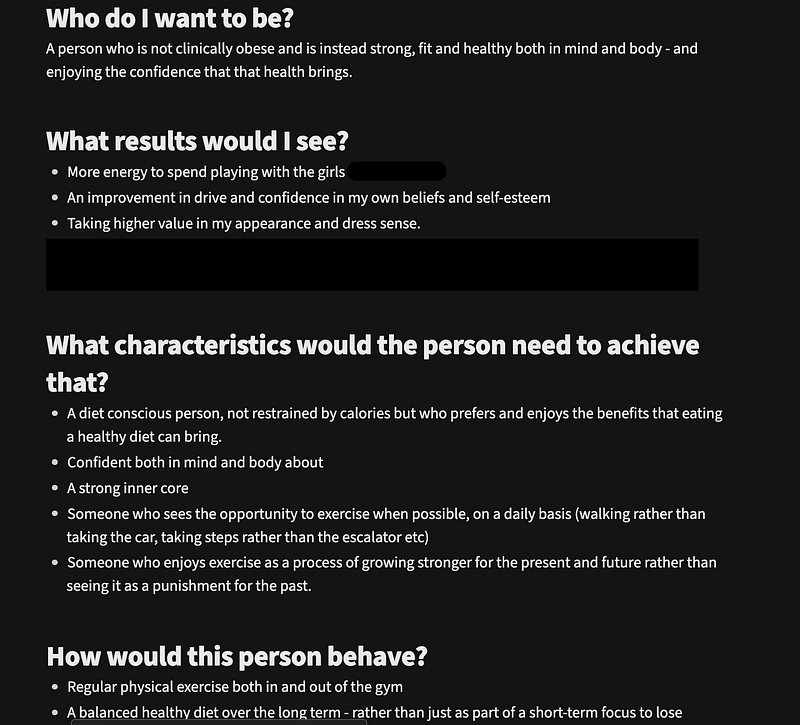
Once you’ve done this for each of your roles, you should have an outline of the heights you want to be hitting and what each of those roles will mean to you.
What next?
Don’t just file these roles away and forget about them. If they truly represent how you’re living your daily life, you need to be checking in with them regularly. How are you aligning with that person you set out in your time? What did you do this week that you’re proud of? What can you do next week that will push you on a little further?
For me, that means that I ensure my roles are replicated across as many different parts of my day as possible. For example, my roles are listed out in my Task Management tool and all of my tasks are divided between them.
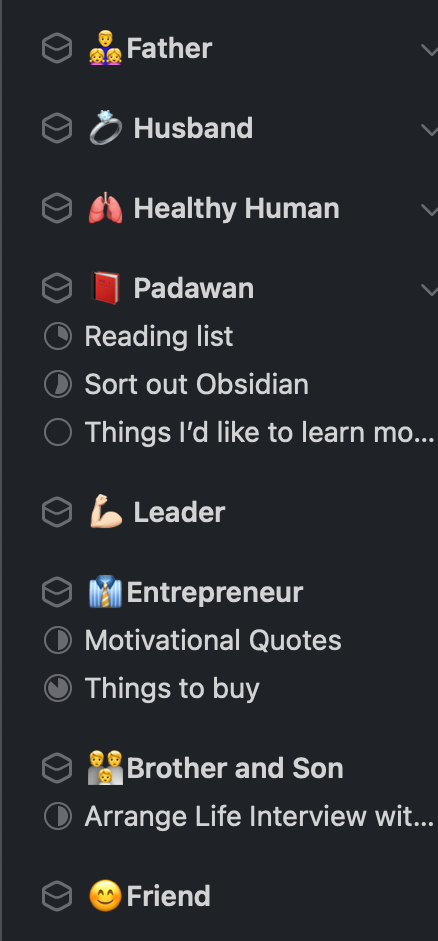
I’ve also just started tracking my time using Timery and anything I log there is tagged with one of my roles so that I can see how much time is being on each on — or, perhaps more importantly, those roles where I need to focus a bit more.
When it comes to PKM, my roles have a dedication section to themselves and for a note to be accepted into the PKM, they have to be directly linked (metaphorically and literally!) to one of the roles I’ve committed to.
When I carry out my reviews, I evaluate how well I lived up to each of the roles. When planning weekly or quarterly reviews, I look for areas that can help me develop a little further or for potential issues that might trip me up.
By placing these role at the heart of my days, weeks and quarters, I put myself in a position to improve all areas of my life both over the short term and the long term — and without the need to commit to distant one-dimensional objectives.
Summing up
I’ve found the roles based approach to life to be a really refreshing one. It more accurately represents the way that I live as well as providing me with much more flexibility around my aims and objectives. No longer am I aiming for one life-long goal, which is years away and may well need to change based on short-term circumstances.
Instead, I’m changing my objectives based on much shorter term objectives that the important people in my life have of me. I’m living a day at a time and trying to be the best version of myself to those around me — whatever role they may see me as.
One last thing …
Thank you very much for taking the time to read the article above — I hope you found it useful.
If you did, then you’ll pleased to know that I’ve finally got myself sorted out, socially. You can now find me on Mastodon. I’d love to chat more about this stuff, so feel free to reach out and carry on the conversation there!