Not Excited to Be at Work? Check Your Values.
This exercise uses data to get to the real truth of who you are—and decide what to do about it at your job.

Procrastination is a form of inner mood repair. If you’re unhappy about your job, one response is to procrastinate. But that makes most of us feel worse in the long run. Fortunately, procrastination isn’t the only solution to mood repair on the job.
Being a “super productive” remote worker myself, I was cleaning out a long-neglected closet (while suppressing my sense of guilt over neglecting my real work). One box tumbled out and spilled out around my feet. It held matching sets of binder-clipped note cards—the values exercise I used to lead as a professional development counselor.
It was one of my favorites, designed to help clients identify their core values.
It seemed like a sign. I sat there on the floor and dug in to complete the exercise on the spot.
What I found, though, was that this values exercise didn’t go far enough. So I developed a way to take it further… with the end result of changing my situation so that cleaning my closets was no longer more attractive than doing my work.
First I’ll describe what I did, and then give you step-by-step instructions so you can do it, too.
My Own Values Exercise
Step 1: I started with a stack of cards labeled with values like “Learning,” “Family,” or “Freedom.”
Step 2: Then I identified which values were important and applied to me and which didn’t by putting each in a “yes” or “no” pile.
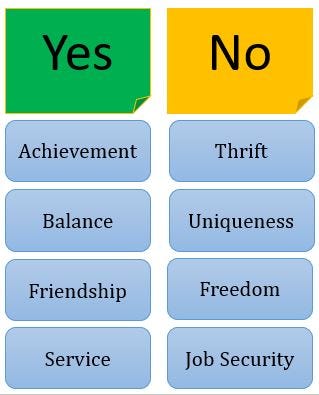
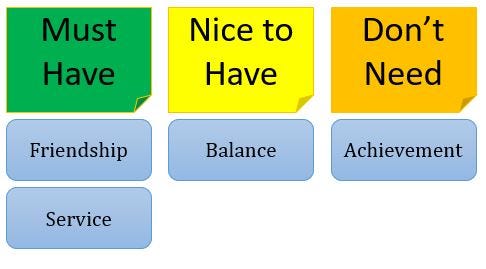
Step 3: I discarded the pile of “No” cards and set them aside. Then I sorted the “Yes” cards between “Don’t Need,” “Nice to Have,” and “Must Have.”
Step 4: Then I slowly, painfully reduced my “Must Have” pile to only three. Twenty minutes later, I identified Competence, Honesty, and Travel as my core values. Your own will look different:
But now what?
“Now I should get back to work. Ugh.”
Then it occurred to me, right there on the floor of my guest bedroom, that maybe I had been dragging my feet at work because I wasn’t doing the sort of things that were in line with my values.
Based on my experiences from my mental health counselor days, I pulled up my calendar and looked at my recorded activities. We can talk ourselves into anything, but our behaviors don’t lie.
The key to self-knowledge is not in your thoughts, but in your actions
I made my way back to my laptop and pulled up my Google calendar and work log. I took a hard look at my activities for the past two weeks.
Our core values are the same whether we’re at work or home, so the information I gained from what I did in my off-hours informed the process as much as what I did for work.
I divided my actual behaviors between:
- I will never give this up
- I like this
- I must do this for survival
- I never want to do this again
At first, I wanted to put my whole job into “I must do this for survival.” I had to force myself to break the tasks down. Doing this forced me into realizations like this one: I absolutely was not going to get fired if I didn’t check my email at 8 p.m.
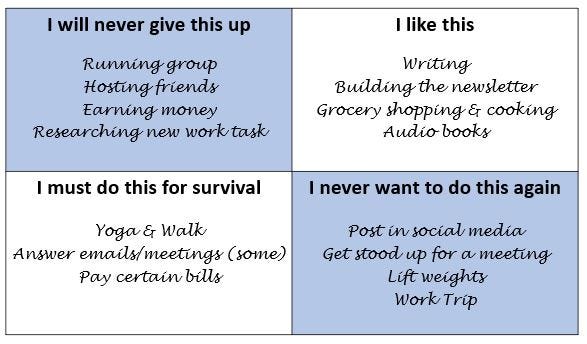
Each of these behaviors corresponded with at least one value. I tried matching the behaviors in the “I will never give this up” section with values from my list.
I realized I had incorrectly identified my core values. “No way!” I thought to myself. “I’m obsessed with self-awareness. How can I not know my own core values?!” I had been telling myself a story about who I thought I should be. The truth in my behaviors put me in my place.
For example, I noted with loathing a recent work trip and had to admit that I didn’t much like traveling for work. I liked the ego boost that I got from being perceived as a jet-setter, but ego strokes do not sustain us like our core values do.
Additionally, I found activities that went under “I will never give this up” that didn’t align with the original values I had chosen. Some of my favorite things were running with my “drinking club with a running problem,” hosting friends for dinner and drinks, and learning new work skills.

If the things I love the most do not fall in line with my core values, then I have misidentified those values. I needed to examine my behaviors to figure that out.
I went back to the exercise with my behavioral data in hand. My behaviors showed that the core values I wanted to live by were Excellence, Independence, and Fun.
Three tactics to make work better: elimination, minimization, and delegation
With my real core values in hand—Excellence, Independence, and Fun—I reexamined all of my work tasks.
I was stuck in a spot at work where I had to be a jack-of-all-trades and do many things competently and none of them with excellence.
Strike one.
Independence was knocked out of the park. I had almost complete autonomy. Home run there.
Fun. With my autonomy, I did get to learn many new things, but since I worked from home, I spent a ton of time feeling isolated.
This was strike two.
Not a complete strikeout. So, I didn’t quit that day. In reflection, however, that was the day I decided that I needed to move on.
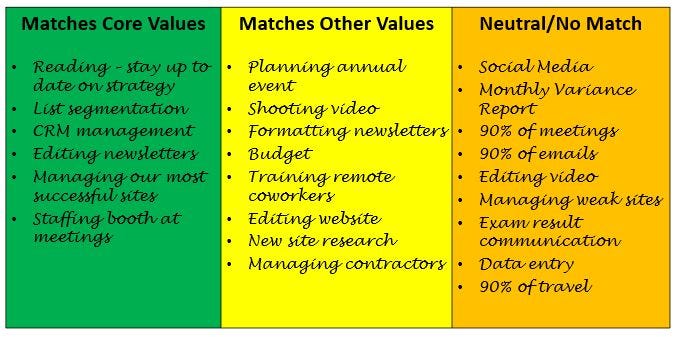
In the short term, I made a list of all my work tasks and divided them into “Matches Core Values,” “Matches Other Values,” and “Neutral/No Match.”
Then, I did the following three things:
- Elimination: For anything in the Neutral/Doesn’t Match Values, I took a hard look at why I was doing it and what would happen if I stopped. If I wasn’t going to get fired or tank the business, I stopped doing it. I immediately recommended pulling the plug on two teaching sites that were struggling.
- Minimization: For anything left in that category, I considered what would happen if I did less or did it less frequently. I felt neutral about our variance report and no one minded me doing it quarterly instead of monthly.
- Delegation: There’s someone out there for every task. If you don’t love it, find someone who does. Thus our social media contractor was hired.
This ended up taking a lot of unpleasant or uninteresting tasks off my plate and gave me more time to pursue the tasks I liked to “excellence” status. In retrospect, I had way too many things on my excellence list and ended up too busy to do any of them justice. I figured that one out later. That said, the delegation and taking things off my plate completely is something I recommend everyone reflect on as a potential tactic every quarter or every six months.
I felt I had made an amazing start and it kept me in the job through another raise—and a calm and careful job search, rather than an exasperated walkout.
With the new job, I’d love to say that I did it better right out of the gates, but I didn’t. I did figure out I was screwing it up again a lot faster. I’ve already been through a round of elimination, minimization, and delegation. I have been granted some flexibility in what direction my job will go and I have been holding these three values front and center as I experiment and explore.
In looking at my core values, it hasn’t created an answer to all questions but knowing them has been a guide to help me ask better questions.
Now it’s your turn.
How to Do Your Own Core Values Identification Exercise
The values exercise isn’t a brainchild of mine. It’s been in the world for a while now, so there are lots of resources for you to use to do one.
What none of these exercises have you do, though, is to check yourself against your actual behaviors.
What I recommend is that BEFORE you do a values exercise you look at how you actually spent the past two weeks. Write down all of the activities. Then write down any of your favorite activities or activities you wish you had done. Then circle the ones that are vitally important to you. The ones where if I paid you $10,000 to stop doing them, you’d tell me where to stick it. Pay honor to both your work and home life.
Step 1: Divide your actual behaviors into the following four categories
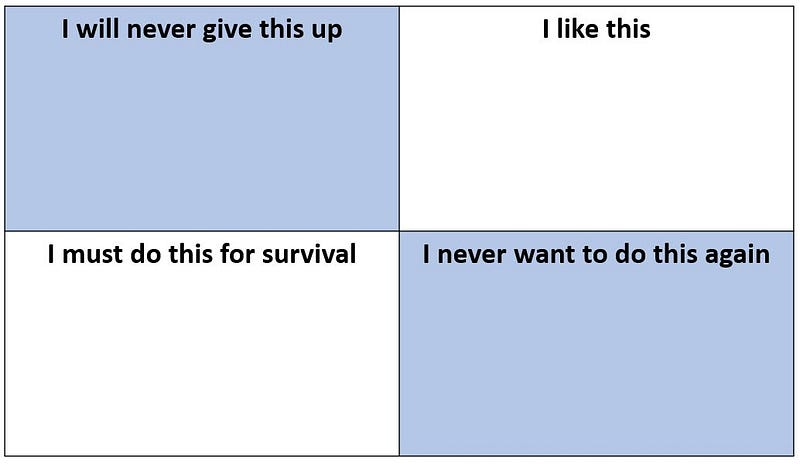
Step 2: With your actual behaviors in hand, go through a values exercise
If you’re a Brene Brown fan, this values exercise probably sounds familiar. She recommends it in several of her books, the latest being in Dare to Lead. She has a pdf you can use to try and narrow it down. Consider using my two-step “Yes/No” and “Must Have/Nice to Have/Don’t Need” process. If you want to go digital, you can play online with Think2Perform and The Good Project.
As you go through one of these values exercises, keep referring back to your list. Reflect on what it is about those activities that is fulfilling. Make sure that you’re not telling yourself a pretty story about how you should be.
I would love to say that intelligence is a core value of mine, but my behaviors simply do not bear that out. I spend WAY too much time wine tasting and playing Settlers of Catan for that to be the case.
As a reminder, determining your values isn’t an easy, straightforward process. Here are a few tips that might help you along the way:
- Don’t feel too attached to the values list. Yours might not be there.
- Ask someone close to you to look for themes with you. Look for grouping of values in line with a theme. Achievement, Career, Recognition, and Success could be a grouping. And one very different from Caring, Kindness, Justice, and Service. Once you have a grouping, see if they all fit under one of the values. Does success mean being recognized for your achievements at work and you don’t care that people recognize that you ran three marathons last month? Then Career may be the dominant value. Alternatively, if you want recognition for your marathon and your career, then Achievement may be the dominant value.
- Check out your “I never want to do this again” list, as I did. If you can identify the value that you dislike, its opposite should at least make your shortlist of possibilities.
- If you’re still stuck, use the Five Whys for your list. It’s a little more labor-intensive but it helps.
Here’s an example of using the Five Whys to identify a core value:
Why is it important to read a book to my son at night? Because it’s time for us to bond. (Note, it could be to improve his reading skills and that would take you down a different path.)
Why is it important to bond? Because I want him to grow up to be a secure and confident adult and he’ll need to learn to trust people to get there.
Why is it important for him to be secure and confident? Because that is how he will be successful and happy in life.
Why is it important for him to be successful and happy? Because the purpose of life is to be successful and content.
See, we didn’t even need the 5th why to find Success and Contentment.
Step 3: Reality check your values against how you actually spend your time
Once you have your values, revisit your list and divide your tasks according to how they match or don’t match your values. I recommend doing a separate one for work and personal life just to simplify.
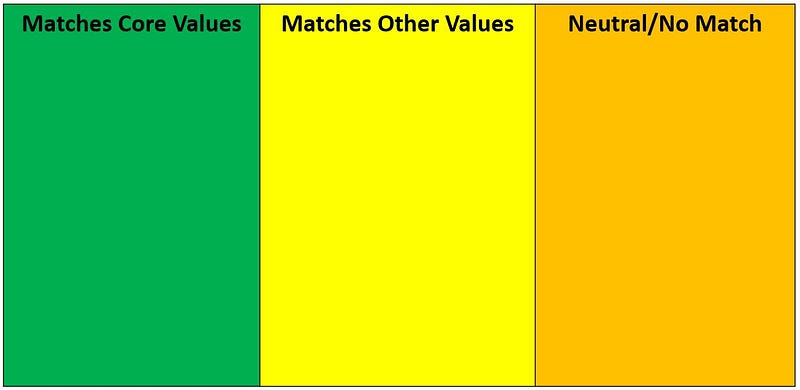
This is your target list for elimination, minimization, and delegation.
Ask yourself the following questions:
Eliminate:
- From my neutral/no match list, what can I eliminate? For the items that you feel you must do, ask yourself if that’s really true or if you’re just making an assumption.
- Is there anything in the Matches Other Values list that I can eliminate to make room for more time for the items that match my core values?
Minimize:
- From the items left on my Neutral/No Match list that can I minimize? What can I do less often or what parts can I eliminate to make the tasks shorter?
- Is there anything in the Matches Other Values list that I can minimize?
Delegate:
- Of the remaining tasks left, which ones can I delegate?
- Even if no one can do it better than I can, is it okay if it’s done less well by someone else? (The answer is an almost unvarying YES.)
- Now make an actual to-do list for when and how you will eliminate, minimize and delegate each of these items.
Step 4: Be intentional about your calendar
This process will make more space for you. If you don’t protect your calendar, however, this extra space will fill up with busywork.
First and foremost, consider not adding anything. Imagine what life will be like — what your work might be like — if you weren’t “busy.”
If you don’t suffer from being too busy, then choose with great intention what tasks you will spend more time on and what tasks you will add. Block time out on your calendar for them.
Moving Forward
I recommend you keep this list and three months from now, fill it out again and see if your distribution has changed.
You can also use it to evaluate new opportunities as they arise. Rather than taking on another to-do in your life, take some time to consider how it fits with your values and things you already do that align with them. Then you can make a decision based on what you really want—not just on the fear of missing out on an opportunity (and one that wasn’t right for you in the first place).
When you hold your core values at the center of your decision making, they act as a guiding light to show you what to say yes to and what to say no to. They guide you in the pursuit of work that is a better fit for who you are and who you want to be. That is work you can get excited about.


