
A Straightforward Account Of Those Living In Close Quarters With Death
Murakami’s Norwegian Wood is a thesis in grief
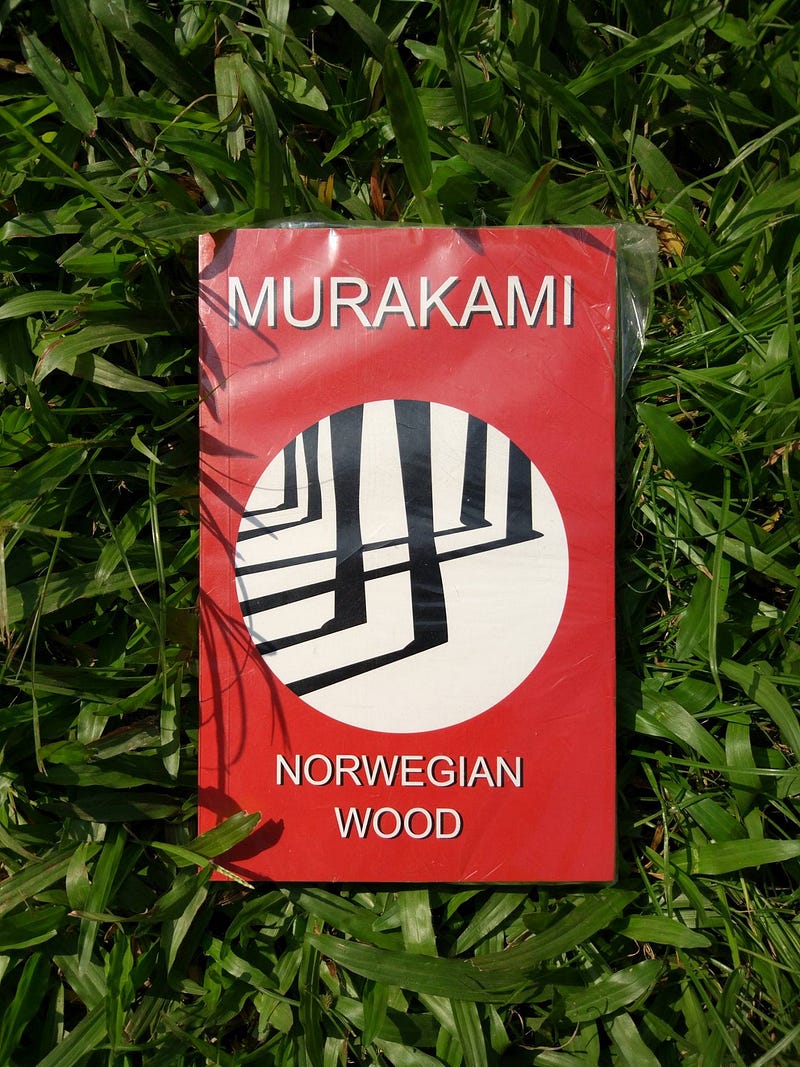
“Until that time, I had understood death as something entirely separate from and independent of life. The hand of death is bound to take us, I had felt, but until the day it reaches out for us, it leaves us alone. This had seemed to me the simple, logical truth.
Life is here, death is over there. I am here, not over there.
The night Kizuki died, I lost the ability to see death (and life) in such simple terms. Death was not the opposite of life. It was already here, within my being, it had always been here, and no struggle would permit me to forget that.
When it took the 17-year-old Kizuki that night in May, death took me as well.”
Norwegian Wood is one of the initial works of Japanese gem-of-an-author, Haruki Murakami. The novel was released in 1987, a little before I was born.
While the whole story is just a guy remembering his young adult days, it’s written like a traveler’s account. Often when we remember the past, its easy to attach our own shades to it — nostalgia, romance, regret, and then some.
But there is little emotional reminiscence in this story. Murakami traces the early years of his protagonist — Watanabe — with the industriousness of a factory supervisor. This happened, then that happened, and then the next day this happened.
It’s all very matter of fact. And therein lies that challenge: take what you will from it.
That’s why Norwegian Wood actually works.
The Events
A 17-year-old boy navigates through life in Tokyo in the aftermath of momentous (read big, bad) changes. Watanabe is a smart undergrad who has enrolled at a private University in Tokyo just to get out of his hometown. Norwegian Wood summarizes his years of Uni. What’s most interesting about the book is the events are actually the people he meets during these years.
Characters show up, then are cut away abruptly, kind of like how it happens in real life. Then some of them pop back up for no reason. It’s all very mundane; there are no lessons to be learnt here. Murakami makes no promises to tell you anything profound, and ironically, that’s what draws you into Watanabe’s world. Also, you don’t read Murakami for the plot line anyway.
Writing Style
At 300 pages, Norwegian Wood makes for a thick read. Most of the emotions in the story come from dialogue. The characters talk a lot. They have really long discussions that reveal their unique histories and perceptions, giving a sense of closure with each character.
Except Watanabe. You only know him through what little he speaks, and that’s what keeps you going till the end. In that manner, this book is a great example of the ‘Show-Don’t-Tell’ technique. There are no soliloquies or internal musings here. I’m the kind of reader who loves to dismantle the mind of the protagonist but Watanabe is a tricky fellow. He doesn’t talk a lot but he is a great listener. Ofcourse, that is why the other characters open their hearts to him.
Characters
This book is full of complicated, unfortunate women. Watanabe’s love interest and childhood friend, Naoko, looms at the core of the story. She is the deceptive little seed at the heart of a plush peach that ends up giving you a toothache. Naoko is the most interesting character of the story (even more than Watanabe) because she finds it too hard to cope up with the simple act of living.
Naoko’s older roommate, Reiko, is a mature woman who admits her own madness in such a clinical way that it scares the hell out of the reader. Then there is Watanabe’s friend, Midori, who is, again, a charming, quirky but extremely unlucky girl. There are more characters, by the way. Like Nagasawa (Watanabe’s impressive senior) and Hatsumi (his girlfriend).
What makes the story so engrossing is the way people keep killing themselves. Suicide is almost like a disease that shadows Watanabe. On an off note, let’s admit that Murakami is a bit obsessed with happy, normal-looking people topping themselves off.
What Makes This Book So Great
The story is very modern
Most of us know that Murakami’s works are translated from Japanese so the English is usually kept simple. Even so, the story itself is timeless. It has a lot of interesting, open dialogue and most descriptions are short and crisp. For a novel written back in the 80s, there are no winding sentences or detailed imagery. In fact, if he doesn’t tell us at the start that it’s 1968, it’s kind of hard to tell the era.
Living with death
The novel is a straight forward documentation of how people live with death. All the characters are survivors as all of them are dealing with the death of something crucial. Occasionally and with great care, Watanabe’s state of mind is also laid bare but only for the most observant reader. Like the time when Watanabe refuses to say ‘Present’ during the roll call in class. This conveys how deeply he refuses to be a part of this life — where friends die, go insane or simply vanish. The grey quadrangle outside Watanabe’s window constantly reflects the numbness he feels inside.
The dream-like story
Though the narration has a factual tinge, the story in itself has a dream-like quality. It’s surreal to meet with characters who own their emotions so well. One simply doesn’t encounter that sort of honesty in the real World. It kind of makes you wish that real people were more like Reiko or Hatsumi, who had the courage to say what they meant.
Final thoughts
Norwegian Wood — like a lot of Murakami’s works — is all about ordinary people trudging through lives full of anguish. And you will begin to feel restless while roaming the back alleys of Shinjuku or grossed out by the tiny bed of a love hotel. But remember, that’s exactly what the author intends for you to feel.
People suggested this one if one is a beginner in Murakami’s works. I’d say, start with a short story collection. Here’s one of my favorites ~ With The Beatles published in the New Yorker early this year.