
Nordic Summer Nights in this Haunting Munch Painting
Perception and expression in a landscape
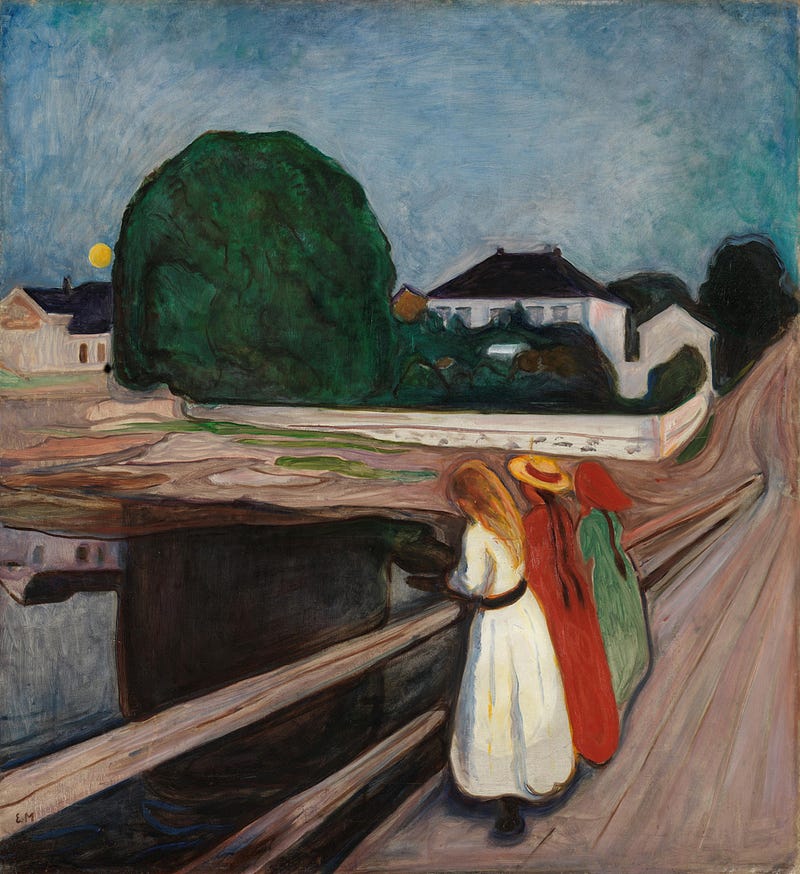
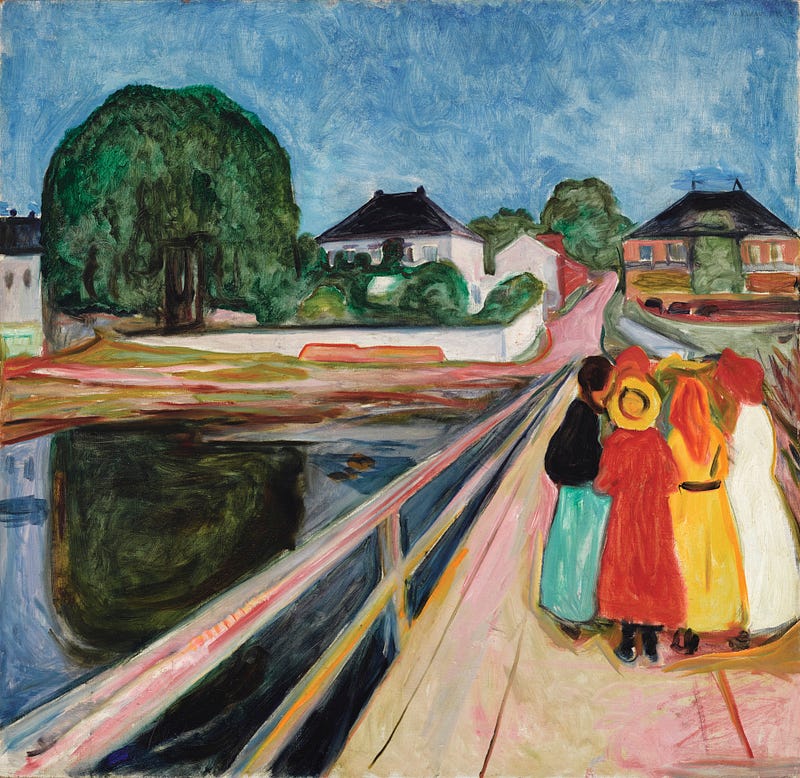
This Edvard Munch painting, titled The Girls on the Bridge, takes us directly into those crepuscular Nordic summer nights, when the sun never quite sets but skims the horizon before lifting again for the next day.
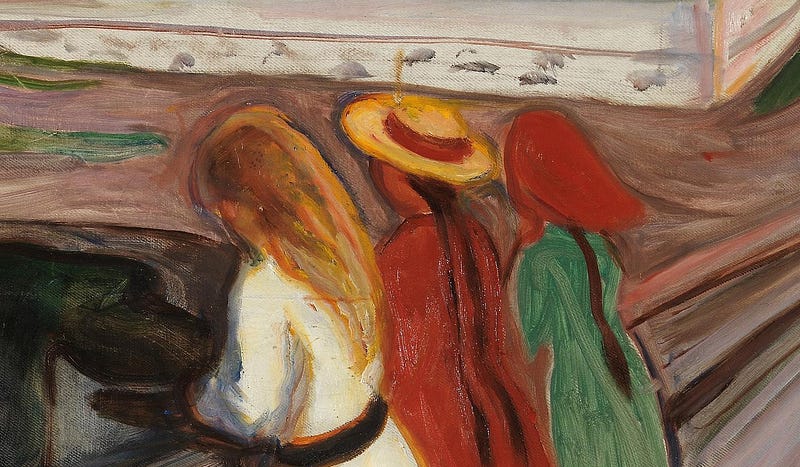
I’ve only seen a handful of Munch’s paintings in real life. Of those, one aspect that always strikes me is how the surfaces are made up of such thin and loosely handled paint. You can feel the brisk movements the artist must have made with his brush.
The texture becomes like a river flow, weaving in great currents around the canvas — brooding and brimming like a swollen river about to break its banks.
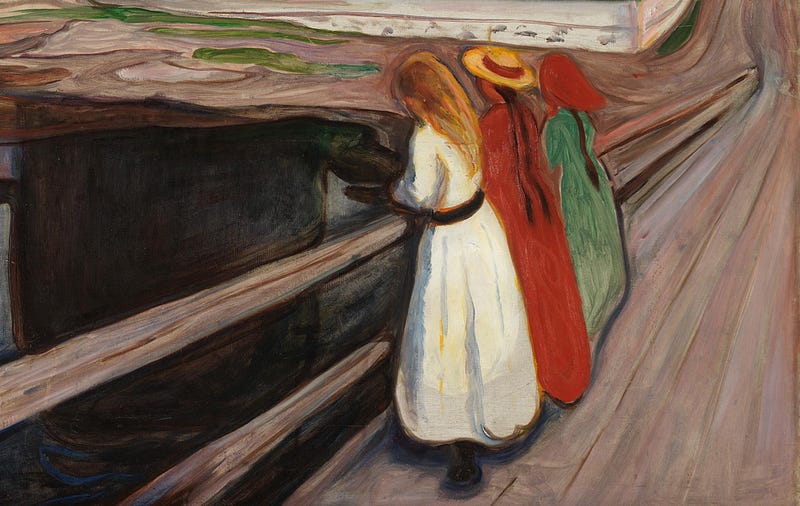
You only need to look at the smeared form of the bridge in this painting, or the spooling depth of the black water into which the three girls gaze.
It’s such a mystifying thing, since the paint feels insubstantial at close quarters, but when you step back it breathes and pulsates, coagulating into objects and people rather than simply depicting them.
This translation of paint into ghostly forms is what gives Munch’s paintings their unusual glowing, almost humming effect. It also helps that he painted deeply ambiguous images that toy with a sense of reality. We always feel like we’re glimpsing into a psychological dimension, where the interplay between people and landscape is fluid, suggestive of altered states.
It was a quality that not everyone around him appreciated. When, in 1892, Munch had the chance to show his pictures at the Association of Berlin Artists, the public was shocked at the surreal melancholy of his imagery. The exhibition closed prematurely after just a week, a failure that Munch reflected on with humour: “I could not have a better form of publicity.”
Expectant Mood
The Girls on the Bridge, made in 1901, depicts the seaside village of Åsgårdstrand in Munch’s home country of Norway, close to where he grew up and where he later had a summer house.
It shows us three girls standing on a bridge with their backs turned to the viewer.
Few details are shown with any clarity, except for their full-length monochrome dresses, along with their hair and headwear. Their presence is modest but insistent, seemingly private but sure of being seen.
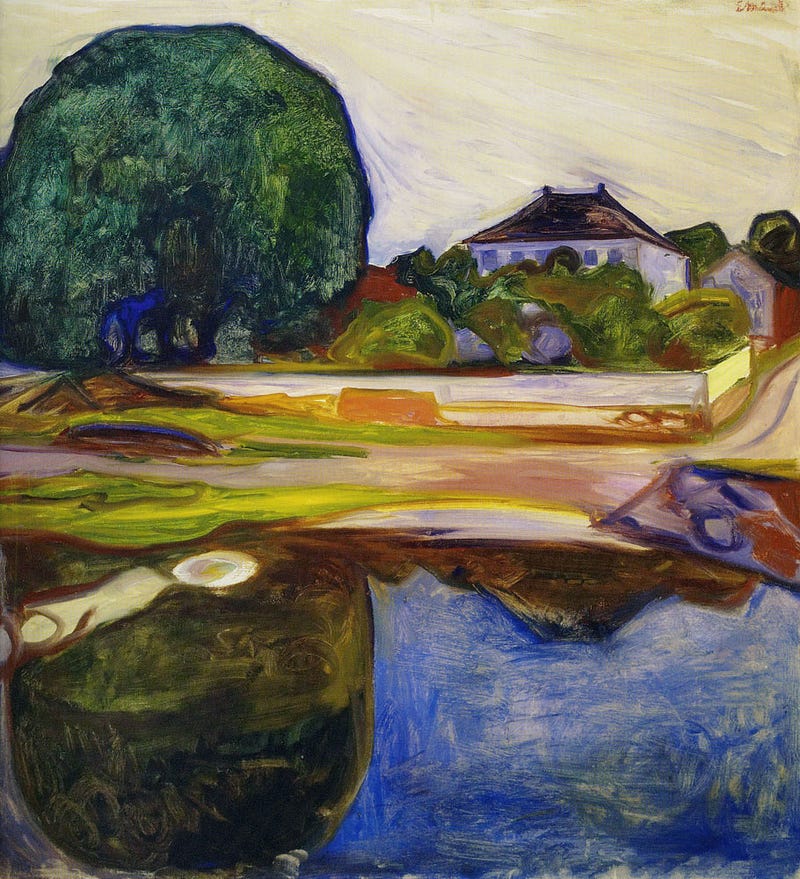

The house that appears in the background was (and still is) a stately manor known as Kiøsterudgården that featured in several of Munch’s paintings from around this time.
A low white wall surrounds the property, and in front of it a tree that the artist repeatedly painted as a hunched, ominous dark-green form whose body is reflected in the still water.
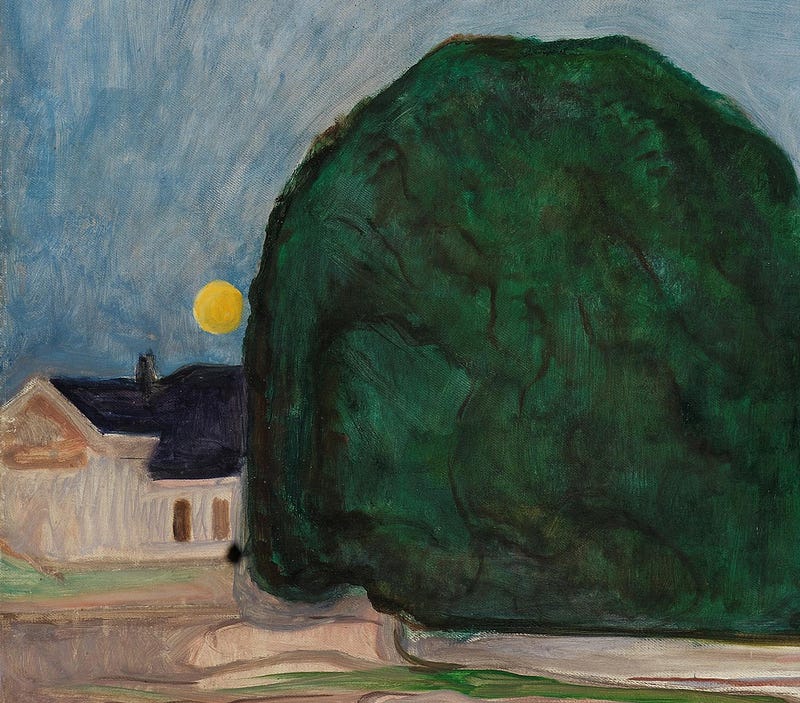
And just in sight, nearly touching the distant rooftop, is the summer sun, which faintly illuminates the scene in what feels like to me a perfect impression of twilight.
This low light unifies the scene and lends it a lyrical and expectant mood. If the three girls are stood waiting for something to happen, then we can sense it will happen slowly, and perhaps only confidentially, inside themselves.
An Artist at Home
Munch had bought a small house in Åsgårdstrand in 1898 and felt a deep connection with the coastal village. He was born not far away in Kristiania, today’s Oslo, in 1863.
Munch’s was a troubled upbringing. When he was five years old, his mother died from tuberculosis, and he was left in the care of his religiously zealous and emotionally unstable father.
As a child, Edvard was sick and close to death on several occasions. Forced to stay in bed for whole winters, he was unable to attend school and was taught at home instead. But his poor health also gave him the freedom to discover a passion — drawing.
At the age of 22, thanks to a scholarship, he finally travelled to Paris where he stayed for three weeks. For the first time, a bigger world beyond Norway opened up to him.
Yet, despite several later sojourns in France and Germany, he always returned to the area of his upbringing and painted most of his best-known works there. He later said: “Walking here is like walking among my paintings. I have such a desire to paint when I am walking in Åsgårdstrand.”
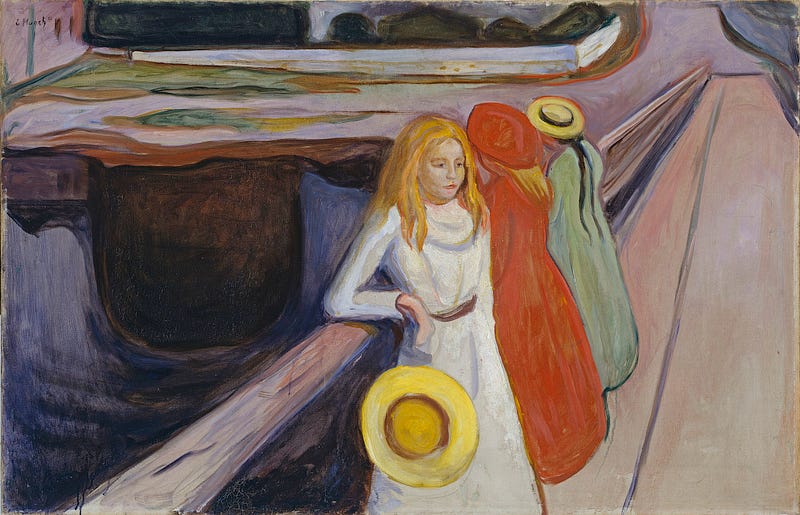
The image of girls or women gathered on a bridge was a theme that Munch returned to numerous times over a forty year span.
He painted twelve works with the same title, The Young Girls on a Bridge — with this work being the first of them. He experimented with different arrangements, sometimes showing the figures in a huddle in the middle of the bridge, and at other times turning at various angles to the viewer.
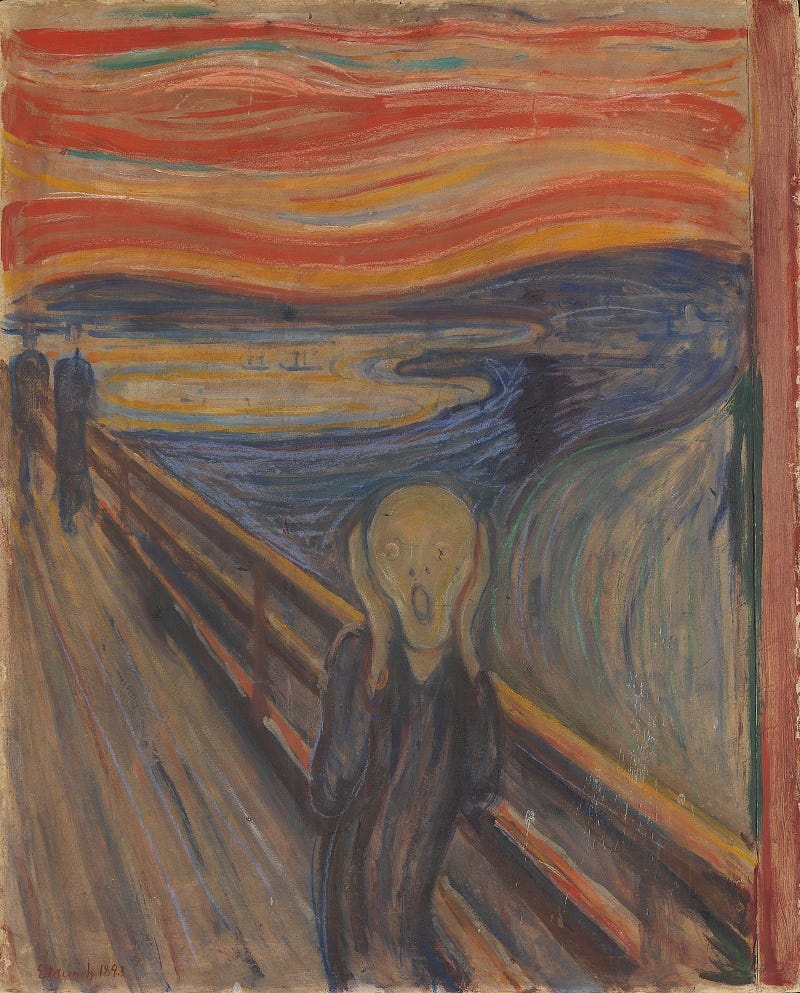
Another recurring motif was the diagonal element of the bridge, most instantly recognisable from Munch’s 1893 work The Scream. He evidently enjoyed the strident slanting thrust of the bridge, which he used in contrast to the curving forms of the sky and water.
It was the opposite he often employed: between man-made and organic elements. Munch’s figures tend to be placed somewhere in between, preserved in a never-ending process of flux, as the sinuous, serpentine landscape revolves around them.
Munch first displayed the painting in 1901 under the title of Sommeraften (“Summer Evening”); in a later exhibition of 1902 in Berlin, it had a slightly expanded title of Norwegische Sommernacht (“Norwegian Summer Night”).
Perhaps as much as any other of Munch’s paintings, The Girls on the Bridge succeeds in merging the observable world of landscape and figures with a psychologically perturbed undertone.
This marrying of perception and expression works, I think, because Munch left the ultimate theme open ended. The half-light cast by the midnight sun creates an equivocation that is both nostalgic and hopeful — a kind of beautiful uncertainty.

My most recent book is Great Paintings That Tell Stories, an exploration of some of the most iconic artworks in history.
Would you like to get…
A free guide to the Essential Styles in Western Art History, plus updates and exclusive news about me and my writing? Download for free here.
Join me…
On Instagram for more great paintings on the go!