avatarVidya Sury, Collecting Smiles

Free AI web copilot to create summaries, insights and extended knowledge, download it at here

4893

Abstract

work well for them. Moreover, some might have been conditioned by the idea that if a student could not perform well within a system that had worked for them, the problem lay with the student rather than the system.</p><p id="7a58">Although there is now a better understanding of learning disabilities, that understanding does not translate into the entirety of the education industry, with still too few schools and colleges catering to those who learn differently. Even then, those with mild learning disabilities or who are wired to learn differently could still fall off the curb.</p><p id="7024">In other words, if you are not the kind to learn well by rote or abstract reasoning, or if you are the kind to get distracted too easily not just by external stimulus but by over-obsession with details that others might skip over easily, then the conventional form of teaching, learning, and assessment will usually indicate that you are an under-performer.</p><p id="27bf">For instance, if you are very proficient with practical, artistic, and mechanical skills but fail to grasp mathematics and abstract sciences in the ways they were usually taught, the school authorities might think you are a better fit for vocational training than the academic route.</p><p id="3142">While this might appear to be empowering at a glance, it is actually another form of disempowerment. By convincing you that your talents can only lie in particular areas and that you should not even try to go that other route if you fail, the educational establishment need not expand its resources to diversify teaching and learning.</p><p id="5976">In other words, if you are good with words or art but perpetually fail school math, you should not even think about becoming a mathematician and engineer. The inverse is true — you may love to draw but find that you do not possess the supposed ‘natural’ aptitude that talented artists are supposed to have, so you think the world of art and all it entails might be the wrong choice for you.</p><p id="e405">Some learned belatedly as adults that what they thought they could never be good enough for was complete hogwash, as documented in the work of <a href="https://www.hup.harvard.edu/catalog.php?isbn=9780674034648">David Edwards</a> and <a href="https://barbaraoakley.com/books/learning-how-to-learn/">Barbara Oakley</a>, but these are the minorities and largely from the more elite sections of society. For many, they would feel that there is no turning back.</p><h1 id="0b70">3. Is there anything that you can do about this?</h1><figure id="d490"><img src="https://cdn-images-1.readmedium.com/v2/resize:fit:800/0*1H-22aqKtWronQRi"><figcaption>Photo by <a href="https://unsplash.com/@hillary_jeanne?utm_source=medium&amp;utm_medium=referral">Hillary Ungson</a> on <a href="https://unsplash.com?utm_source=medium&amp;utm_medium=referral">Unsplash</a></figcaption></figure><p id="7616">That depends on your willingness and where you are at in life. For those still within the K-12 system (or if you are parents of children of K-12 students facing some of the issues I have mentioned), here are some workarounds that I wished I knew as a student and which I know very well as a college teacher.</p><h2 id="bd6c">A. Teachers are very human with their own biases, prejudices, and blind spots.</h2><p id="b0b7">But this does not mean that you cannot make full use of what they have to offer. You begin by asking questions, and lots of them. A lesson I learned from teaching very young children is how they are not afraid to ask questions or sound stupid, and this self-confidence appears to depreciate the older they get as learning traumas accumulate.</p><p id="1300">In school or college, you may find that certain subjects come more easily to you than others, and usually, that means that how the subject is or was taught to you resonates more with how you are wired.</p><p id="8f29">Find out if you could apply some of the same methods that have worked well for you in these other subjects to subjects that are your weak points. Don’t try to do this all alone — talk to your teachers or principal if possible. If you find the teacher to be less than helpful, try to look around for other potential resources for help (the Internet could be helpful if you look the right way).</p><h2 id="eca2">B. Try thinking about the subjects you hate in the same way that you think about the topics you love.</h2><p id="10e5">Although I was a science student and even became a science major in college, I actually found the formal learning of science exceedingly hardgoing and uninspiring, so my formal education in science saw me with mixed grades. For the longest time, I did not understand why what made sense to others was so confusing to me.</p><p id="3e71">Although I love the big ideas science carries, I could not make myself care about their mundane details. It was not

Options

until I started studying literature formally (which was the beginning of my entry into other humanistic studies), that I finally realized how naive and wrong-headed I had been about learning.</p><p id="d33f">I took to studying literature easily, because a young love for stories had already wired my brain to look into multiple layers of meaning within a text, finding intentions in the interactions among characters, and even to see how events, both the tangible and abstract, could be connected to each other.</p><p id="6c31">As a highschooler and, later, college student, I mistakenly thought that science was not like that when that was never the case. Those who did well intuitively understood the importance of finding your own resonance with the material you are learning rather than using another person’s approach.</p><p id="8ef3">Many years after that realization, I ran a <a href="https://www.epicurusartsci.com/news-and-announcement">project</a> teaching STEM educators the importance of awakening the imagination of their students, not by imposing a specific way of thinking on the students, but by allowing the students to form and then examine the narratives they have formed about the topics they are learning in a way that is fitting with their experience and level of knowledge.</p><p id="4c9f">That project was inspired by earlier projects relating to artscience learning I had subsequently written up and <a href="https://www.researchgate.net/publication/358954493_Channelling_Artscience_Through_Fan-Fiction_for_Diversifying_STEM_Approaches_in_Participatory_Learning_in_Malaysia">published</a>. All of these projects were my own adult exploration of the what-ifs of learning if I could relive the life of a youthful learner.</p><h2 id="5e8d">C. Struggling makes you a better person.</h2><p id="04b3">As a college teacher, I had taken a continuing course on college teaching with a math professor from another institution. She told the participants of the course that math did not come easily to her despite being a math educator today and that she had struggled hard as a student.</p><p id="c70f">However, it was this struggle that made her an empathetic teacher and more determined to find ways to make math work even for the most math-phobic student (as an aside, math phobia can have a terrible consequence on your life, especially in how you manage your finances regardless of how successful you might be otherwise).</p><p id="39e8">Many Nobel Prize winners <a href="https://www.hindustantimes.com/world-news/nobel-chemistry-winner-failed-the-first-college-chemistry-exam-101696437940956.html">struggled through failures</a> before they became the success everybody wanted to emulate. Entrepreneurs live with daily <a href="https://www.weforum.org/agenda/2021/11/why-failure-is-important-for-entrepreneurs-lessons-from-9-founders/">failures</a>, big and small.</p><p id="e2aa">If you have failed before, your ability to take calculated risks and tolerance for discomfort goes up. I came from an education system that punishes failure rather than uses it as a learning opportunity.</p><p id="48dc">Hence, it is not uncommon for those coming from such educational programming to associate anxiety with <a href="https://www.theguardian.com/science/occams-corner/2016/jan/04/academic-anxiety-dreams-what-they-mean-jenny-rohn">dreams of taking an exam</a> while feeling thoroughly unprepared. As an educator, it became necessary to revisit that painful past so that I could develop more empathy toward my students.</p><p id="f41f">As an entrepreneur with empathy, you can create more meaningful products and meaningful work for your employees. If you are an adult today and have always had problems with a subject or in learning a particular skill due to the way you were taught, now you are in a sufficiently safe space to try again without needing to compete with another person.</p><p id="9403">I did that myself when I decided to enroll in courses on Coursera during the pandemic lockdown to work on subjects I used to have difficulties with. Without even caring about the outcome, confronting the fear left an impalpable sense of accomplishment.</p><p id="d914">Thank you for reading my story.</p><div id="af97" class="link-block"> <a href="https://medium.com/@normasalim/subscribe"> <div> <div> <h2>Get an email whenever Clarissa Ai Ling Lee, PhD publishes.</h2> <div><h3>Get an email whenever Clarissa Ai Ling Lee, PhD publishes. By signing up, you will create a Medium account if you don't…</h3></div> <div><p>medium.com</p></div> </div> <div> <div style="background-image: url(https://miro.readmedium.com/v2/resize:fit:320/0*Ikcee5gQpM1TlOFG)"></div> </div> </div> </a> </div></article></body>

Globetrotters | Travel | Photography

Norbulingka Institute — a Tribute to Tibet’s Heritage

And of course, happy belated birthday to its founder, The Dalai Lama

The deity at the Norbulingka Institute. Vidya Sury ©

In April 2015, during our trip to Dharamsala, Himachal Pradesh, we met the Dalai Lama. Oh yes, just saying that takes me right back to that moment when he asked me “You came all the way from Bangalore to meet me? Thank you!” And squeezed my hand. And leaned into my hug. And tickled my son’s beard. I still feel the warm cozy pressure of his hand.

I am taking you to the Norbulingka Institute today, a peaceful and picturesque world all its own.

Norbulingka Institute, Sidhpur, which is a pleasant 30-minute drive from Mcleod Ganj, Dharamsala, Himachal Pradesh, India, was officially inaugurated in 1995 by His Holiness the Dalai Lama. The weather was gorgeous, gently sunny with the promise of April showers. Nature did not disappoint.

Norbulingka Institute

Norbulingka Institute was founded in 1988 by Kelsang and Kim Yeshi, with the aim of preserving Tibetan heritage and culture in its literary and artistic forms, as a haven for artists to work on their crafts. Today, visitors from all over the world flock here to explore live workshops and see traditional artists at work.

As soon as one enters the gates, it is a different world with gurgling streams, charming Zen-style gardens, birdsong, and green-green-greenery. Nature truly loves it here! The architecture is reminiscent of an old Tibet.

Norbulingka means “Jewel garden” and the Institute is a fabulous example of community living while nurturing a self-sustaining living heritage.

The ground plan for Norbulingka Institute follows the proportions of the deity of compassion, Avalokitesvara.
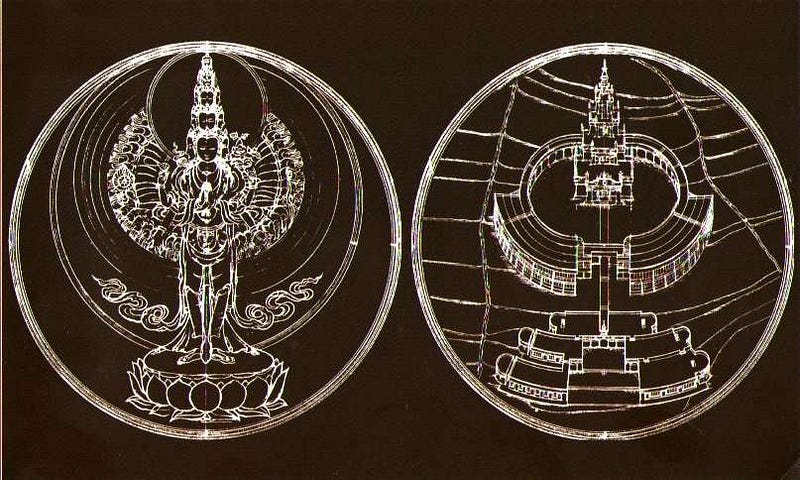
Floor plan of the Norbulingka Institute Vidya Sury ©

While the workshops and offices are constructed in the shape of his thousand arms, the temple is his head, and in the middle is the water spring, representing his heart, emanating kindness to all living beings.

Artists at work

Most of the artists were employed for the actual construction of the institute, which was designed in traditional Tibetan architectural style.
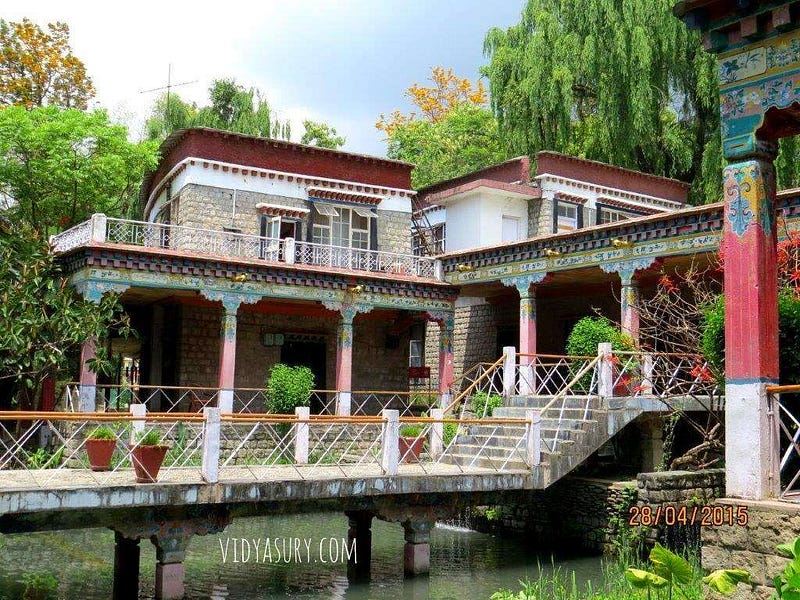
Vidya Sury ©

Woodcarvers and carpenters helped to erect the buildings, while thangka painters worked tirelessly to complete the frescoes on the walls of the temple.

Today, Norbulingka has nine workshops including thangka painting, statue making, thangka applique, woodcarving, applique, wood painting, tailoring, weaving, and screen printing.
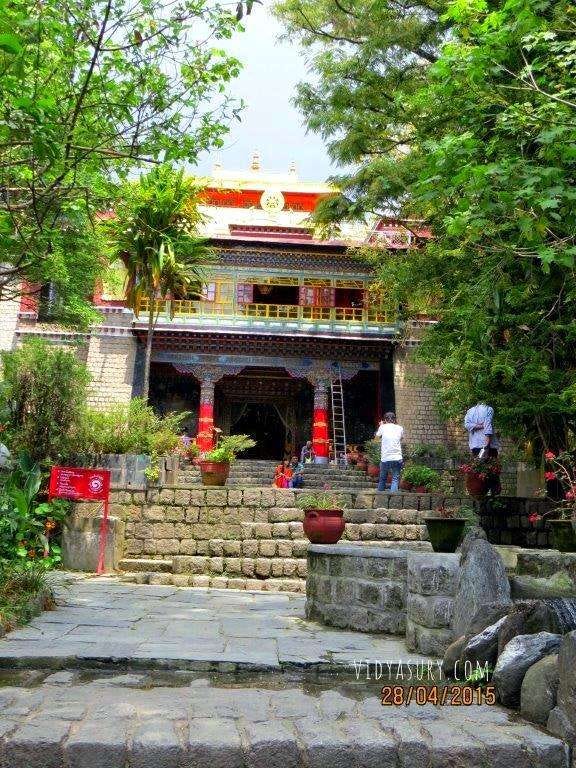
Vidya Sury ©

There are customized workshops where visitors can enroll as individuals or in groups and get acquainted with thangka sketching, wood carving, wood painting, and appliqué. A master artist will supervise each participant, who, at the end of the workshop, will proudly take home a beautiful work of art created by her.
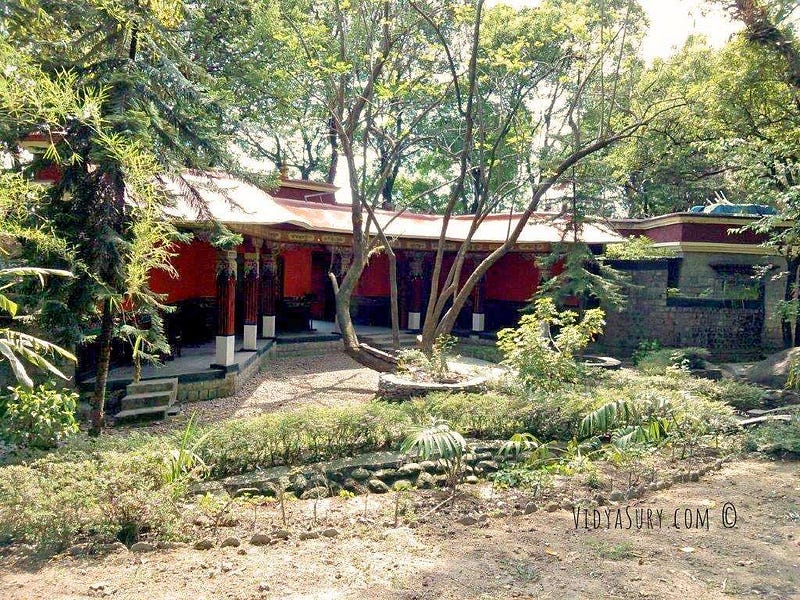
Vidya Sury ©

There are over three hundred people at the Norbulingka Institute, including masters, their apprentices, scholars, students, the admin, and hospitality staff.

The fields around Norbulingka have now transformed into a thriving and I felt, stylish, Tibetan community with plenty of cafes, restaurants, shops, and homes.

Let’s go inside now!

There is a guesthouse, a café, a temple, a museum, and a shop. We learned that the ideal time to visit is March to May and Oct to Dec. July to September is when monsoons strike and it can be very wet.

By the time we reached Norbulingka, a gentle shower had started. We paid a nominal entry fee of Rs.40.00 and entered the gates.
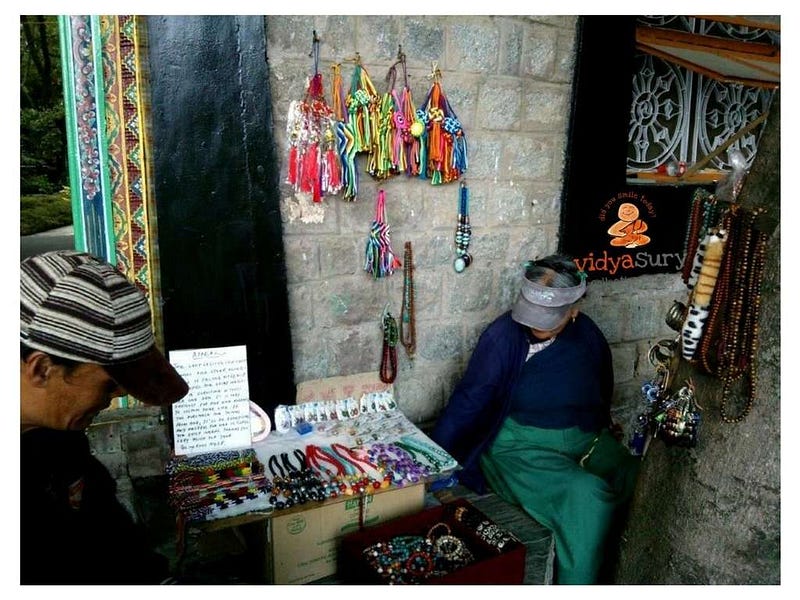
A the entrance Vidya Sury ©

Apparently, there’s a guided tour available, but we preferred to wander around on our own and explore. Of course, we were fascinated by everything we saw. The ambience was so soothing and…Zen!
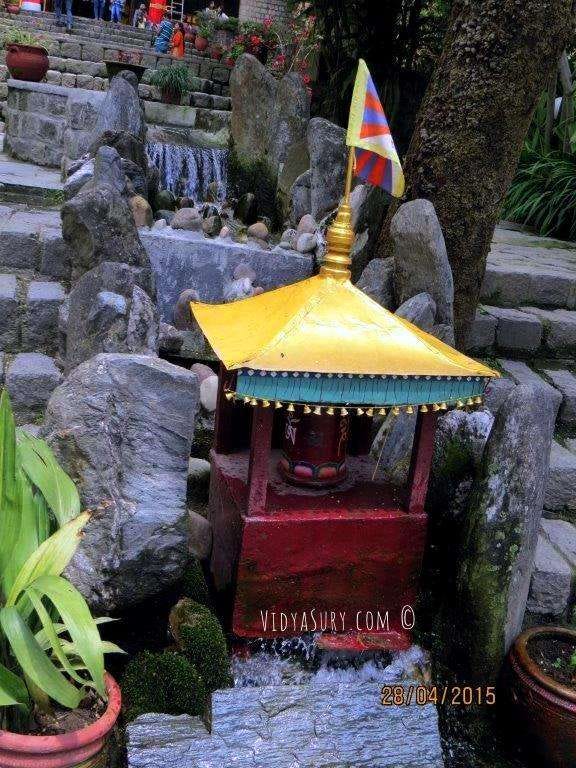
Vidya Sury ©

As I twirled the prayer drums, I was definitely dreaming of meeting the Dalai Lama the next day!
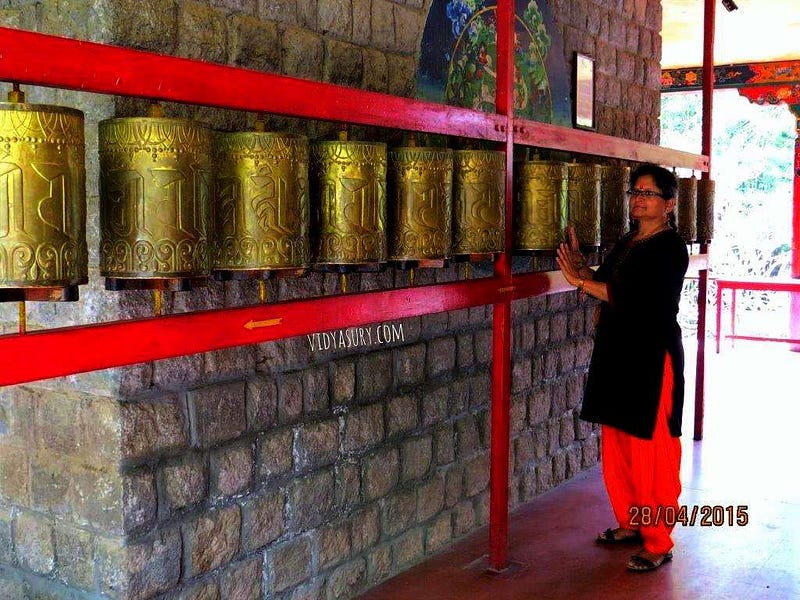
Vidya Sury ©

After walking around the grounds for a while, and noticing the little streams and shrines, we entered the main area to look at the Tibetan artisans and their apprentices at work.
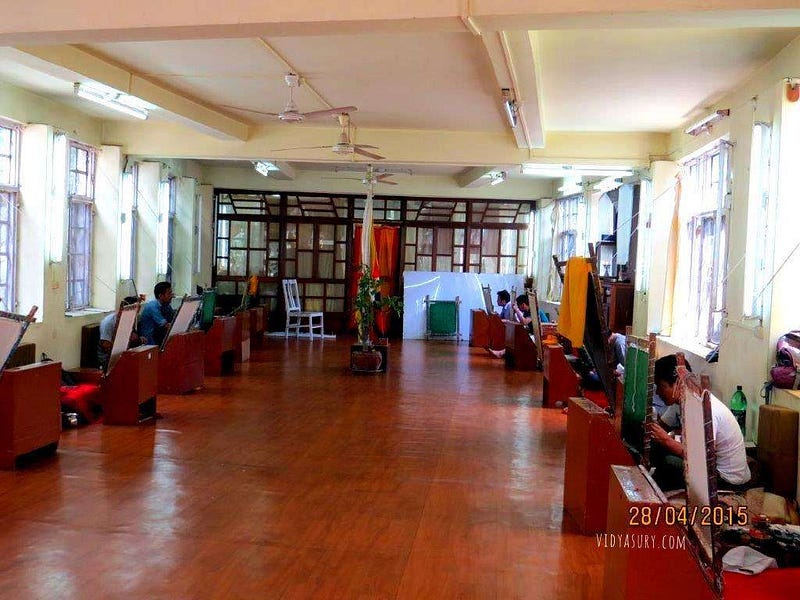
Vidya Sury ©

There are sections on various ancient Buddhist art forms including statue-making, thangka painting, thangka applique, woodcarving, wood painting, tailoring, and weaving. The doll museum was exquisite.

What really stood out for me was the perpetual smile on everyone’s faces. Ever friendly and happy to spend the time of day with anyone who stopped to talk.

Our next stop was at the gorgeous temple, Deden Tsuklagkhang (say that five times — that is your homework today!)
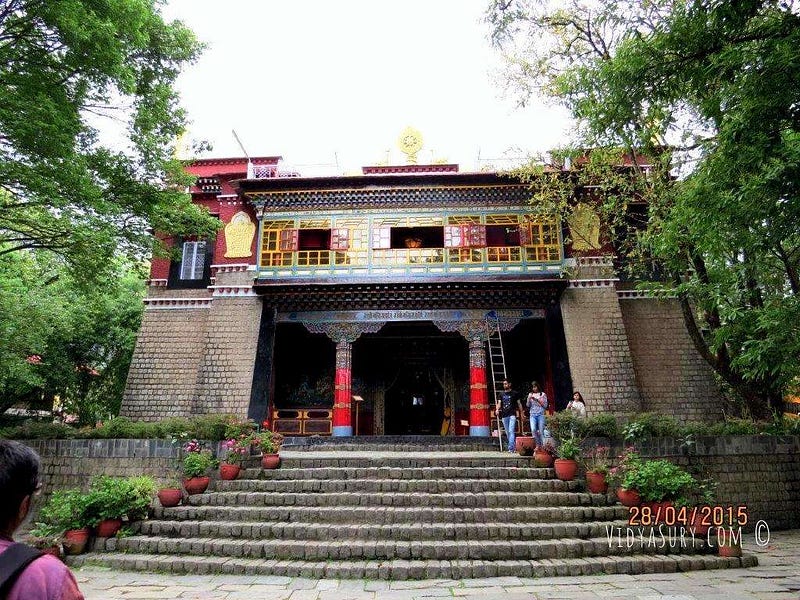
Vidya Sury ©

The Tibetan religious architecture and art done by Norbulingka’s artists makes it a serene place, where one can pray or just sit and reflect.
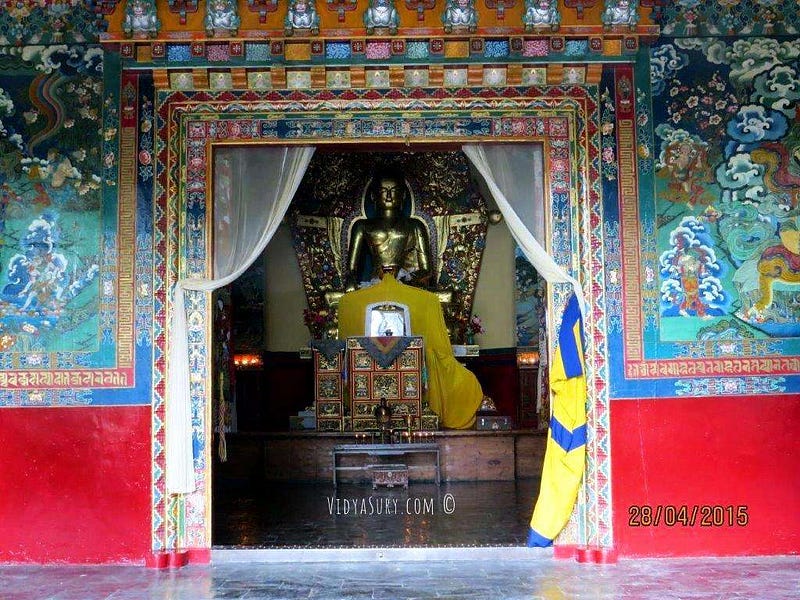
Vidya Sury ©

The walls are rich with thangka frescoes portraying Buddha’s life work, the fourteen Dalai Lamas, and other Buddhist greats.
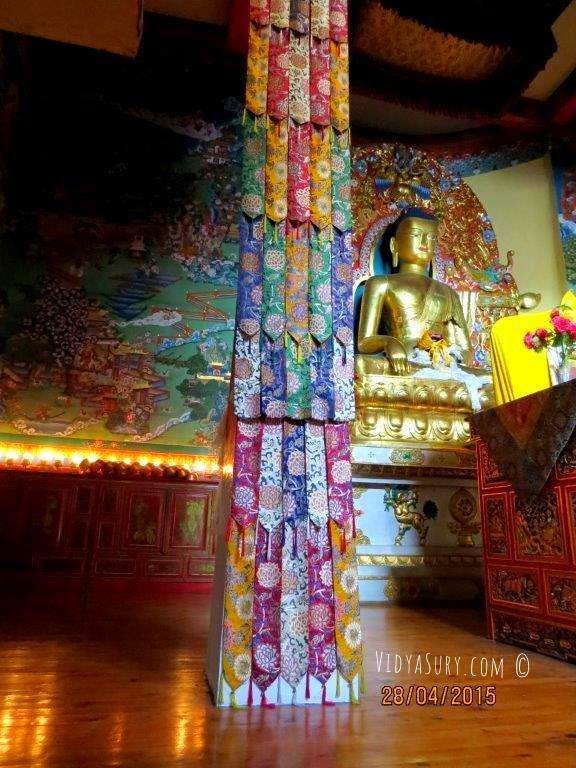
Vidya Sury ©

An applique thangka, almost two stories high hangs from the ceiling, and is stunning to look at.
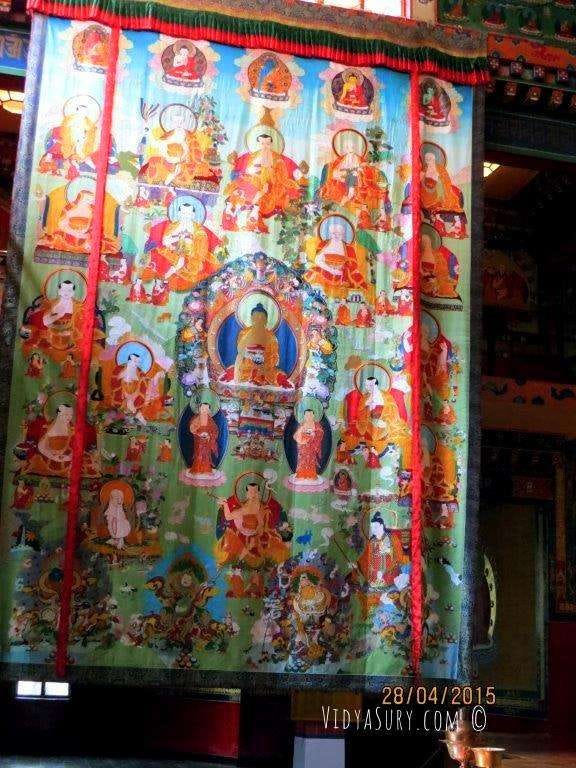
Vidya Sury ©

It portrays the Buddha and the 16 arhats — I can only imagine how many artists, and how many thousands of hours must have gone into it.
Vidya Sury ©

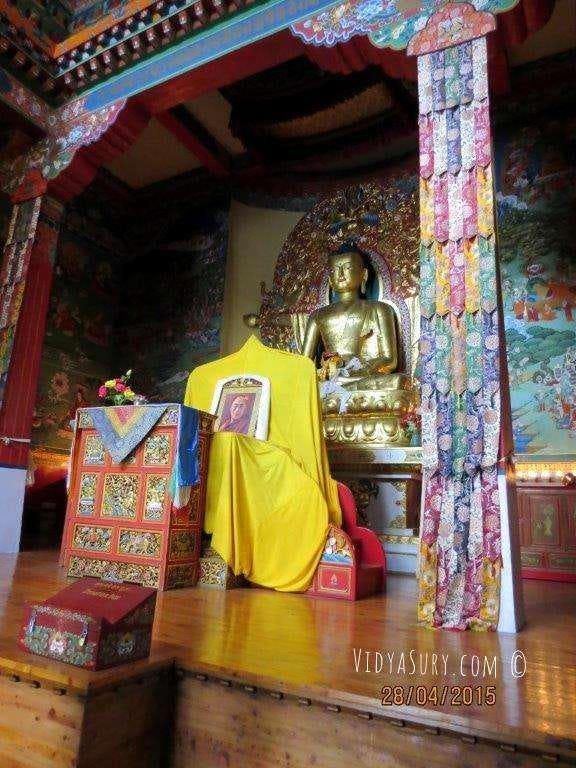
Right in the center of the temple and visible from the outside, is a 14-foot-high gilded statue of the Buddha Shakyamuni, the largest of its kind outside Tibet. This is also made by Norbulingka artists from hand-hammered copper sheets.

The expression on his face is … sweet!

Oh this face! Buddha Shakyamuni, the largest of its kind outside Tibet — Vidya Sury ©

The Doll Museum

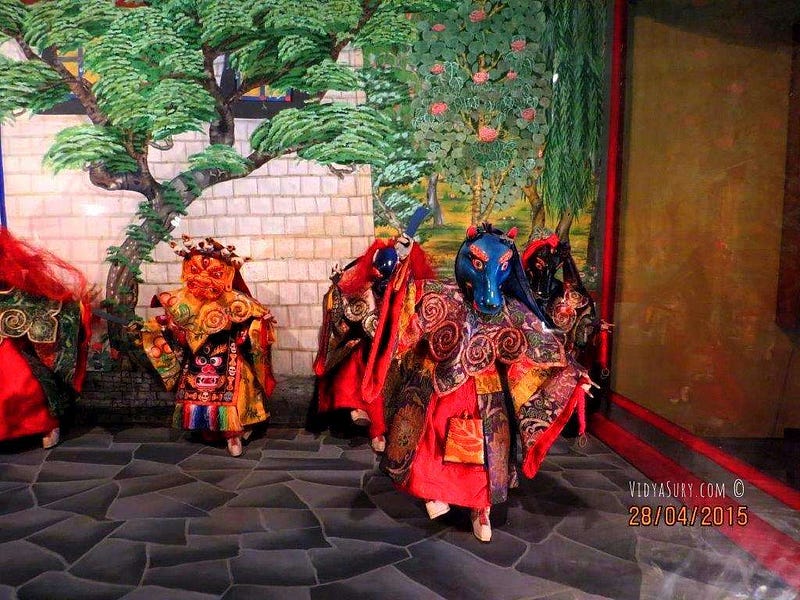
My son couldn’t wait to get into the Losel Doll Museum on the premises, where a collection of more than 150 dolls dressed resplendently in traditional garb from various regions in Tibet are on display.
Vidya Sury ©

These garments are made from the original materials and give an insight into traditional life in Tibet.

The Losel Dolls were created by a group of artist monks from Drepung Loseling Monastery. There’s a small entry fee to see the museum.

Onsite shop

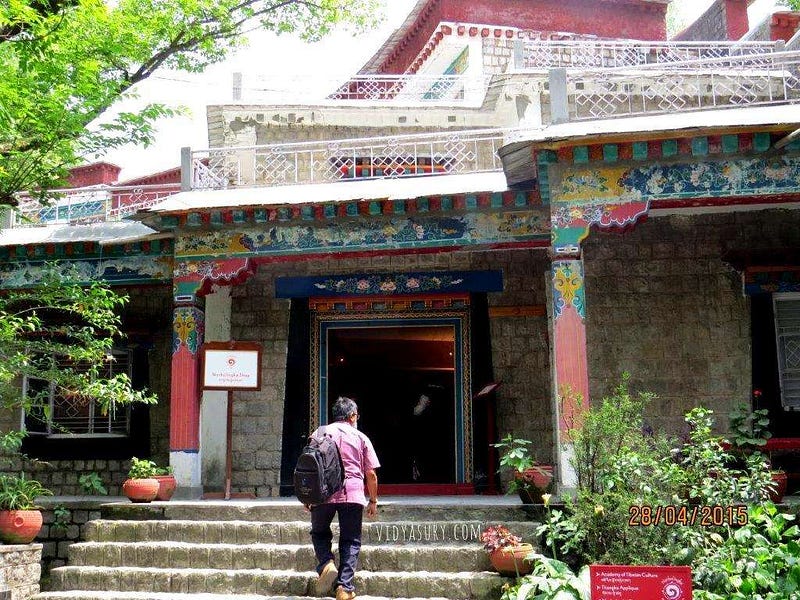
Next, we wandered into the Norbulingka shop, which offers the entire range of products created in their own workshops — thangkas, handmade furniture, clothing and accessories, and plenty more. We weren’t allowed to take pictures inside the shop. While everything was slightly on the expensive side, it was a treat to window shop.
Vidya Sury ©

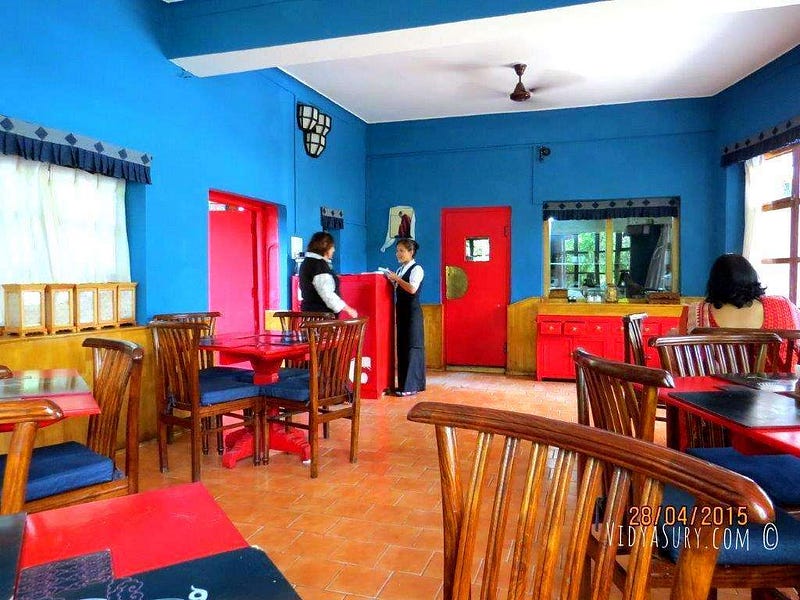
Our final stop was the Hummingbird Café, thanks to our growling tummies. We contemplated driving back to the city to eat, but figured we might as well enjoy the experience of the Café, whose menu covered vegetarian international cuisine, ranging from Tibetan Thukpa to cheese pizza to hummus to freshly baked pita bread to the ever-present momos.
Vidya Sury ©

They also had juices and smoothies and ahem! Specialty coffee drinks. Dessert is homemade cakes. We learned that there is a conference hall that can take up to 200 people. Beautiful place!

Vidya Sury ©

Replete with a pleasant lunch, we reluctantly left Norbulingka Institute. However, once we got into our car and headed back to Dharamsala, we were excited at the thought of visiting the fabulous cricket stadium set against the backdrop of the snowcapped Dhauladhar mountain range. Sigh.

Did I say everything about our trip was superb? The weather, the company, the people…everything! I took close to 1500 pictures that day!

Did you enjoy the trip? ❤

My heartfelt thanks to the editors of this fabulous publication — Globetrotters 💐

Vidya Sury, Collecting Smiles ❤ Did you smile today?

Help me support underprivileged children via Ko-Fi. Thank you!

Somewhat enviously, I recommend Darren Weir’s gorgeous series on Rajasthan, India. I haven’t been, and I hope to, soon!

Chase waterfalls with me here:

Travel
Photography
Art
Inspiration
This Happened To Me
Recommended from ReadMedium