
None of Your Article’s First Paragraphs Are Original
Some algorithm has already written them
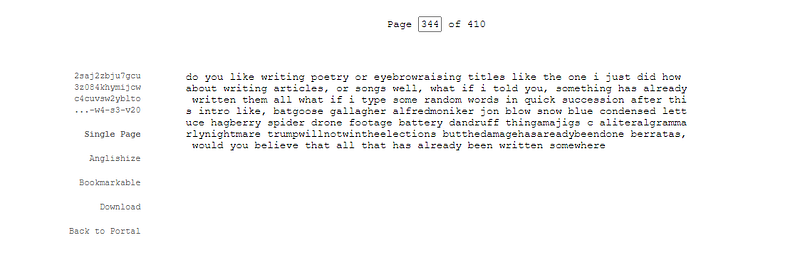
Do you like writing poetry? or eyebrow-raising titles like the one I just did? How about writing articles, or songs? Well, what if I told you, “Something” has already written them all? What if I type some random words in quick succession after this intro like, batgoose gallagher alfredmoniker jon blow snow blue condensed lettuce hagberry spider drone footage battery dandruff thingamajigs c137 aliteralGRAMMARLYnightmare trumpwillnotwinthe2020elections butthedamagehasareadybeendone berratas, would you believe that all that has already been written somewhere?
Well, as eerie as it may sound, it already has; and it is in a page, in a book, on a shelf, in a hexagonal room, inside a giant library.
I am talking of course, about The Library of Babel. The library of Babel is a library of everything. It is a website that literally contains everything that has been — or could be — written.
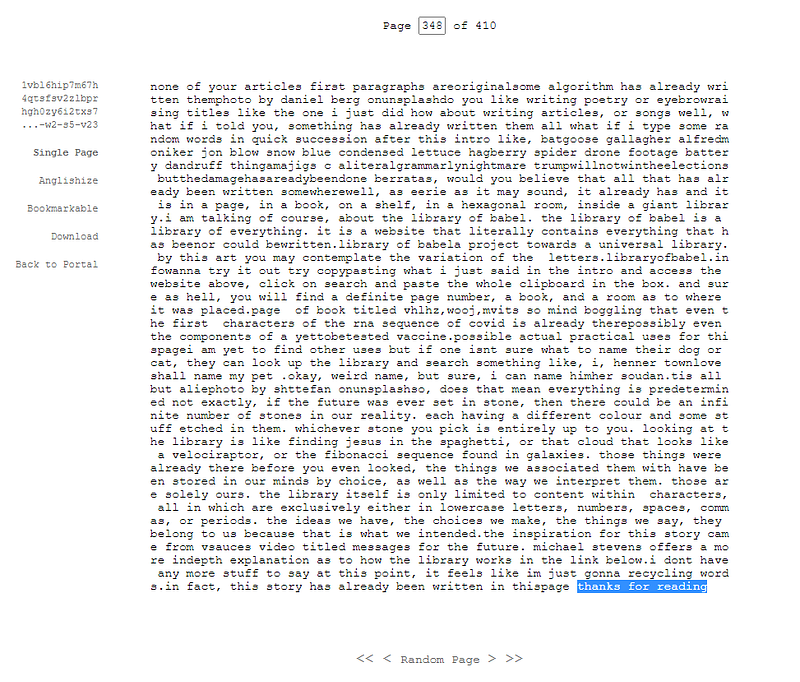
Wanna try it out? try copy-pasting what I just said in the intro and access the website above, click on search and paste the whole clipboard in the box. And sure as hell, you will find a definite page number, a book, and a room as to where it was placed.
It’s so mind boggling that even the first 3200 characters of the RNA sequence of COVID19 is already there — Possibly even the components of a yet-to-be-tested vaccine.
Possible Actual Practical Uses for This Page
I am yet to find other uses but if one isn’t sure what to name their dog or cat, they can look up the library and search something like,
“ I, Henner Townlove shall name my pet” _____.
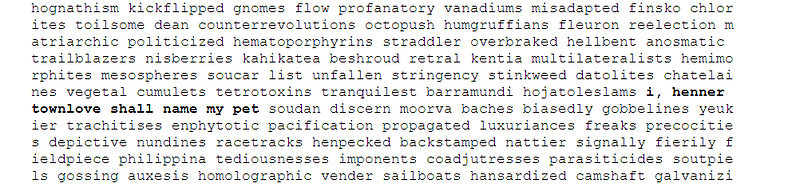
Okay, weird name, but sure, I can name him/her Soudan.
Tis all but a lie!!
So, does that mean everything is predetermined? Not exactly, if the future was ever set in stone, then there could be an infinite number of stones in our reality. Each having a different colour and some stuff etched in them. Whichever stone you pick is entirely up to you. Looking at the library is like finding Jesus in the spaghetti, or that cloud that looks like a Velociraptor, or the Fibonacci sequence found in galaxies. Those things were already there before you even looked, the things we associated them with have been stored in our minds by choice, as well as the way we interpret them. Those are solely ours. The library itself is only limited to content within 3200 characters, all in which are exclusively either in lower-case letters, numbers, spaces, commas, or periods. The ideas we have, the choices we make, the things we say, they belong to us because that is what we intended.
The inspiration for this story came from VSauce’s video titled Messages For The Future. Michael Stevens offers a more in-depth explanation as to how the Library works in the link below.
I don’t have any more stuff to say; at this point, it feels like I’m just gonna be recycling words.
In fact, this story has already been written in this page:
Thanks for reading


