
Non Verbal Tendencies in Beckettian Drama
Giving power to the unspoken word and the belief that acceptance of one’s fate can set you free

In this article I will identify examples of non-verbal drama within Samuel Beckett’s plays and consider how these have impacted on the world of theatre.
After a world torn apart by War and the horrors and atrocities commited, man wondered at the meaning of life in its aftermath. This context is crucial in beginning to understand Beckett’s work as he emerged in to the world of theatre and for academics trying to unravel the meaning behind his work. Timothy Pytell a professor of history, writes about Viktor Frankl’s search for meaning after surviving Auschwitz:
Fundamentally, therefore, any man can, even under such circumstances, decide what will become of him-mentally and spiritually. He may retain dignity even in a concentration camp. If there is meaning in life at all, then there must be meaning in suffering….Here lie the opportunities of attaining the moral values that a difficult situation may afford him. And this decides if he is worthy of his sufferings or not.
Frankl cited in Pytell, 2003, 101
For Frankl, an Austrian psychiatrist and neurologist, understanding the meaning of his dehumanisation and suffering, found him a certain kind of autonomy in death. This ‘Existentialist’ view presumes that man is responsible for shaping his progression, through the choices he makes. Thus, the only way to influence a change in social condition is to first understand the human condition, that society was in effect a symptom of one’s own anxiety and desire. For many including Frankl, this search for meaning characterised a way of coming to terms with the psychological tumult brought about by War and the death of loved ones.

This search for meaning was of course not just confined to Frankl, it brought about the literary and philosophical Existentialist movement, under which Beckett is often classed. The Existentialist artist believed that art was not about teaching, but about bearing witness to one’s own existence, art’s purpose was to merely be; therefore existence was purely to exist. (Carlson, 1993, 415)
Beckett belonged to a group of dramatists given the name ‘Theatre of the Absurd’ that believed that the world was disordered and beyond logical rationalisation and therefore, man had to do something significant to make his life have meaning. (Worthen, 2002, 533).
Whether one chooses to classify Beckett’s work as absurdist or not, one thing does remain evident, that Beckett had a great love of language and believed in the power of both the spoken and unspoken word. John Calder, writer and publisher, explains how at first Beckett struggled with language and was perplexed at how it had a tendency to conceal as much as it could reveal:
As we cannot eliminate language all at once, we should at least leave nothing undone that might contribute to its falling into disrepute. To bore one hole after another in it, until what lurks behind it — be it something or nothing — begins to seep through; I cannot imagine a higher goal for a writer today.
Beckett cited in Calder, 2001, 17

Both the intellectual and philosophical problems of language continued to perplex Beckett and the meaning they conveyed. Calder believes that Beckett felt he had successfully presented these problems with his early work Murphy. Considered by some to be partly autobiographical the character ‘Murphy’ hunts for a way to transcend to a higher plane or a meditative state where free from sensation he can become alive in his mind. This preoccupation with the conflict between the mind and body seemed to become the common connector and the sense of ‘dualism’ that was to become evident in Beckett’s work. This is a view also shared by Leslie Fiedler, American literary critic, who considers Beckett to be the master of psychological and physical separation:
As early as “Murphy,” he has discovered his function as the laureate of dissociation, the celebrator of the schizoid. The logic of the method of “stream of consciousness” leads finally into illogical depths where outer reality is lost in the shifting of fantasy and dislocated memory, where the “real” no longer matters. It is this lost world that Beckett has been trying to find; and because he has been seeking it, he makes the schizophrenic his model and hero.
Fiedler, 1997, online
Beckett soon became known as having a specific uncovered minimalist style with recurring themes such as insanity. This style can be seen as a poetic constant search for the meaning amid what is seen and what is said. Beckett’s characters are articulate and often preoccupied with time, his plots cyclical and repetitive rather than linear. His creative vision was tied to the philosophy that to laugh at one’s own circumstance, is the only way that one can start to tolerate it.
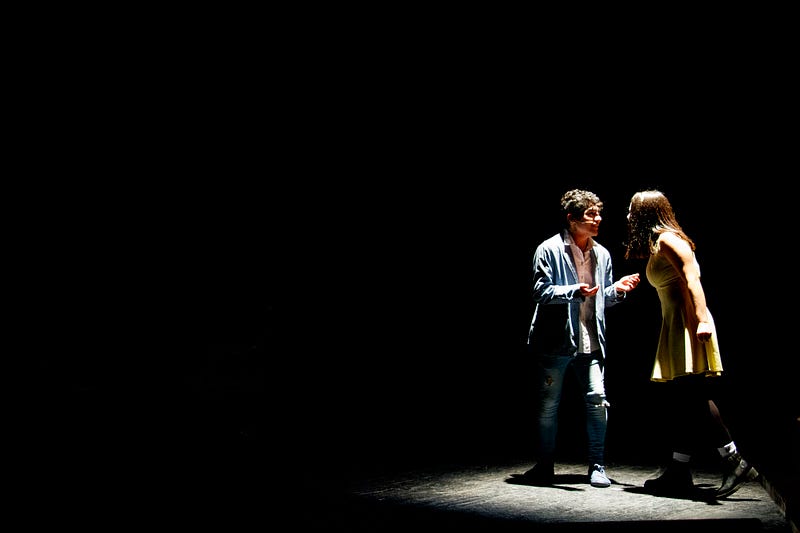
What is truly innovative about Beckett’s work is the recognition that meaning is conveyed through more than just spoken language. Rather than having a stage filled with set and props that are merely unimportant objects, the Beckettian play has a sparse landscape and anything placed within it has a purpose and a thought process to the connotation it gives.
Antonin Artaud, French dramatist, describes this as the physical language of the stage, the things that are exposed initially to the senses rather than psyche. He explains that each and every object placed upon a stage as well as every sound, light and piece of scenery have their own expressive poetry that combine to give an apparent significance on stage. In addition to these physical viewable objects, we must consider the consciousness or metaphysical, the complex language of signs, gesture, posture and linguistics which culminate to provoke thought and change attitude. (Artaud, 1958, 33–47)
The works of Beckett tend to be anti-naturalistic in as much as they show a knowingness of technology and draw attention to the apparatus used in making theatre. For example in Eh Joe written in 1965 one of the main features is the camera, “Camera has nine slight moves in towards face”. (Beckett, 2006, 361) Consequently rather than it being a hidden piece of equipment, it becomes a vital part of the piece with its own set of signifiers. Furthermore the works of Beckett at times play ‘across the footlights’ and refer to the world of the audience, as well as the process of theatre making. For this reason they can be viewed as having elements of self awareness or ‘meta-theatricality’ and therefore do not have the burden of having to show life as true.
Only those writers and producers who claim to reflect life-as-it-is-lived are saddled with the contradiction of deleting expletives and sexual nouns whilst claiming to address people in their own tongue.
Barker, 1998, 29
Howard Barker an English playwright, explains that authenticity is not necessarily the most important aspect for the dramatist; moreover he feels an obligation towards a search for a ‘higher truth’. For Barker, the language of drama creates a world that does not need to be corroborated or have any accountability to politics or the past. Instead the audience is asked to disregard standard supposition about the way in which the reality is replicated. Therefore they engage with the work as it explores and attempts to even go beyond the full variety of human emotion and consequently investigate and consider the many varied areas of human occurrence. (Barker, 1998, 29–31)
Beckett’s interest in human nature is apparent in his plays; they are concerned with brutality in a world without purpose and appear filled with suffering. However, what becomes apparent is the message he conveys: If man can accept the unavoidable fate of death and the fact that he will be nothing as he was before birth, then only can he find peace.

His preoccupation with the passing of time, serves to highlight that any vanity or belongings that had value on Earth, have no worth in the enormity of space and time. Moreover, these belongings have only made the load a little easier to bear as time passes by and one waits for something that is to never come. Consequently, Beckett’s message can be read as one should do everything in their power to ease the torment of others and if possible thwart it. Beckett believed that there was one very effective way to do this and this was not to bring new life into the world. (Calder, 2001, 129–142)
These themes can be seen in Act Without Words 1, a play completely without spoken language. This overtly demonstrates Beckett’s non-verbal tendencies as the whole act is mimed, but it is not necessarily the mime itself which conveys the full meaning behind it. The lone character is pushed into a dazzling desert from where it seems there is no escape. Throughout the act, the man is offered a variety of objects that could be deemed useful: A tree, a pair of scissors, a carafe labelled ‘water’, some rope and different sized cubes. Nevertheless it seems these objects are in fact under the control of some concealed force that is announced by a whistle. The dazzling light not only inflicts heat on the man but also serves to highlight his suffering.

The act presents a study of human condition and draws on Martin Heidegger’s existential philosophy of ‘Geworfenheit’, the theory that one is ‘hurled’ or ‘thrown’ into life. This existence offers no hope of control or escape and the anguish can not be lessened. The man could for example hang himself with the rope or slash his wrists with the scissors, yet the non-verbal or metaphysical message reiterates Beckett’s belief that he must bear witness to his own existence, before the hope of peace can be found. (Smyth, 2008, [online])
Stanley Gontarski, a leading scholar on the works of Beckett, explains that the piece can read as a study on psychological behaviour and how the protagonist deals with the realisation that he can neither achieve nor gain anything. What happens instead is he learns, “goes towards the left wing, hesitates, thinks better of it, halts, turns aside, reflects” (Beckett, 2006, 204) here he learns not to trust the whistle luring him to the right wing and that there is no hope of escape. Throughout he discovers how to use the tools thrust upon him effectively and when he does, they are confiscated. This is communicated not through words but through a sequence of gestural repetition where after each sequence of events, the man ‘reflects’.
It is at the end that we realise how Beckett can be interpreted in many different ways and how he requires his audience to reflect on what they have experienced. At the close of the piece the man does not move, this can be interpreted that he has given up, it can also express his denial to comply with the unseen force. This refusal coupled with his self-denial of seeking comfort from the shade of the tree or taking the easy way out, corroborates Beckett’s vision of acceptance for his own fate and consequently gives the protagonist ultimate freedom. (Gontarski, 1976, [online])
Article written by Drama Llama | Educator | Writer | Academic | Consultant