
Non-Success: A Climber’s Way of Reframing Failure
A willingness to not succeed is a key contributor to success.
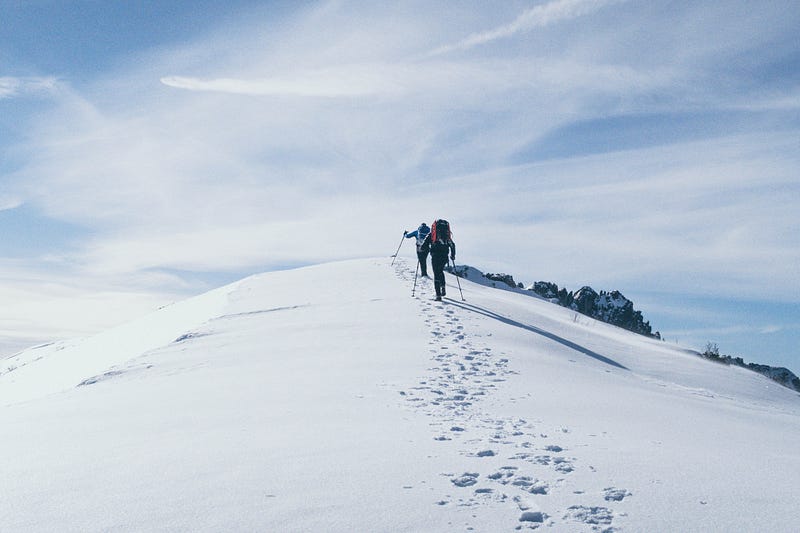
Imagine running on a treadmill and breathing through a straw. Imagine the treadmill alternates between icy and rocky surfaces. Imagine doing so with a heavy backpack on your back, crampons on your feet, goggles to protect you from blinding snow and sun, and thick clothing to keep you warm. And imagine that 10,000 foot cliffs surround your treadmill.
What a workout that would be, huh? Well, there are a few select people crazy enough to do that workout all the time. They’re called mountaineers; they climb the world’s highest mountains, and I hold them in extremely high regard.
In the climbing world, an exclusive club of mountains distinguishes the cream of the climbing crop. 14 mountains are in this club, the 8,000 meter club. Their summits extend over 8,000 meters above sea level, which translates to roughly 26,250 feet.
All 14 of these beasts are in Asia, dotted across the Himalaya and Karakoram mountain ranges. You probably know about Mount Everest, but 13 others hold an equally special place in the minds of aspiring alpinists the world over.
You might be wondering what’s so special about the 8,000 meter mark. At that altitude, the air contains about one third as much oxygen as air at sea level. Above that altitude, the human body cannot naturally adjust to the lack of oxygen. It starts to die, minute by minute and cell by cell. They call it the Death Zone for good reason.
The Death Zone
You can’t just drop in and stroll up an 8,000 meter peak. The altitude forces you to spend time acclimatizing. Your body needs time to physiologically adjust to your new surroundings, mainly by producing more red blood cells to increase your absorption of the scarcely available oxygen.
To summit a mountain like Everest, climbers will often devote eight to ten weeks to prepare before they attempt to enter the Death Zone. They have to time their ascents carefully, paying close attention to weather patterns — and in some cases, congestion too. One or two days of delay could cost a climber the opportunity of a lifetime.
And success is of course not guaranteed, regardless of a climber’s level of preparation and aptitude. In particular, a number of serious health issues can render a climber incoherent, unconscious, or dead. You are literally and figuratively walking on very thin ice when you pierce the clouds and tread on hallowed ground.
Finally, once you get to the top, you have to come back down. As they say in the climbing community, climbing up is optional, climbing down is mandatory. More people die descending than ascending.
Even the most dedicated and skilled climber might fail to reach the literal pinnacle of their profession because of circumstances outside of their control. But trials, tribulations, and trauma don’t deter them. Neither does the thought of spending years training for high altitude climbing, months preparing to climb a given peak, and weeks acclimatizing and slowly making one’s way up treacherous slopes all for naught.
But the real ones still do it. They don’t give up. They’re chasing a different nirvana. Standing on top of the world does not make one successful. What does is being prepared, sticking diligently to a process, enjoying the journey, and controlling what you can.
Ed Viesturs And Achieving ‘Non-Success’
Despite the unbelievable challenges of surviving at this altitude, let alone climbing steep peaks in gut wrenching frigidity and wind, some extraordinary climbers have managed to successfully climb these mountains without supplementary oxygen.
Ed Viesturs is the only American to have successfully climbed all 14 of those 8,000 meter peaks. He is one of those distinguished few who did it all without supplemental oxygen.
Viesturs has often detailed the highs and lows of his craft. In a TED Talk delivered a decade ago, he described one time he fell just short of summiting Mount Everest:
“Walking away from a mountain under those conditions wasn’t a failure due to my lack of motivation or desire or preparedness. It was due to conditions beyond my control. And so it wasn’t a failure, I simply called it a non-success.”
Imagine that: a non-success. Thomas Edison had a different way to put it: a way that won’t work. He once said “I have not failed. I’ve just found 10,000 ways that won’t work.” Michael Jordan once said “I’ve failed over and over and over again in my life. And that is why I succeed.”
Viesturs had two non-successes on Mount Everest before he stood on top of the world. Third time’s the charm, eh? Maybe, but Viesturs would tell you that the stars had to align for him to summit the world’s tallest mountains. Good luck controlling the stars.
The best of the best often mention a willingness to not succeed as a key contributor to their success. It’s perhaps the biggest paradox of success.
Viesturs has ‘not succeeded’ multiple times in his high-altitude quests. In most of those cases, factors outside of his control prevented him from rising to the top. But his mindset insulated him from the paralyzing regret that can accompany those ‘failures’.
“Because of my passion, I had the patience necessary. And if you have passion, you become more patient. You can deal with adversity, you’re willing to wait longer for success because you enjoy the process.”
When Viesturs set out to make a career of this punishing endeavor, he anticipated that adversity would come painfully often. Any number of things could derail a climbing expedition. But he’s willing to be patient and wait for everything to align on those special days where he can stand above the world. If anything, the non-successes make the periodic successes special.
Plus, every non-success is a learning experience. When you pursue your passion, you learn from the journey, not the destination.
Master Your Own Everest
Viesturs chooses to climb mountains because he loves it. He loves the nitty gritty parts of the process that might deter an otherwise talented or passionate climber: the grueling mental and physical preparation, the time spent away from WiFi and distractions, the dangers he faces with every step, the adaptability required to respond to circumstances foreseen and unforeseen. When he finds himself on top of the world, he knows it’s a temporary reward, more like icing on the cake.
Sometimes, a little bit of hard work and good fortune allows you to pick your own Everest, whether it’s 29,029 feet high or not. Sometimes, life forces an Everest upon you that you don’t want to think about, much less climb.
Whether or not you can control that, think about the people who’ve climbed the real Everest. Think about how and why they venture to the roof of the world.
And then think about how and why you’re going to venture to the roof of your world.
Mind Cafe’s Reset Your Mind: A Free 10-Day Email Course
We’re offering a free gift to all of our new subscribers as a thank you for your continued support. When you sign up using this link, we’ll send you tips on how to boost mental clarity and focus every two days.


