
Noh: The True Essence of Japanese Traditional Culture
How Noh plays inspire artists beyond borders
Thankfully, there are more and more people who tell me that they love Japan. In London, many people say they like Sushi, Matcha or Anime, and some say they are fans of Japanese films or Ukiyo-e prints. All of these comments make me happy, because I love them all myself.
Although very rare, there are even some people who say they like Kabuki or Takarazuka Revue. However, I have yet to meet anyone who says they like Noh theatre. Why is this, though, when Noh plays show the very best of Japanese traditional culture, with exquisite costumes, well-thought stories, beautiful music, dancing and chanting?
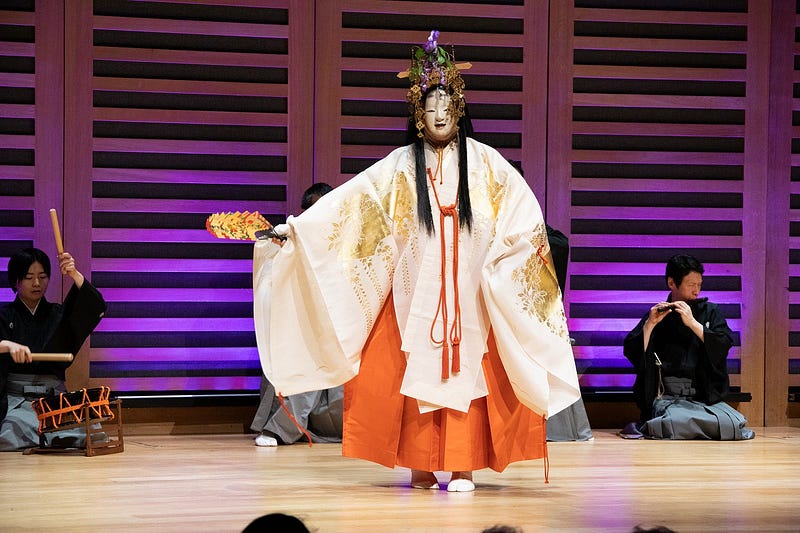
In a nutshell, it is because Noh is high culture. To fully understand Noh plays, one needs to have good knowledge of Japanese culture and history. You also have to understand Japanese old language, symbolism and even Chinese history sometimes. Few Japanese are confident in these areas, and most foreigners find it a tough challenge.
Of course, it is possible for both Japanese and foreigners to enjoy Noh in a more simple way, such as admiring Noh masks and costumes or enjoying the music and chanting. In fact, there are many people who enjoy Noh with that attitude, which is also wonderful.
Having said that, Noh is undeniably categorised as high culture, loved by the noble and the high-ranked Samurai. Even today, if you visit a Noh theatre, you will see many ladies in the most elegant (and expensive) Kimono and gentlemen also being dressed smartly. Noh pleasantly stimulates intellect and aesthetic sense of such people.
On the other hand, Noh has also been a great source of inspiration for leading artists, even beyond borders. Some examples are given below.
First, I would like to name the Japanese film director Akira Kurosawa (1910–1998), who himself influenced many other directors in the West and in the East.
Several of his films are clearly influenced by Noh, the most obvious of which is the film ’Throne of Blood’. Who else could execute such a stunt: Using Shakespeare’s Macbeth as a storyline and employing the formal beauty and characters of Noh at the same time? As a big fan of both Shakespeare and Noh, I was mesmerised from start to finish!
Next is the Italian composer Orazio Fiume (1908–1976).
He is said to have read an article on Noh theatre in the magazine La Scalla, which inspired his opera ‘Il tamburo di panno’ (The Drum of Cloth). It seems that the original Noh performance was Aya no Tsuzumi. The opera was well received on stage and was also broadcast on local radio and television. Japanese opera singer Norie Akisada once played the role of the princess as well.
And the British composer Benjamin Britten (1913–1976).
When he visited Japan in 1956 to perform his own work, he saw a Noh play named Sumidagawa. He was so deeply impressed that he saw it twice! He later created the opera ‘Curlew River’, based on Sumidagawa, to be performed in churches. I will write more about Sumidagawa and ‘Curlew River’ in another article.
Last but not least, the French philosopher and writer Catherine Clément (1939- ).
In her novel ‘Le Voyage de Théo’ (Theo’s Odyssey), as the title suggests, the boy Théo travels around the world and experiences different faiths — Judaism, Christianity, Islam, Hinduism, Buddhism, Taoism and Confucianism. He also visits Japan, where he sees a Noh performance. Noh plays a most striking and important part in this beautiful story.
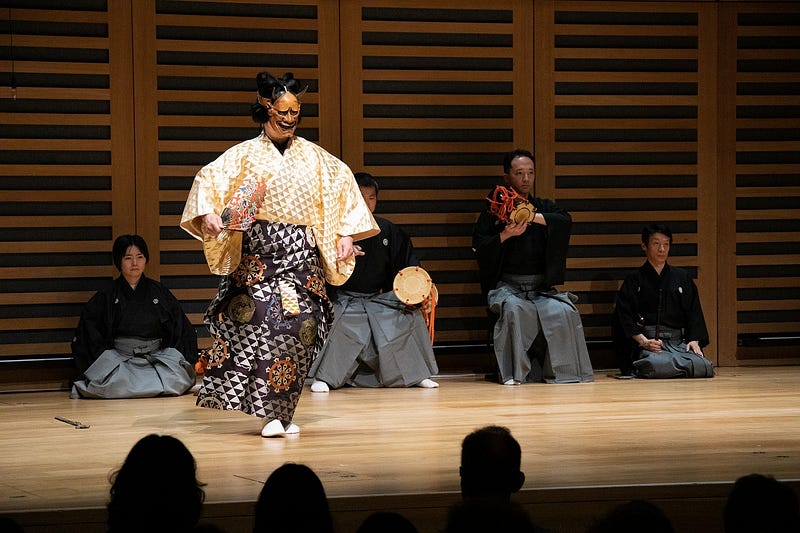
For the reasons mentioned at the beginning of this article, many people think that Noh is difficult to understand. I admit that it may not be everyone’s cup of tea. However, there is still something special about its depth and beauty, and it has inspired many intellectuals and artists beyond languages and cultures. It is well worth seeing if you are interested in Japanese traditional culture.
It is also said that as one gets older, one’s view of Noh changes and one can enjoy it anew. Therefore, even if you have previously seen Noh and found it boring, you may find it more appealing if you see it again after a while. In my twenties, I was crazy about ballet and other glamorous forms of entertainment that were easy to understand too!
Now are you a bit interested in Noh? If so, please watch this video showing the Lion Dance in London in 2018. This is a excerpt from a Noh play called Shakkyo (Stone bridge), but you do not need to know any complex context to enjoy this exciting dance and music!!
I hope that one day you will enjoy a full Noh performance in Japan or other countries. Occasionally there are Noh events in London and Paris, probably in the US and some Asian countries as well. And please let me know what you think🥰
Do you like traditional art and theatre? Or do you prefer modern forms of entertainment? Please share your preferences in the comments section.
Thank you for reading. If you enjoyed it and would like to support me, there are several ways, all of which I would greatly appreciate. Arigato Gozaimasu!
- Engage with this article by liking, commenting, highlighting and sharing it.
- Subscribe to my articles. You will receive a notification once a new article is published.
- If you feel super generous, buy me a tea! That will make my day🎉


