
No, You Don’t Want to Time Travel
What’s forgotten when imagining time travel
The idea of time travel has long captured the human imagination. How many times in novels, movies, and TV shows have the plots involved characters traveling back in time? What an exciting thought to be able to witness events in the past or see what will happen in the future!
Time travel has been a staple of science fiction since its modern inception with H.G. Wells’s The Time Machine. It is overused now as a plot device, but the dramatic possibilities of time travel intrigue both writers and audiences.
Physicists debate whether it is possible to travel through time. Some say it is possible. Others say it is not possible. The physicists’ conjectures are based on discussions of relativity, spacetime, the massive energy required, and whether time exists as something real outside of human perception.
These conjectures and discussions grapple with deep and meaningful issues but ignore one simple fact: time travel is a very bad idea.
Time to Think about What Really Would Happen
So, let’s say that you, being the genius you are, have solved the physics problems of traveling through time. You have invented and built a time machine and are eager to use it. Before you start your career as a chronic argonaut, you should remember one very important fact. Even if time is the fourth dimension, you cannot forget about the first three dimensions. Moving through time also means moving through space. Let me explain.
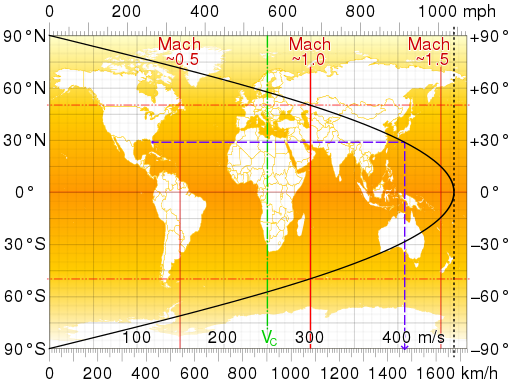
The first problem with your time travel is that Earth rotates on its axis. A spot on the Earth’s equator is rotating at 1,674.4 km/h. Other locations on the planet are rotating at a slower speed, as figured out by those kids who paid attention in trigonometry class, and is indicated in the graphic to the right. If you could stand still, the Earth’s surface would be speeding past you faster than a commercial jet. That includes the location from which you start off in your time machine. So, if you launched your time machine from Cape Canaveral and set the clock for one hour in the future, you’d end up near the west coast of Mexico.
All right, you say, you can solve that problem by moving to one of the poles. You have a warm coat. True, your rotation speed is close to zero and you won’t end up somewhere else because of Earth’s rotation. Or, better idea, from anywhere on the globe you can calculate your time jump to the exact second so you emerge at the exact same time on a day in the past or future. The Earth will have rotated one full circle and you will be right back to where you started, right?
Sorry, no. The Earth also travels around the Sun at an incredible speed. The orbital speed of Earth is 29.78 km/s or 107,200 km/hr. So, if you launched your time machine one hour into either the past or the future, you’d arrive up to 107,200 away from Earth, which is three times farther than geosynchronous orbit. Suffice it to say, your exploration possibilities in your new time and place would be limited.
Oh, and don’t think you can time it so that you reach the same second of the same day each year and end up on the same spot on the Earth in its orbit. The whole solar system orbits the center of the Milky Way galaxy at around an estimated 500,000 km/hr. That’s well past the distance of the moon.
Even if you learn how to move through time, you won’t be able to set the machine and emerge in a different time within the same room you left. You will end up somewhere in cold dark space and die pretty quickly. Only if your starting and ending point were at the same stationary point in space would time travel be simple. And only one tiny group of people believe such a thing exists.
Only a Flat-Earther Would Want to Time Travel
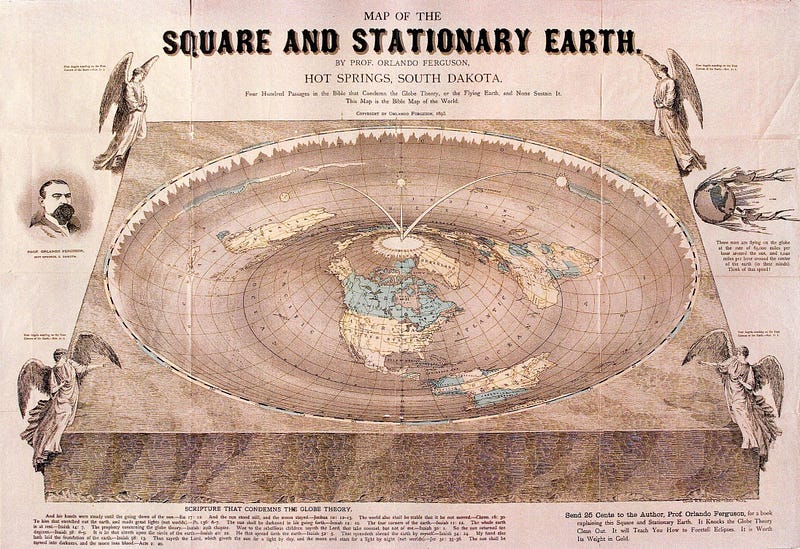
The only people who would consider time travel a feasible pursuit are those who ignore reality and believe the Earth is flat and motionless. There are, strangely, a few people who still believe that. Search YouTube for “flat Earth” and find some hilarious videos about flawed science experiments and bizarre conspiracy theories.
The flat Earthers aren’t smart enough to figure out the physics of time travel, but if they did, they too would end up somewhere in cold dark space and die pretty quickly. Only a flat Earther would be foolish enough to time travel.
An interesting article on the science of time travel: Is Time Travel Possible?