
No Tears for Dad
Fear Wrapped in Blame

I don’t jump, physically or metaphorically, preferring my feet on solid ground, physically and metaphorically.
Risk and change are terrifying to me. If I take a chance and fall flat, it will be my fault. Whatever happens to me or others around me will be all my fault.
And, I can never make it right.
Thanks, Dad.
I hesitate to complain about my childhood. We were middle-class with a home better than most in our poor, rural community. Our cupboards were never bare, in fact, they overflowed. I had clothes to wear, pets, toys.
The saddest part of my life was the lack of a mother, mine having passed when I was an infant. Her absence created a nontypical family. At different times, I or one of my older sisters occupied the position of lady-of-the-house, and we all learned very early to cook, clean, do laundry, grocery shop, and mow the lawn.
Our childhoods were not very childlike and, really, that was okay. We matured at young ages through the responsibilities on our shoulders.
Still, we were safe, except from blame. Blame was the monster in the closet.
Perhaps, my father's scapegoating personality was the result of being widowed with three young girls. Maybe, he was always like that. I believe the latter.

Dad didn’t believe in accidents or mistakes, not even from children. A spilled glass of milk, a broken dish, a lost shoe, a torn dress, a bloody knee were treated as willful acts of defiance. To him, youthful blunders were the same as calculated, spiteful deeds.
Worse than the accusation of willful intention was the lack of understanding and forgiveness. A cracked window, caused by my 9-year-old miscalculation of the wind’s effect on a ball, led to a two-week, in-room isolation topped by three weeks of parental silence. Not one word did my father utter to me in three weeks. I was nine-years-old.
When I dared to disagree with my father about a particular musical artist, his silence lasted for months. At the time, we were the only two in our home. My sisters, several years older than me, were already free of his silent tantrums while I was held captive in walls of stillness.
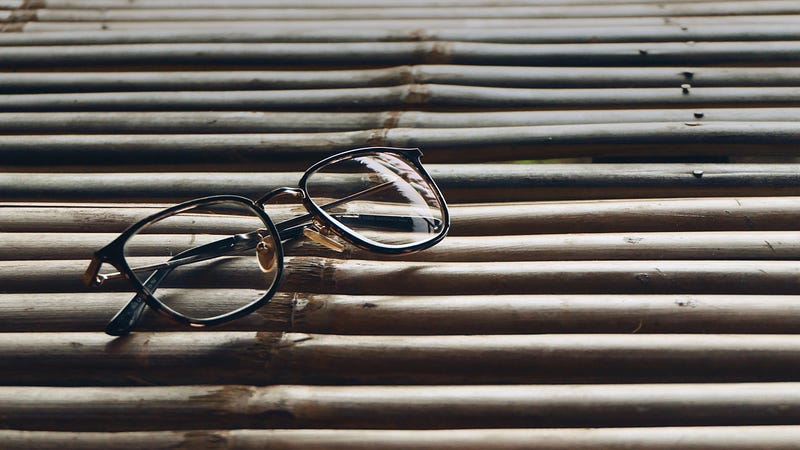
When I misplaced my glasses at the age of ten, Dad refused to buy me another pair. He could afford them but not replacing my glasses was punishment for my purposeful irresponsibility. My eyesight worsened over the years, causing me to always sit in the front of any class and read with a book held inches from my nose. An avid reader, I suffered from never-ending headaches. Playing sports was impossible because I couldn’t see the ball or the other players. The damage to my eyes was permanent.
My sisters and I learned to do anything we could to cover our mistakes and accidents. Once, after breaking a light fixture globe in my bedroom while one sister and I were making Christmas wreaths on the top of my bunk bed, we cleaned up all the debris and dumped it in the woods, then rearranged my bunk bed away from the light so the missing globe would not be as noticeable. Finally, we begged a neighbor to drive us 15 miles to the store where my father originally purchased the fixture and used my sister’s birthday money to buy a new one. In the middle of the night, while Dad slept, we surreptitiously installed the new light. All done to avoid my father’s blame/punishment game.
As adults, he continued to shower us with criticism. Any decision we made that didn’t work out well was a cause for his derision. Often, he predicted our future failures, assuring us we would not succeed at one thing or another.
I wasn’t free until I walked away from him — completely — when I was 48-years-old. My oldest sister did the same many years before. The middle sister stayed in contact with Dad but lived far enough away that distance provided protection.
The lasting effect of Dad’s blame/punishment game was the fear it bred in me. I feared the unknown, the unfamiliar, and anything that held the slightest risk. I lived in terror of making a mistake, disappointing someone, being proven wrong. My errors were shadowed in lies. And, believe me, I could lie — look you deep in the eyes and lie, if it meant saving myself from shame and blame. The ability to lie successfully as a form of self-protection was my father’s gift to me.
I lived years in an unhappy marriage because I was frightened of an unknown world of not-being-married.
I chose the known evil over the unknown good.
I changed that day I walked away from my father, never to see him again. He would die alone a few years later because he had no friends and only one remaining daughter far, far away. A neighbor would call the police after being unable to remember the last time he saw my father. The coroner figured Dad died at least five days prior to his body being found on the floor of his home, a home I bought for him.
I cried no tears for Dad.
Instead, I put more effort into becoming the person I might have been if not blame-bullied. I concentrated on healing and cultivating bravery.
And, I made decisions — some great, some good, some not-so-good. I learned to accept the less-than-stellar results of some choices and to treat them as lessons and stepping-stones.
I stopped lying because the need to lie was gone. Owning up to my mistakes was my new approach.
In my childhood, I didn’t hear I’m sorry. Those words never left my father’s mouth so I didn’t learn them. Now, I can say I made a mistake, I’m sorry, how can I make it right without being choked by fear.
In many ways, I am in my second childhood, learning what escaped my first one.
If I cry, the tears are for the missed opportunities, the falsehoods, the years held captive by fear. But, there are
No tears for Dad.
In response to this Community Challenge by Xavier Van Holde:
which was inspired by this piece by Alex Woodroe:
with gratitude to both Alex Woodroe and Xavier Van Holde.