
No Present, Then How to Live?
The Present Only Exists in the Past
Einstein once said: “The distinction between the past, present and future is only a stubbornly persistent illusion.”

Warning:
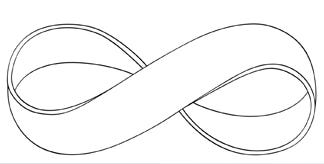
Reading the following may be analogous to living on a Möbius Strip (see below). As such, this complex subject may boggle your mind and permanently alter your world. Hang on to your illusions, it may be the only real thing left or…
The Illusion of Free Will as a Key
Sam Harris’s research has shown that Free Will does not exist (maybe). Decisions are made in our brains microseconds before we humans become consciously aware of them.
His discovery has much deeper and far-reaching implications. He is likely unaware of these implications.
Neurological research shows a lag time between when a decision arises as an impulse in the brain and when the “decision maker” (you or me) becomes aware of said “free choice”. This has been determined by an f-MRI measuring the formed decision as a bio-chemical neurotransmitter activation nanoseconds before awareness appears in our thoughts.
There are three immediate deeper issues at stake.
Issue One: Awareness is Divided
Most people live in their heads. As such, there is a divorce from the physical body. We know we have a body. But we may not know that we are bodies.
In having a body, we treat our bodies as objects, separate from the self. This may originate from the mind-body dualism of religious dogma of the past. Or it may result from how we are treated within a hierarchical system of civilization and/or capitalism. Many indigenous people consider their body as sacred as the body of Earth. All beings are a part of the human body and vice versa.
Think on this for a moment: My body is Earth’s body. And Earth’s body is my body. I am the body of a virus and the body of a virus is my body. The body of a dolphin is my body and my body is the body of a dolphin. This is part of the as above so below reflective device and it is literal in the mind of the indigenous ones.
Our thinking is associative and dualistic: light versus dark, good versus evil, greed versus altruism and so on… This dualism assists us in separating our minds from our bodies and emotions.
Issue Two: Language
Written and spoken language is another way we humans divide ourselves from reality. Our world is built on the symbology of language, which stands between us and the real world. Language is a fundamental technology that has been internalized and it is external too. It is a social tool that aids in the advancement of civilization in the world we have today.
Language has been hard-wired into brains. As a result, we can no longer think without the use of language. Very few people can remember what it was like to live before we acquired language as a child.
Issue Three: Time
Time is a concept born of language or language are concepts born from time. Like any concept, we define time as a tool to organize life in our social order. We divide the passage of time into:
•past •future •present
Most people are clear that the future is speculative and can not be known like the past.
The past really isn’t the past. There is no place that we call “the past” that exists as a specific place in time other than what we remember. We may agree as a group of memories as in the history of Europe, for example. Mutually shared “past memories” make-up the illusion of history that we have agreed upon.
Some thinkers conclude that the present is the only state we can experience. It is described as a fleeting moment. However, as we describe the present, it becomes the immediate past. There is no way we can grab onto and say:
“Here it is — the present, I have it.”
One of the biggest problems with time is the language we use to describe it. It’s inadequate.
Linear Space-Time
Einstein reports that space and time cannot be separated. That appears to be a given. Linear Space-Time is analogous to time’s arrow. The past, present, and future are paths that appear to shape time. Linear Space-Time is conceived as events from the past, creating a present and shaping a future. Memory makes time work for humans.
The conception of time is flawed. Our brain, rewired by language, creates how we perceive time. We can almost imagine what’s beyond the concepts of “past”, “present” and “future”. When we have an experience of timelessness and return to a singular self, we attempt to analyze what has happened. The process of analyzation triggers concepts and we enter a circular loop to which there is no escape. The set of conceptual thinking cannot, by definition, use concepts to transcend itself. Thus, the loop.
The Esoteric “Student — Teacher Relationship”…
Teachers (not gurus) often use a special way of communicating with the student — a nuanced language of the present as a guide. Teachers would advise the student to keep most of their experience to themselves to step outside the concepts of time. This was done to help the initiate keep the experience pure and untainted by reductionistic concepts.
This kind of relationship is based on methods and techniques meant to transcend the conceptual way of language and linear space-time into a wider experience of the world. This relationship (mostly outside India) has existed for centuries as one way to access unseen worlds and dimensions.
The Purpose for Methods and Techniques
All methods (Yogic, Vipassanā or Mantra meditations) or techniques (guided meditations or inner spiritual practices) work to quiet thinking, open the practitioner to feelings of peace and an experience of being.
Linear Space-Time and Being Time
Linear Space-Time is my ordinary experience of time that came with my informal and formal education. As a child on summer vacation before I began part-time work, time appeared to pass oh-so-slowly, compared to when I picked strawberries, string-beans or ran a vegetable and fruit stand in town. Why? Those two months in the summer when I wasn’t working, time-space wasn’t divided up into organized increments as when I was in school or was working, so it appeared to pass more slowly.
We’re all very familiar with linear space-time, the conception of our self and how life proceeds from birthday to birthday, grammar school to high school and then sometimes to college and/or into working. This is how we all experience time. Ordinarily, we don’t question it.
The conceptualization of life’s experiences assists me in capturing and owning parts of my experience. The following statement is an idea I once had when I was I was in 7th or 8th grade:
“When I grow up, I will have a great job, make 100K a year, have a great girlfriend that loves me and I love her, and a fantastic car. Then I will be happy.”
Goals within ordinary time are predicated on future events as the trigger or causative agent to produce a desired outcome:
“When I do ‘A’ in the future, then I will feel happy.”
Happiness is predicated on a future event conceptually connected to a positive outcome. This may cause the positive outcome perpetually being postponed to “the future” which never comes. Or the concepts/things/people either do not satisfy my need for happiness or they satisfy my need but for a very short duration. Either way, I will need to repeat the formula to achieve the goal. Call this attachment, identification, and/or addiction.
Being Time falls outside linear space-time and includes it. Being time belongs to our Lightbody self that exists eternally in the relative present moment. This kind of time and awareness is difficult to write about because it has one concept — maybe. The concept is a feeling — a feeling that has very little precision, if any at all. The concept is one of self as lightbeing.
As a lightbeing, there is no time. But, as being consciousness crosses into ordinary awareness, being embraces past and future in an expansive now. Being connects my body, emotions, and thoughts into my lightbeing in an expansive now.
Concluding Remarks
Sam Harris’s research has shown that Free Will does not exist. Harris’s research floats on an illusion that the present exists. But does it?
Our awareness of the present in linear space-time is a present that exists in an immediate past or a past through memory. If that is the case, then it casts doubt on the method of Harris’s research parameters. The lag time between when a decision is created before awareness of the “decider” is the issue and not the awareness.
Time — as in the measurement of the present as it becomes the past, or a memory is where awareness takes place. My contention is that all perceptions of the present take place in past memories of the present. Awareness is a reflection within memory in ordinary linear space-time.
Therefore, the present does not exist.
Thanks to all of you (more than on this list) for your camaraderie, inspiration and support. Blessings to you. If you have not been tagged and wish to be let me know and likewise — if you do not wish to be tagged please let me know.)
Rebecca Romanelli | DL Nemeril | Winston Huang | Marcus aka Gregory Maidman | Elle Beau ❇︎ | Filiz Özer | Melanie J. | madmess’s thoughts | Dr Mehmet Yildiz | Joseph Lieungh | Alison Hollingsead | Matthew Nashira | I. Trudie Palmer | Ravyne Hawke | Alberto García 🚀🚀🚀 | OrlaK | Mark Tulin | Shirley Willett | Alan Lew | David Price | Diana C. | Blaine Coleman | Michelle Roussin |


