
No One’s Going to Find Your Tweets on the Beach
We’re all just hurling our bottles into the sea.
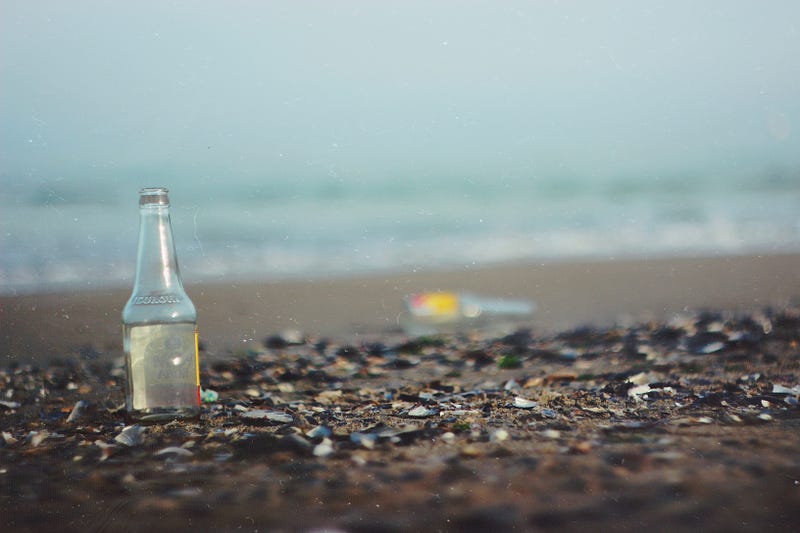
I often find myself in strange, silent rooms.
An occupational hazard, I suppose. The rewards of writing fiction are numerous, but they are rarely monetary. Especially when you write what I do. Especially when you write the way that I do. I could probably write a series set in a teenage vampire academy or the turgid tale of some young female protagonist who is not like the other girls trying to survive in a dystopian nightmare future.
But I’d rather write about strange men surviving in the wilderness, the ravages of PTSD, and the collapse of the Austro-Hungarian Empire. Nobody buys my books at the airport.
Up on the top floor of the library, there’s a quiet room full of weirdos like me. The staff can’t help you enough; they have nothing better to do. They all but run to fetch the arcane volumes you request from the dusty shelves where they have lain undisturbed for decades. Dead news from another world.
In a newspaper from 1913, a tiny article caught my eye. In among Mexican rebellion and the attempted assassination of the King of Spain, a short notice told of a bottle washed up on a beach in Vancouver with a message inside.
“Please look for me,” said the message, scrawled on a sticker from a package of popcorn. “I am lost on the Lone Fisherman’s Island. Josephine Pogue.”
There’s something romantic about a message in a bottle.
Something delightfully old-world and analog. There’s never been a society in history with capabilities of communication anything like we have. The Internet is available to billions. I can and do talk regularly to people around the world, transmitting and receiving messages instantaneously around a world wrapped in copper wire.
But there’s no charm in a retweet. There’s none of the delicious randomness, the tactile sensation of unrolling a scrap of paper and reading the words written by another. A message in a bottle is about the worst way to be heard, the longest of longshots. A refuge of the folorn and the hopeless. A message of pure desperation.
It’s rare that the bottles are even found. It’s hard to put a definitive number on the recovery rate, but it may be only 3%. And there’s no way of knowing when recovery will happen. The oldest message in a bottle ever found bobbed around the ocean for 151 years before being picked up.
Consider the touching story of a love letter tossed into the sea by a soldier in the First World War, days before he was killed. By the time the message was found, his wife was long dead, and the farewell letter was delivered to his 86-year-old daughter instead.
For that reason, messages in bottles tend to be timeless. Declarations of love or heartfelt cries of the spirit. There are better ways to deliver news.
Not that Josephine Pogue’s idea was unworkable. Occasionally, lives have been saved by a scrap of paper hurled into the void. In 2019, three hikers trapped by a flooding river released an SOS message in a Nalgene bottle that made its way downstream and summoned a helicopter to rescue them the following day.
But Josephine may not have been so lucky. I’ve searched around, but I can’t find any more to the story. Maybe she was rescued before the bottle even made it to shore, its message already redundant thanks to some passing fishermen.
Or maybe nothing was ever heard from her again, and she slipped at last into the steel-colored water of the North Pacific, drifting ever downward, deaf to the music of whales that hummed in the ocean all around her. I know. Stories need an ending, even if it can’t be a happy one. But I’m not writing fiction now.
You never really know what’s going to last.
Probably nothing. Something like one hundred and eight billion people have lived on this earth, and almost all of them have left no trace. They didn’t carve their names in stone or build great monuments or die in scientifically fascinating ways. They simply disappeared. Bottles with a seal that lets in water, or glass that gets smashed in a storm.
Or else your words wash up on some stony beach when nothing grows and nothing moves, and the slow work of sun and tides and time wipes away what you wrote before anyone discovers it. You’ve probably realized by now that I’m talking about more than just bottles.
We want to make a mark. The graffiti of Pompeii and the handprints on the walls of Lascaux prove that. In his lifetime, Michelangelo only signed a single work of art, but it was a good one. Maybe it’s the fear of death that makes us want to be remembered, as though there could be some kind of continuation of life in the minds of others.
But I think there’s more to it than that. People who sailed the vast seas in creaking wooden ships or set out into the lightless Arctic where no maps could guide them weren’t the type to tremble at the idea of extinction. Some of us don’t care so much about staying alive as we do about living fully in the time we have.
After the earthquake that struck Japan in 2011, wreckage began to show up in British Columbia.
Thirteen thousand miles separate Fukushima and Vancouver Island, but the poignant remnants of the lives of strangers started to show up on West Coast beaches not long after the tsunami. Plastic bottles. Lumber. Soccer balls. Even a Harley-Davidson motorcycle.
All the paraphenalia of the daily existence of people on the other side of the world. People whose ordinary lives were suddenly shattered forever by a blind caprice of fate.
This is the eerie magic of the message in a bottle. A glimpse into the life of a stranger is far more evocative than an online article or a pointless tweet. We know more about each other than we ever did before. But somehow, it was more enticing when we knew less.
I can’t be alone in being more fascinated by the broken axe of a long-dead Viking than I am by the online blathering of some reality TV narcissist. More and more, we live in an online world. A huge portion of my life is spent in the unreal atmosphere of the Internet, my thoughts and feelings and even some of my personal relationships existing only there.
But there’s a special magic in the physical, the carved graffiti you can run your fingers over, the paper that yields as a pen kisses it.
In its way, this article, like everything else I write, is a message in a bottle.
I don’t know who will find it, who will consider it worth picking up, who will bother to read it. But I hear about it instantly. I don’t have the uncertainty of poor Josephine Pogue, shivering with the cold on her lonely island and hoping someone got her message.
If you read this, I will know about it. If you respond, I will know who you are. You’ll see me and I will see you, the glass of the bottle lengthening and sharpening our vision so that it stretches across the boundless waste of ocean between us.
If that isn’t magic, no magic exists. That doesn’t mean it’s good.
In a few days, it will be precisely one hundred and seven years since Josephine Pogue’s message was found. Thanks to the miracle of print, the weird voodoo of publication, I found it again.
The message itself is obsolete, of course. Whatever happened to her on that lonely island, she’s definitely dead by now. But for just a moment, as I read the tiny article, she lived again in my mind. And maybe now in yours.


