A Narrative Poem
No One Sees Me
Inspired by the Art of Diego Rivera
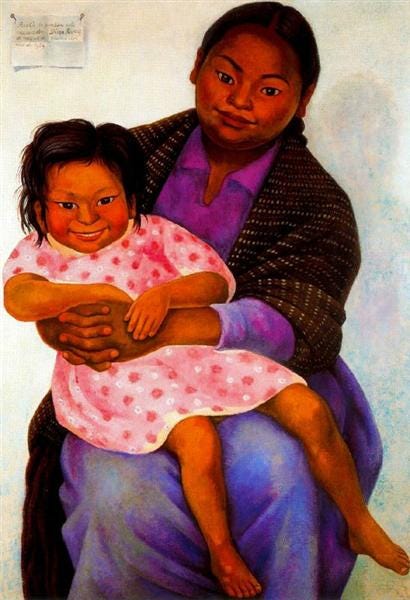
Why do you ask me who I am? Don’t you see my brown skin? My straight black hair? Am I invisible to you? You walk past me as if I didn’t matter. You avert your eyes so that you don’t see my dirty-torn dress. I am a sign that you have failed— that your Christian culture has failed. You don’t see my children running naked through the streets, searching for food in garbage cans. We are invisible to you.
Why don’t you ask me who I am? You there with the pretty hair coming out of the beauty salon. Do you think you can cover up your ugliness? Your darker side? You look at me as if I did not exist— as if you wanted me to disappear from your memory. You spit on me with your eyes. I feel the hatred that you toss my way. You don’t want to understand me. You don’t believe that I have feelings. You walk by in your high heels, your Saks Fifth Avenue dress. Don’t you understand that I want better for my children. My ninos. I have tried to find jobs, but no one will hire me. Sometimes I get work as a maid. Yeah, I have worked in your fancy houses. Then your husbands came after me. They see what you don’t see. They want to use me as their plaything, a toy for their amusement. I am no whore, so I run away. I disappear into the varnished night. And if your husbands don’t chase me, your children drive me crazy. Do this! Do that! Come here now. They think because I work for you that they can boss me around. And you laugh. You think it is cute.
Why do you ask me who I am? Can’t you see beyond the dirt on my face? Why don’t you look into my almond-colored eyes? Why don’t you see the real me, not the one that you fabricate in your unkempt mind, in the wilderness of your imagination. I also see the way you look at my husband, mi esposo. He is something exotic to you. I see you strip him naked with your empty eyes. You run your long thin fingers over his dark brown body, hard from years of toil and labor. You want to feel him inside of you. To enjoy the pleasure of his body, to rip his manhood from him, to crush him under your fingernails, to spit in his face. You think that life owes you. That you can take whatever you want. That God put us here for your pleasure. We are people too, human beings with big hearts and deep wells of emotion—sorrow, fear, love, and pity.
Why don’t you ask me who I am? Can’t you see what is written in my eyes? Can’t you feel the love that I give to my children? Don’t you understand the pain that grows in my heart as I watch them grow up without enough food or clothes or shelter to protect them. Are you so blinded by your furs and fancy cars that you don’t understand? Or is it that you don’t want to understand because my existence calls into question everything that you hold dear and near? Do you understand that your wealth comes on the back of my labor? That without me and my kind, you would have to fend for yourself. That you would have to clean your own house. Take care of your own children. Cook your own meals. You despise me and call me names. You laugh at my pain and tell your friends jokes about me. Don’t you understand that inside this dirty body is a person, someone who feels the fear that she will not be able to feed her children, someone who feels the anger of always being left behind, of never fully receiving a fair share, of being slapped in the face by some white woman who thinks that she has the right to hit me. I want to shout from the mountaintops. I want to tell the world about the injustices heaped upon me, about the indignities that I have experienced because I am brown, because I am a woman, because I am a mother in a world that does not love me, does not see me, does not hear me.
Why do you ask me who I am? I am the lily on the pond. I am the rose on the bush. I am the wind blowing through your hair. I am mother earth, giving birth to hope and opportunity. I suckle the children of the world at my soft warm breasts. I feed the souls of future leaders. I am the harvest fiesta where lovers dance in the moonlight. I am the flower of change blooming in the hearts of the less fortunate. I am the honey, the nectar of the gods, the spice that warms the heart, the spirit that doesn’t die, the inspiration in times of despair. Do you see me now? Do you feel me in your heart? Do you hear me in your soul? I am the mother of the universe, the giver of life and love, the dancer leading the children into the promised land.
Why do you ask me who I am?
Inspiration for This Poem
The writing of this narrative poem was inspired by my wife of 47 years and by my study of the art of Diego Rivera. My wife is a first-generation Mexican-American and has shared many stories about her experiences with discrimination and racism. On some level, I am channeling her in this poem.
About Diego Rivera
Diego Rivera, a Mexican painter and muralist, was born in 1886 in Guanajuato, Mexico. He studied painting in Mexico, Spain, and France. He was a contemporary and acquaintance of Pablo Picasso. He helped establish the mural movement in Mexico. He painted large murals in Mexico City, Chapingo, and Cuernavaca, Mexico. He also painted murals in Detroit, San Francisco, and New York City. He died in 1957 at the age of 70.
References
Marnham, Patrick. Dreaming with His Eyes Open: A Life of Diego Rivera. University of California Press (Berkeley), 1998.
Downs, Linda Bank. Diego Rivera: The Detroit Industry Murals. The Detroit Institute of the Arts, 1999.
Copyright © 2020 by Harley King
If you like this story-poem, you may also like The Child.


