No-one Can Predict the Future
Are we doomed to continue killing with kindness?
I used that headline (No-one Can Predict the Future) just a few days ago, on a post on my Wordpress blog, dealing with a rather different subject: the inability of an individual to predict the way in which circumstances entirely beyond his or her control might alter his or her life path.
This time I am dealing, not with the future of a single individual, but the future of the whole human race. And this time the headline is ironic because there are many people who believe they can predict the future. Some are optimists who believe that human ingenuity will be our salvation in the future, as it has been in the past. Most, though, are pessimists who believe that we are facing the collapse of civilisation as we know it.
There is no doubt that the human race is facing an uncertain future. Conventional wisdom seems to be that it is our selfishness that is responsible. Our propensity to accumulate artefacts that are not essential to our survival, means that my generation, and my children’s generation, have plundered the planet’s resources to an unprecedented extent. We are experiencing ecological overshoot.
One prediction I will make is that this post will generate comments from readers who will find its central proposition unpalatable, if not downright evil in intent. I am going to say that it is the aspect of our nature that most regard as good and unselfish that has been our undoing.
I am not about to deride ‘doing good’ in the way that cynics so often do. I have always admired those who devote time, energy and money to help those less fortunate than themselves. I still do. And I like to think that I have made some small contribution myself. I always voted for the candidate most likely to have in mind the welfare of the ordinary people he or she intended to represent, rather than the one who I believed would be influenced by the rich and powerful.
In my brief incarnation as a local representative, I always tried to make policy choices on that basis. I have served in various unpaid capacities in a number of different voluntary organisations, including one that provided support and advice to community based charities. I don’t think it would be too boastful to say that I am passionate about any kind of activity that does not have profit as its primary motive. And yet in recent days I have formed the opinion that many such activities actually do more harm than good, when viewed from the perspective of the long term future of the human species.
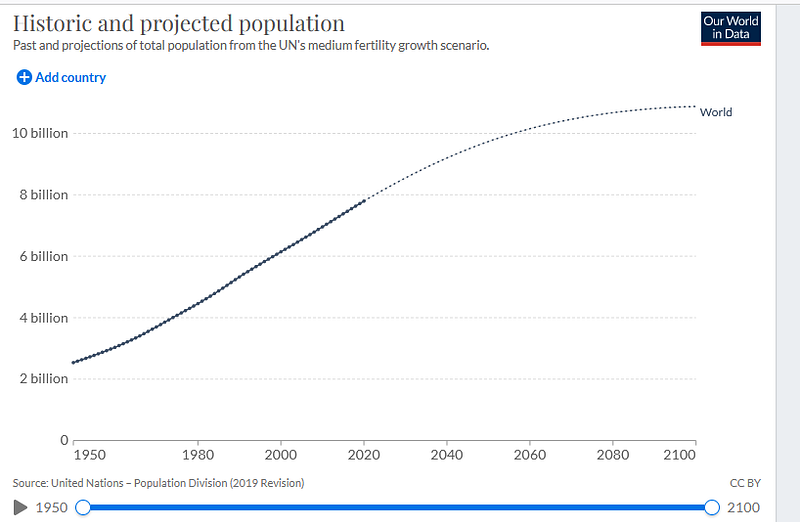
One fact stands out for me as I enter my ninth decade of life. It is this: since the year of my birth the number of humans inhabiting this small planet has not doubled. It has not tripled. It has quadrupled. That is a difficult fact to comprehend. Once comprehended, it is surely shocking. And when you spend a little time trying to understand why this has happened, it is not the consequence of greed or selfishness. It is the direct result of all those individuals collectively working to ‘save’ humanity.
The population increase is not the consequence of couples having more children than their ancestors did. It is the consequence of the fact that many more of the children they do have live long enough to become parents themselves. It is the consequence of our species efforts in preventing and/or curing disease.
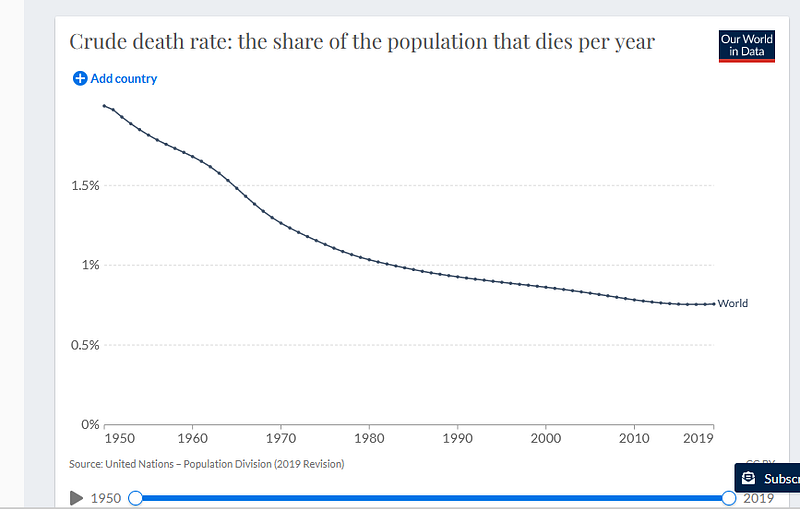
Diseases like diphtheria, measles, tuberculosis, smallpox, cholera, typhoid, poliomyelitis, have all been eliminated, or their severity substantially reduced. People of my generation and older are alive because of the miracles of modern medicine. If drugs or dietary changes don’t prevent your circulatory system from continuing to function, there is always surgery: triple by-pass, valve replacement, heart transplant. Other organs can be transplanted, too, whilst joint replacement ensures continued mobility, essential for heart and respiratory health.
All of these advances in medicine are the result of work by people whose principle objective is the saving of life. Of course it is possible to question the motives of the owners of drug patents, but generally the drugs they profit from would not exist were it not for a desire, in the hearts of their employees, to prevent or treat otherwise fatal or debilitating conditions.
When you consider all of the forms of ‘do-goodery’, it is clear that it is not a minority pastime. There are over 169,000 registered charities in England and Wales alone¹. 64% of adults in the UK participate in some form of voluntary activity.
When it comes down to it, we are all pro-life, even if we might support abortion. Once it is born, we want every child to have a long, healthy and happy life. Most of us regard that as a natural right. And, like all species, we are programmed to act in ways that ensure the species’ survival.
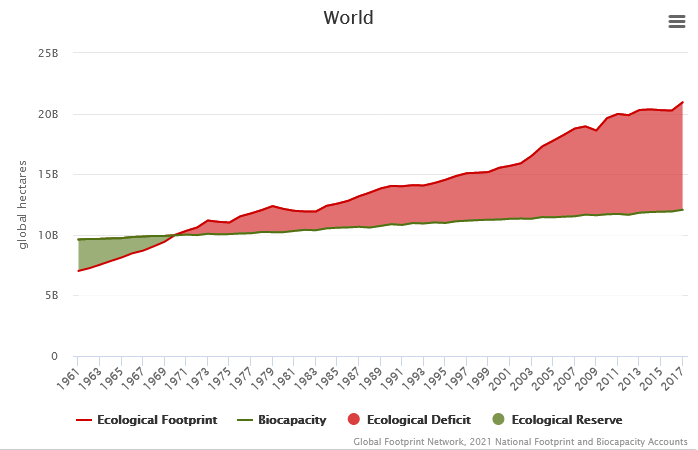
The problem is that there are real limits to growth. Maybe they are different to the ones predicted by Malthus or, more recently, the Club of Rome. But there must be a time, in the not too distant future, when the ability of Earth’s biosphere to provide sustenance for all of humanity is breached. Many argue that we are already there. According to WWF, every year since 1970 our annual consumption has exceeded the planet’s capacity to recycle or regenerate the resources we use². The deficit is now in excess of 50%. We are half a century into the era of ecological overshoot.
It is important to realise that the limit is not like a point on a graph. Think of it as a vessel with a hole in it. It is still possible to fill the vessel to the brim. So long as the volume exiting the tap is greater than the volume leaving through the hole, you can go on filling it. The supply to the tap comes from a reservoir and the liquid exiting the hole is fed back to the reservoir. Over time the level of the reservoir will fall. In order to maintain equilibrium in the system it will be necessary either to enlarge the hole, returning more liquid to the reservoir, or to close the tap to the point where the amount entering the vessel is less than the amount leaving.
And just to answer an obvious question about this analogy — and perhaps take it too far — the overflow from the brimming vessel is the vast quantity of waste our civilisation generates.
Eugenics is an ugly word. Euthanasia less so. Neither is an answer that is either practical or acceptable. So, is the future one in which we watch helplessly as the reservoir slowly empties and the overflow from the vessel fills the room? Must more and more people die as the number and severity of natural disasters increases? Can we prevent more and more people suffering the terrible consequences of resource wars? I don’t have answers to those questions. I doubt anyone has.
¹ https://www.statista.com/topics/3781/charities-in-the-uk/
² https://wwf.panda.org/discover/knowledge_hub/all_publications/living_planet_report_timeline/lpr_2012/demands_on_our_planet/overshoot/


