
No, I’m Not Crazy and Neither Are You
Let’s normalize mental illness

Standing in the lobby’s door was a young and handsome man calling out my name. He stood at six and a half feet in jeans and subtle brown cowboy boots. Curly brown hair and exuberant brown eyes.
Great. I have to talk about my OCD, depression, and anxiety with a young, hot guy. Wonderful.
I grounded myself into self-advocating mode and got over my middle-aged fluster quickly.
Despite his young, know-a-lot-about-a-lot attitude, he listened to me. When I told him I quit taking Prozac because it made my OCD worse and the previous psychiatrist seemed pissed and disappointed I wouldn’t give it more than three days, which is why I was now consulting him, he was on my side.
“You live with this. I’m here to help you make informed decisions for your best care.” Yes, yes, you are, young cowboy.
He didn’t treat me like I was crazy.
After going to therapists off-and-on from the age of five onward and being diagnosed with Generalized Anxiety Disorder, Bipolar Disorder (misdiagnosis), Depression, and bouts of acute depression, I was coming to terms with my new diagnosis of OCD. I carried around my diagnoses like a heavy burden of multiple labels that meant I must be crazy. The average age symptoms of OCD appear is 19. I was 41, although I’d been hiding the symptoms for a large portion of my life.
Similarly, for much of my life, I’ve felt like I didn’t fit in and my emotions weren’t normal — my feelings weren’t always valid. In other words, part of me believed I was crazy.
American culture and mental illness — an evolution
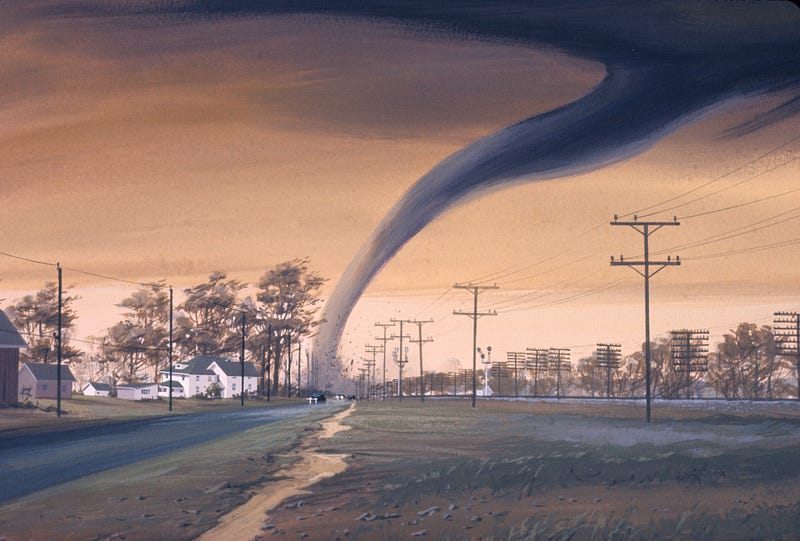
When I was in first grade, I had my first panic attack but I didn’t know it. My class was at the weather center watching real footage of tornadoes and the hair on my neck stood up in primal fear. I over-empathized with the humans in the video. I could feel them being sucked up. I could feel them dying. I was terrified. I looked around.
No one else looked terrified. I stuffed it down, assuming there was something wrong with me, and didn’t talk about it.
I was born in the late 1970s. It turns out there was a whole generation of kids my age experiencing mental health disorders, but it wasn’t discussed much until the 1990s when the book Prozac Nation came out. In the 90s I felt embarrassed and stigmatized to be living with mental illness.
In the 2000s I was terrified to have a serious conversation with my now-husband about living with my mental illnesses. I knew that it could be a deal-breaker. Much to my relief, it wasn’t.
Fast forward to 2019. Mental health and mental illness became socially acceptable topics at work. I had a supervisor who emphatically told us during a staff meeting that our mental health appointments were just as important to keep as physical health appointments. She encouraged us to keep make them, keep them, and take care of our complete selves
By 2019, mental illnesses had made their way firmly into pop culture. I watched the Amazon Prime series Modern Love. Episode 3, “I Am Who I Am, Whoever I Am,” stars Anne Hathaway as she portrays a woman living through the extreme ups and downs of bipolar disorder and shows how debilitating they can be. She recalls when she was unmedicated and experiencing manic mood swings. She met a guy at the supermarket during a high and he came to pick her up for a date during a low.
This excerpt is towards the end of the article when Cheney accepts living with bipolar disorder.
THAT was five years ago — five long years of ups and downs, of searching for just the right doctor and just the right dose. I’ve finally accepted that there is no cure for the chemical imbalance in my brain, any more than there is a cure for love. But there’s a little yellow pill I’m very fond of, and a pale blue one, and some pretty pink capsules, and a handful of other colors that have turned my life around. Under their influence, I’m a different person yet again, neither Madame Bovary nor Hester Prynne, but someone in between. I have moods, but they don’t send me spinning into an alternate persona. — Terri Cheney
Mental health and mental illness are increasingly integrated into the American cultural dialogue, work experience, media, and popular culture. This integration is certainly helping the destigmatization and normalizes people living with mental illnesses over assuming we’re all just crazy.
The problematic nature of labeling in conversations
When you say to me, “I’m so OCD,” you mean you want me to know you’re organized and like things to be just so. When I talk about living with OCD, I must say “I live with clinical OCD” to differentiate between the two. People aren’t used to hearing the second statement and it usually garners the appropriate acknowledgment.
My version of OCD does not include a pristine, well-organized home. It involves intrusive thoughts, ruminations, and contamination fears when it isn’t being treated. There is nothing glamorous or fun about it.
The American Psychiatric Association defines OCD as
“a disorder in which people have recurring, unwanted thoughts, ideas or sensations (obsessions) that make them feel driven to do something repetitively (compulsions). The repetitive behaviors, such as hand washing, checking on things or cleaning, can significantly interfere with a person’s daily activities and social interactions[…].
About 1.2 percent of Americans have OCD and among adults slightly more women than man [sic] are affected. OCD often begins in childhood, adolescence or early adulthood; the average age symptoms appear is 19 years old.”
When I have second thoughts about including in my memoir my overnight stay in the mental psych wing of the hospital in college to protect me from committing suicide, I know mental illness disorders are not completely destigmatized yet.
I get defensive and angry if during a fight with my spouse, for example, he says, “You’re acting crazy!” or “Stop being irrational!” These comments are too easily interpreted as a jab at the mental illnesses I live with when in fact I’m both a person living with mental illness and rational and sane.
The vernacular around mental health in the medical field could use an overhaul. Are we mentally ill? Are we mentally ill patients? Do we suffer from mental illness? Are we patients who experience mental illness? Why is there this good/bad dichotomy around living with mental health and living mental illness?
“I am” statements tend to define who we are. I am OCD. I am depressed. I am anxious. The thing is, *we are not* our mental illness diagnoses.
The labels we use in our language reveals a lot about where we are in our cultural mindset with mental health and mental illness.
A few months ago on Facebook, I asked my friends and acquaintances this question:
The labels Mental “Illness” and Mental “Health” create a polarization saying that one is bad and one is good. Do you believe that is so? I’m planning to write an article about this and would love your input.
What language could we use to describe people who have anxiety, depression, bipolar, OCD, schizophrenia, etc.? At some points in time, these people have been highly valued for the different way in which they see the world.
Creatives tend to have one or more of these “disorders.”
Neuro-divergence is one possibility but it is very vague. Hoping you all join in this conversation!
It sparked a variety of answers. The first response emphasized the importance of people-first language. For example, say “a person with schizophrenia” instead of “a schizophrenic.”
A former professor of mine pointed out, “ In Asia, the mind is part of the body not just in the head.”
I do different things to maintain mental health and other things to manage mental illness. To me the issue is getting rid of the stigma of both…maybe this pandemic is a catalyst for better understanding since many people are struggling with maintaining [] their mental health…CL
People are very quick to pathologize and label something a disorder. Both lay people and professionals. LM
The discussion is happening and that’s great news. The more we continue to destigmatize and openly talk about the importance of taking care of our mental health and respecting and caring for those of us who live with mental illness, the closer we get to normalizing mental illness and dispelling the notion that people who live with mental illnesses are crazy. We’re not.
Creativity and mental illnesses
It turns out people living with mental illnesses may feel sadness and happiness a bit more deeply, which may lend to people with these disorders being more likely to have creative careers or a proclivity for creativity. Kerry McAvoy, PhD referred me to an article that touches on research regarding the prominence of creative people living with mental illnesses.
What he [the researcher, Karol Jan Borowiecki] found appears to bear out popular ideas about creativity and melancholy: a link between periods of negative emotions, especially sadness, and artistic brilliance.
The three composers that Borowiecki studies lived in roughly the same time period and region of Europe, and all had turbulent lives, sometimes tragic and sometimes jubilant. — Ana Swanson, Washington Post
I hope more research comes out on the connection between creativity and living with mental illnesses. Intuitively, I think there’s a connection. And, maybe, just maybe, along with the hard parts of living with mental illnesses, we can recognize there are good parts, too.
The Unique Humanness of Humans
Humans have brains. Much like our fingerprints, our brains are all different.
…[T]ests revealed each individual had unique brain characteristics, which the neuropsychologists used to identify participants with almost 100 percent accuracy…A combination of genetic factors and our experiences shape the anatomy of our brains.— Kashmira Gander, Newsweek
We all experience varying degrees of mental health during our lifetime while only some of us experience mental illness. It is said 1 in 5 adults will experience mental illness in their lifetime. While language is one small part of stigmatization it is an important one to consider.
Flippantly joking that we are crazy or have crazy friends confuses the matter of mental health, mental illness, and behavior that defies conventions. These get muddled together and the conversation is more difficult to have.
While mental illness often gets a bad rap, I believe that people who live with mental illness often have the ability to think more deeply, experience more empathy, and tap into more creativity.
If we lived in a culture that valued and supported deep thinkers, empaths, and creativity would these diagnoses be so vast or so necessary?
I’ll leave that up to you to consider.


