
WRITING PROMPT RESPONSE
No Buses, no Petrol — but Omani People Helped Me Overcome all Obstacles
And this was my first solo travel as a woman
I’m pretty spontaneous when I organize my holidays. As a tour guide, I get my schedule only on short notice, forcing me to decide quickly. Sometimes it is a bit frustrating because I can’t know how many free days I can expect in the following months. But when a 10-day or two-week gap pops up between trips, I start to think about where I could travel.
Since I’m a regular flyer, I have membership cards of various airlines that grant me points after each journey. In this particular case, I could either go to a European city or opt for the special discount to Doha in Qatar. I wished to see something exotic and different. Since I had a friend working in Doha whom I met during a flight, I decided to visit him for a few days and then head to Oman, a less-known Persian Gulf country.
I quickly booked the flights. A few days later, I was on my way to Doha. My friend had lived there for several years, and I knew I could entirely rely on him to show me around. It was very relaxing for me. But then I went for a week to Oman alone. And I was utterly unprepared. As I said, the decision came a few days earlier, based on the options my membership card gave me. Indeed, I do not like over-organizing my trips. Apart from booking accommodation for the first and last night and making a rough itinerary, I let myself drift by the events and rely on my instincts and information on the spot.
But this spontaneity was a bit extreme. I’m from Hungary, and it is impossible to find a book about everything in my language. Not even in English. As Oman is not the most popular destination, I could not get any guidebook to prepare for my trip. Finally, I got a quite expensive “Lonely Planet” in a local bookstore in Doha. But I had no choice as I had zero knowledge about Oman. I only had the time to get acquainted with the country on the short flight to Muscat, the capital of Oman.
And it was my first time to travel alone as a woman. I know, I know…Oman is the “obvious” choice for that!
Now I know more about this country. Thanks to Sultan Qaboos, the 4.7 million inhabitants live in a modern environment. Even remote villages are provided with electricity. It has a university, and an increasing number of women participate in the government, which is unusual in the region. There is a skilled workforce and good public safety. It is one of the most peaceful countries in the Arab world. Sultan Qaboos immensely invested in education and gave the equal right for girls to study. Half of the students at the university are girls, and they often outnumber men in engineering. The first female aviation engineer in the region is also an Omani. On top of that, Oman is at the forefront of environmental protection and was a crucial mediator in the regional conflicts.
When Bahrain, Qatar, and Kuwait were building welfare states with a modern pattern in the middle of the 20th century, Oman was still impoverished with high infant mortality and illiteracy. Sultan Said bin Taimur feared that a rapid modernization would sweep away Omani values. The ultra-conservative ruler banned wearing sunglasses and listening to the radio, for example.
In 1970, his son, Sultan Qaboos, overthrew him with British support and became the Arab world’s longest-serving ruler. After governing Oman for 50 years, he died in January 2020 at the age of 79. Sultan Qaboos set Oman on the path of modernization and development. When he occupied the throne, the country had only 10 km of paved roads, three schools, and two American hospitals. In addition, the country was in a civil war.
During the Arab Spring, there were uprisings, demanding greater democracy and a faster pace of “Omanization,” i.e., replacing foreigners with local labor. Almost half of the population are ex-pats, but this is still far from the tendency in the other Gulf countries, where they make up more than 80 percent of the population. Oman’s oil reserves are limited, and it needs to rely on local labor, as well.
Oman adopted the modern transformation of the Gulf countries but retained its traditions, clothing, architecture, and hospitality. Oman as a whole is a success story. The sultan was unmarried, without any direct successor after his death. He was the only ruler most Omanis knew that raised serious concerns about what would happen to the country after he is gone.
His cousin, Haitham bin Tariq Al Said ascended the throne in line with Qaboos’s wish disclosed in a sealed envelope opened after his death. The sultan promised to follow the path that Qaboos started.
Oman is a fantastic place with its desert, wadis (canyons), and beaches, where you can still find authentic Arab culture. Omani people are helpful and friendly, and I even got invited to a family. I still plan to return. But there were several unpleasant surprises when I arrived. First, Oman is expensive. It is not a low-budget backpacker destination. There are no dormitories, and the simplest, absolutely not fancy rooms start from $30 to $40. Tourism is still in its infancy. Public transport is inadequate between cities, and there are no organized trips to join. Travel agencies exclusively offer private tours with a driver. As a solo traveler, it was unthinkable for me to pay hundreds of dollars for a day trip.
I planned to take a bus from Muscat to Sur, another big city. Everybody I asked could confirm that there is a bus, but nobody knew when, not even the travel agencies in Muscat. There is no official website or hotline where you can check the timetable. I had no choice but to travel to the bus station to check out the schedule for the day after. There were two buses to Sur. I took the one early in the morning. In the Gulf countries, petrol is so cheap that public transport is unpopular and everybody drives a car. Finally, I was the only passenger on the bus. The driver offered me to stop whenever I wanted to take a photo. He also tried to explain his country, although his English was far from perfect.
After this bus journey, it became clear that public transport is not an option in Oman, and I was eager to get to Wadi Sahab, a lovely canyon, and Jebel Shams, the Grand Canyon of Arabia up in the mountains. Like other Arabic countries, Oman is an oil-rich country, and petrol costs only a fraction of what you pay in Europe. So I decided to rent a car. It cost $30 per day, was brand new with the seats still covered in plastic and was white (Don’t ask me which brand — I’m still a woman).
There was only one problem. It was an automatic car. I know it is not a big issue nowadays, but six years ago, that was still a curiosity in my country, and I just heard it exists. Even today, manual cars are still widespread. In Oman, however, almost nobody uses a manual gear change any more.
I’m not a typical untalented woman driver, I think. I dare to drive long distances in any organized European country and any weather circumstances if necessary. But I prefer not to drive in far countries. It is stressful always to concentrate to find my way in crazy traffic. Public transport is the most budget-friendly, comfortable option to me. Plus, it is the best way to interact with the locals.
But here, in the lack of public transport, I had no choice. When the driver delivered it to me, I quickly spotted that it is not the type of gear change I’m used to.
“I never drove an automatic car before,” I told the driver.
“Then I will teach you now,” he said.
I think this is what they call getting out of your comfort zone.
“Forget about your left leg and trying to change gear all the time.”
When you first drove an automatic car, you may remember that it takes a while to get rid of your automatic reactions. We made two rounds, and then the driver said:
“You are lucky. You learned it for free while locals pay some hundreds of dollars to attend a course. Now you can drive.”
Maybe as a man, you do not find it a big thing, and of course, I’m used to that by now, but that time it was a real challenge.
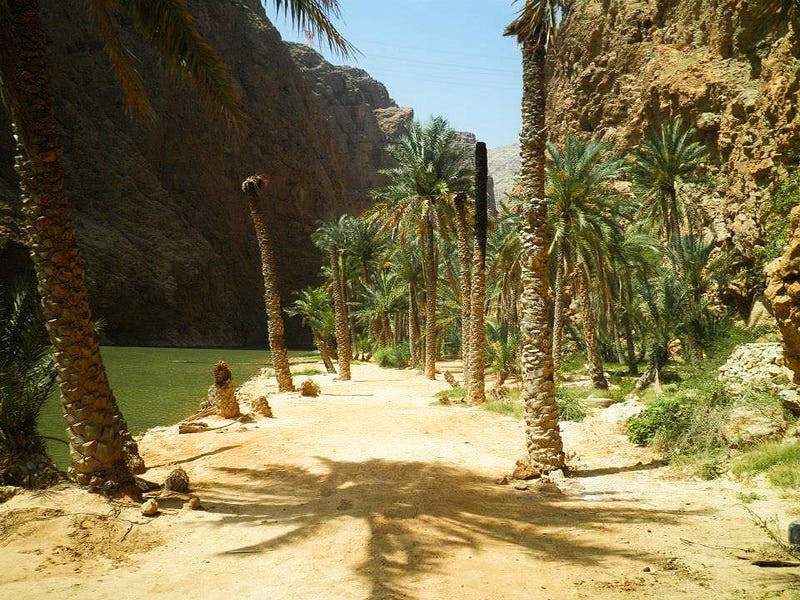
I was on my own now with no time to waste. That day, I had planned to go to the stunning Wadi Sahab, a canyon cut through by crystal clear rivers and lakes and an oasis of palm trees. In the end, it became a favorite place for me, and I stayed a day longer.
It was far from being the last challenge. I was so focused on learning how to drive that I did not notice that the tank was almost empty. It is not something you can expect when you get a rented car, right? But I did not worry much about that. I was out of Sur city on the highway, and I headed to the next petrol station, which just wasn’t in sight, and I had only 15 km to go according to the blinking display. It turned out that there is no petrol station at every corner in Oman. Whenever you are in a city, please tank your car! You can drive some hundred kilometers without finding one — another test for my problem-solving skills. I spotted a hotel sign along the highway, and I decided to stop there. I rushed to the reception and asked for help. The receptionist did not seem to be surprised at all.
“It often happens to tourists. Unfortunately, we do not have petrol stations as often as you are used to in your home country and foreigners often land here with an empty tank.”
He took a plastic can and poured some petrol into my tank and didn’t even let me pay for that.
Now I was ready to reach Wadi Sahab that exceeded all my expectations. I parked the car and hopped into the small boat to cross the river, and started to hike in the jaw-dropping Wadi. In Arabic countries, it is still unusual that a woman is traveling alone, so I attracted some attention. I’m open to talking to locals by remaining cautious at the same time. The young guy who navigated the boat offered his guidance in the Wadi, which I reluctantly accepted. He had to kill some time in this way, as there were not many visitors to take care of. Finally, he invited me to his family for dinner, where I could enjoy the Omani hospitality and get a first-hand experience of the local life.
Arriving unprepared in Oman, I ended up driving an automatic car for the first time in my life and nearly ran out of gas. After overcoming all the difficulties, I had a wonderful day in Wadi Sahab, and I was even invited to an Omani family. After a bad start, things turned out to be better than I expected.
#unplannedadventures
Sign up for our newsletter to stay informed with up-to-date curations from our editors:👇