
No: A Complete Sentence
Three No’s that changed my life
Saying no is a very important skill we all need to develop. Sometimes we feel pressure to please others, maintain certain appearances, or continue to live up to our own expectations of ourselves. Learning to say no when it is appropriate is vital to our career and life successes.
A few weeks ago, I wrote a story:
In it, I told how I said yes to two mundane requests at the SIU’s Union School and how my willingness to accept the responsibilities led to a yes that put me on a very high-paying ship.
I attempted to show how opening ourselves up to opportunities by answering “yes” can have a major impact on our life trajectory.
The story has garnered a modest amount of attention, and I’ve received some great feedback. Some of the best feedback to the story was a caveat. That caveat is the importance of saying “No” when it’s appropriate.
Thank you, James Bellerjeau and Mary Ingram, for your wisdom and insight.
Saying yes to innocuous opportunities from people who have the potential to change your life is important. Equally important is recognizing when it’s appropriate to say
NO
Three times I said “No” and how it changed my life:
The first “no” is coincidentally about the first story I wrote on Medium titled “A Blue Day at Stone Barn.” If you want to read it, be warned, it’s a journal entry I wrote years ago chronicling my working interview at the famous restaurant Blue Hill at Stone Barn. If you read it, you will be one of the first.
It’s a wall of text, no wonder nobody has read it. I leave it there as a reminder of how far I have come as a writer.
The gist of the story goes like this: I went to Blue Hill at Stone Barn for a “Stage,” pronounced with a soft “g.” It’s French, for exploitation.
I worked my ass off for 14 hours, was treated like shit by multiple chefs, made to feel 10 inches tall by Dan Barber himself, and then offered an “opportunity” to do it for an entire month.
Blue Hill at Stone Barn is one of the nicest restaurants in the world. It is featured on the first season of Chef’s Table on Netflix. It is the quintessential Farm to Table Restaurant. My green thumb and love for the kitchen had led me that far, and I was standing at the precipice of the holy grail of Farm to Table Cuisine.
During culinary school, I began to see just how broken the industry is: slave wages, no work-life balance, rampant alcohol and drug use, and the normalization of an abusive work culture.
I could see all these problems, and after spending 15 years in restaurants and coming to the end of the most prestigious culinary education money (in my case, grants, scholarships and sleepless months working) could buy, I could see that there was nothing at the end of it.
Just broken individuals feeding their egos and perpetuating a dysfunctional work culture.
Even owning a restaurant is a flawed prospect. Inputs steadily increase, and customers are unwilling to accept higher prices, all the while labor costs need to remain below the poverty level just to justify your business’s existence.
Guess what, “entrepreneurs”? If you cannot offer a living wage, your business is a failure.
That goes for you too, Walmart and Amazon.
Broken, that’s all I saw. Here I was at the restaurant that is the icon for “sustainability,” and all I could see was rich people exploiting free labor.
Deciding whether or not to accept the internship was still very difficult. Was this the opportunity that would propel my career? I would never know, because I said,
No
The second “No”
This one came shortly after. It was much tougher to say no to. While interviewing for jobs, one stands out to this day as a
“what if?”
When I was a child, I watched reruns of “Wings” on Nic at Night. I thought it was the funniest thing on television. I was obsessed with airplanes, so it was natural for me to admire the two main characters. I never thought much of the island it was set on. I never really knew anything about it. Never cared.
Fast forward 20 years, and I am driving up from Poughkeepsie to catch the last ferry to Nantucket. I climbed onto the ferry with nothing but my knife bundle and a change of clothes.
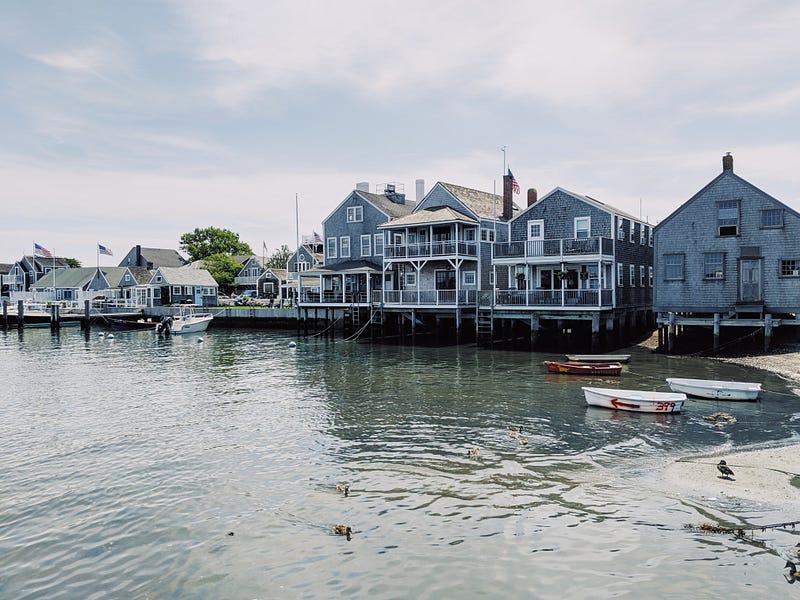
There is nothing like the view of Nantucket harbor. The blue cedar clad old homes lining the wind-swept island. It’s uniquely beautiful and truly an American treasure.
Stepping off the ferry boat, your feet immediately land on ballast stones from old whaling ships. The streets are lined with them. The setting is lost in time; you are sent back to the 1800s, walking down old roads flickering from lamp lights.
One of the kindest restaurateurs I have had the pleasure of meeting greeted me on the pier of the ferry and walked me to his cafe, Fog Island Cafe. A fellow CIA alumnus with a big heart and a fantastic operation.
The next day, I took a jog with plans to run to the ocean. I didn’t know exactly where I was going, but I looked at my map on my phone and just started running. About halfway to the ocean, I looked up, and the scene from my youth was directly in front of me.
I had run right in front of the Nantucket airport, and there was the cutscene image of the airport right in front of me.
The workday was relaxed and the chef treated me very well. I was offered a great job with good pay, health benefits, and ample time off. Most importantly, a free place to live on Nantucket!
The Chef, who I trailed, just bought a home on island. If you have any idea how expensive living on Nantucket is, you should be able to see how well the owner treats his employees.
My heart had other plans.
Perhaps I had already heard the siren song of the sea. By this point in my job search, I was already considering joining the seafarers union but was on the fence about abandoning restaurants and the illusion of glory they elicit.
Or maybe my heart knew that serendipity had bigger plans somewhere in the South Pacific.
Had I accepted the job, I would not have met my wife in Saipan one year later.
When I told the owner I was having hesitations about accepting the job, he sweetened the pot. He offered me an acre of his personal land to farm to create my own farm-to-table operation within his growing company. I said,
No
The most important “no” of my life.
This is the most important “no” of my life. It’s truly a moment in my life where I had two choices, and one would have led me down an unknown path, and the other led me here.
I met my wife in Saipan in October of 2018. We wanted to see each other again, and as soon as my hitch was up, we made plans to meet in Hong Kong, from there, she would show me China.
I was excited.
A beautiful woman wanted to give me a grand tour of China, starting in Hong Kong and Macau.
Our first few days together were a little rocky. Me being a carefree American Sailor and she being a modern but traditional Chinese woman, let’s just say culture shocks were imminent.
It didn’t take long before she was questioning my suitability as a partner, and I was questioning her sanity.

It came to a head at the pier in Hong Kong, where the traditional ferry boats cross from Kowloon to Hong Kong Island.
We had an emotional “come to Jesus” moment where we both were debating going our separate ways due to what we saw as fundamental differences. We had a long, drawn-out emotional back and forth, and after we both agreed to go our separate ways, we started walking.
But not away from each other.
We both just walked together to the ferry and got on the boat. We crossed to the island holding hands on the ferry boat. We had a really nice day after that.
Had we said “Yes” to the agreed separation, our lives would be totally different now. Saying “No” to splitting up, when we both thought it was what’s best, changed my life.
Three “No’s” that changed my life
These are three of the most important times I said no in a situation that was tempting me to say yes. Had I said yes to any one of these, my life would be radically different. I look at my wife and son and thank God I said no and yes at all the right times that have led me to this one.
What I am reading
Mary Ingram writes a short and sweet story about the importance of patterns and the effects they have on our life.
Read it here:
and for a good look at how success necessitates the word No,
read this story by James Bellerjeau
