
Nietzsche’s Philosophy for Living a Good Life
Lessons on success, relationships, and being a good human.
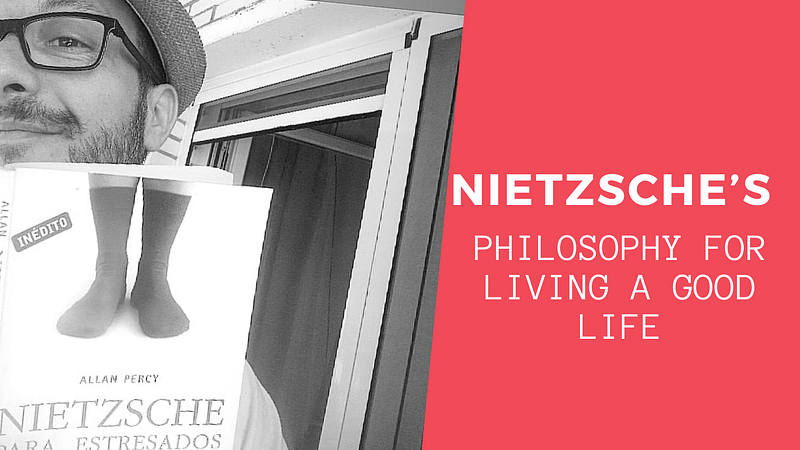
Sometimes life is hard for me. I think of all those things I won’t do, all the places I won’t visit, all the people I won’t meet, and I get overwhelmed.
Why does life have to be so short? Why does it have to be so unfair?
People often soothe their discomfort by reading articles about billionaires or watching superhero movies, or reading biographies of millionaires who think they are superheroes.
It doesn’t work for me.
I like to identify with people who lived lives similar to mine. Lives where the good guy doesn’t always win.
I guess I like to read about big losers because they are the genuine winners of history.
They endured the most adverse fates with stoicism and came out ahead, fighting until their last breath.
One of my favorites is Friedrich Nietzsche.
That guy was so used to losing that when you read one of his books, you know that the advice written in it is being given by someone who knows perfectly well what defeat is.
- During the Franco-Prussian war, Nietzsche applied to join the army. And after a month working as a stretcher-bearer, he contracted diphtheria and dysentery.
- As a result of all the ailments he suffered (blindness, migraine, stomach pain, and so on,) he lost his job as a professor at the University of Basel.
- In 1882 he proposed marriage to the Russian writer Lou Andreas-Salomé but she rejected him and went to Berlin with Paul Rée, a friend of Nietzsche.
- At the age of 44, he had a mental breakdown. Which turned out to be part of the root of his dementia.
As you can see, Nietzsche knows well what it is to be in the hole.
That is why in today’s article, I will share with you some of the thoughts, that despite everything, helped him to get ahead and live fully.
Let’s begin.
I. Don’t be like everyone else
“The individual has always struggled not to be absorbed into the tribe. But no price is too high for the privilege of being oneself.”
— Friedrich Nietzsche.
Sometimes feeling marginalized can scare us. But to be the odd one out, the different one is not as bad as it seems.
Think about it, would you like to be like everyone else?
Maybe you want to fit in. That’s understandable. You want people to value you. But if they don’t appreciate you for who you are, you’ll have to live a life of lies. You’ll have to pretend to be someone else to fit into the social puzzle.
If you’re old enough, you’ve already played that game: the game of being a piece that fits. And you know it never turns out well.
When I was twenty years old, I went to live in Salamanca. I didn’t know anyone, but I tried to do my best to contribute to my new city of residence. I studied industrial engineering, I ran several night businesses, I even organized standup shows.
Do you know what happened?
Instead of being loved, I was envied and defamed. I would always be the outsider. I would always be the lucky one. No matter how hard I worked, the finger was always pointed at me.
After ten years, I changed my place of residence, and the cycle started all over again. But this time, I heeded Nietzsche and paid the price of being myself. I didn’t try to fit in.
And you know what?
This time I did make some great friends that I still have today. I guess when you risk being you, those who are like you come around.
Be yourself. And don’t let yourself be trapped by any tribe, or your life will become a carnival where you will have to live disguised as who you are not.
II. Learn to live alone
“Every fearful person does not know what it is to be alone. Behind his shadow, there is always an enemy.”
— Friedrich Nietzsche.
What is fear?
In principle, it is a feeling of anguish provoked by the presence of real or imaginary danger.
But I am inclined to think that in the 21st century, it is a feeling of distrust that leads us to believe that something contrary to what we want will happen.
Why is that?
Because we are selfish.
We are so afraid of not being right that we prefer to relate to people who think like us. Rather than challenge our beliefs by confronting them peacefully with those who think differently.
We are afraid of not getting our own way. Because the only problems we really care about are our own.
What do we care about a war that doesn’t happen on our doorstep?
We don’t care at all.
You may be wondering what this has to do with fear and loneliness.
You see, loneliness scares us more than anything else in the world because it forces us to listen to that inner voice that does not lie to us. A voice that tells us: “The war in that distant country is also yours” or “Climate change is also your responsibility.”
It is a voice so uncomfortable that people prefer to silence it by doing something else. Watching TV, playing video games, going out to bars to drink, anything that takes them away from themselves.
But that voice won’t shut up. The problem is that you don’t listen to it. You repress it. And everything that is restrained grows stronger.
You have come to this world to experience the reality that surrounds you and to know yourself. Both are important. You cannot live in fear of loneliness because being alone is necessary for self-knowledge.
Start by giving yourself an hour every day. Don’t take your smartphone with you. Don’t use your iPod.
Just take a technology-free walk.
You’ll thank me when you’ve been doing it for a month.
III. Get into the habit of reflecting before you speak
“The way to everything great is silence.”
— Friedrich Nietzsche.
In my neighborhood, we say that who eats quietly eats twice.
The world is full of noise.
We live on a planet of braggarts. And we all know it. The problem is not that people speak freely; the issue is that people talk without knowing. You only have to open TikTok to realize it.
Opinions are like asses: everyone has one.
Having formed opinions, that’s something completely different. A formed opinion is based on knowledge. And acquiring that knowledge requires time and silence. Time to search for information and be quiet to concentrate and reflect.
But people make their value judgments based on three videos they saw on their favorite social network. This makes it terribly easy to stand out. And you can apply it to any area of life. You just have to do what most people don’t do: listen.
When you learn to listen and observe, you learn to spot things that can be improved. And that’s the beginning of everything.
Meeting needs with products and services is the basic principle of wealth.
Want to make more money?
Find a problem that many people have and then offer them a solution. That’s greatness. And that greatness comes from silence. From reflection, from knowing how to listen to the market.
Listen to Nietzsche. And never forget that you have two ears, two eyes, and one mouth for a reason. Zeno of Citium said, “to hear more and speak less.” And Epictetus said, “so that we may observe and listen twice as much as we speak.”
IV. Learn to organize yourself
“When you have a lot of things to put in it, the day has a hundred pockets.”
— Friedrich Nietzsche.
To explain this principle of Nietzsche’s I am going to use three of his most famous quotes.
- He/she who has a why to live for can face all the hows.
- The real world is much smaller than the world of imagination.
- The thinker knows how to consider things simpler than they are.
The first thing to have a good life is to have a well-defined goal.
For me, pursuing my goals is the engine of my happiness. I know it may sound crazy. But believe me, inactivity is what numbs you; activity is what activates you.
So dedicate yourself first to find your goal.
The second sentence is a concept that we often forget. In the real world, resources are limited. In your mind, they are infinite. And remember that everything that the human being is capable of imagining can be created before or after. If you don’t believe me, think of all the things in science fiction literature that have come true.
The third sentence refers to the tendency we have to complicate things. A good thinker turns complicated into simple. And not the other way around.
Complicating things makes us expend more energy than necessary. If we always keep a clear idea of what we want to achieve in our minds, everything will be easy. And the paths we choose to achieve our goal will be easier to follow.
All of the above will help you to be clear about your goals. Also, to use the right mindset and to choose the easiest path. And therefore, you will distribute your time more wisely. And as Nietzsche says, you will realize that the day, if you organize it well, seems to have a hundred pockets because it fits everything.
But don’t forget Parkinson’s law,
“Work expands until it fills the time available for its realization.”
In other words, your tasks will always last as long as you have set them.
In my case, I used to set a goal of writing one book a year and, if I had time, two.
Do you know what happened last year?
I only wrote one book.
This year I set a goal to write a book every six months.
Do you know what happened?
This year I managed to write two.
In the end, I was on schedule.
V. Learn to face reality
“When suffering comes, look it in the face and face it.”
— Friedrich Nietzsche.
As people say: death is so sure to win that it gives us a lifetime’s advantage.
Sooner or later, life will turn dark. We all know it. It is only necessary to live long enough to experience illness, pain, betrayal, love, heartbreak, disappointment, etc.
It is as if life is losing its brightness as we grow older. There are fewer and fewer “first times” and more and more disappointments. Boredom takes over our daily lives.
It’s easy to lose our sanity as adults. Every day seems the same.
Reality can become a prison. But there is no need to be afraid. The passing of the years may weaken us physically, but time will only take away our will to live if we allow it to.
We have to face suffering without looking away.
Looking directly at adversity is something we must learn to do over the years. For even if we lack energy, we have experience. And experience is a great help.
But that experience is also a responsibility.
Human beings learn by looking. Since we are children, we watch how others do things and try to replicate them. That’s how it works.
That’s why it’s important to measure up. We must not be cowed. We have to face life as it comes. And not only for yourself but for the young people who come after you.
I like to think of life as a relay race.
I was given the relay by my grandfather. I picked up the baton from him. And to that baton, I have added my learning, and I want to think that someday I will pass on all that knowledge to someone else. That is why I am writing.
That is why I have written this article. To tell you that you are not alone. That I’m having a hard time too. But all adversity can be overcome if you make an effort and acquire the necessary knowledge.
It’s all a matter of perspective. As Henry Ford said,
“Whether you think you can or you think you can’t, you’re right.”
Although I like to exemplify it better with a story told by David Foster Wallace in his famous water speech. It goes like this,
Two men are sitting together in a bar located in a remote part of Alaska. One of the men is religious, the other is an atheist, and the two are arguing about the existence of God with that intensity that comes after the fourth beer.
Then the atheist says,
“Look, it’s not that I have no reason not to believe in God, it’s not that I’ve never experienced Believe-In-God-and-Pray and stuff. Just last month, I got caught in a snowstorm far from home. I was totally lost and couldn’t see anything. The temperature was fifty degrees below zero, so I tried it: I knelt down in the snow and prayed, ‘Oh, God, if you exist! I am lost in the snow, and I will die if you don’t help me.”
The religious man looks puzzled at the atheist and says,
“Then you must believe now. After all, here you are, alive.”
The atheist shakes his head and says,
“No, man, all that happened is that a couple of Eskimos happened to be passing by and showed me the way back.”
Do you want to know my opinion about the fable?
I believe that miracles do exist. Because for me, it is a miracle to have been able to share this article with you. Thank you for existing. And never stop believing in yourself.
If you have read to the end of the article, I want to thank you for your support. I hope this article has helped you. If so, let me know in the comments. I really appreciate it.
Thanks for reading. Alberto García (Malafama1981).
Other articles that may interest you


