
Nicolas Cole or Whoever Says He Writes 10,000 Words Per Day Wants You to Fail

I love Nicolas Cole even though I freak out at the fact that he does self-promotion everywhere, especially right before clicking his story—he has his image in every story he shares. That’s fine: maybe he might not trust his headline or voice or story but an image. Cool.

I turned on my air-conditioner, lied down on my couch with my feet on the table, put one cushion behind my head and was excited to read when I found out one of his articles, titling How I Write 10,000 Words Per Day, Every Day. I skipped my school homework to read this.
I thought: “Yay, now I will know all his secrets. I will know how he started. I will know how he can now write 10,000 words daily.”
Eight minutes is all it took for my world to shatter.
Truly speaking, I never want to write 10,000 words in a day, ever. I was just curious to know how others (especially him) have done it but mostly, what I can if I want to do it too. But it didn’t show me that.
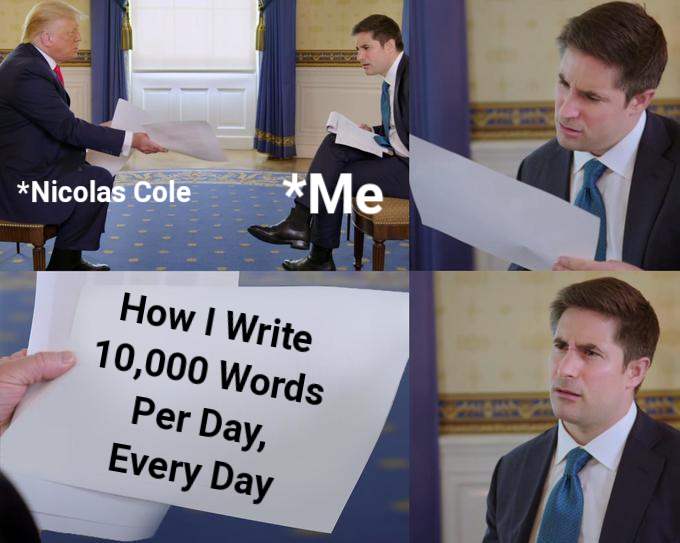
Nicolas Cole Always Adds Value (but Sometimes Doesn’t Fulfill His Promise)
In this article of his, a few lines which made me fall in love with him again were:
- “The brutal truth is that you don’t become a professional writer, let alone someone who can consistently crank out 10,000 words of straight steam by waiting for inspiration to strike.”
- “Part of the gig is just accepting that not every day is going to be one smooth adventure.”
- “All you can do is take things as they come and do your best to guard your time. I wish I could say that being a professional writer is all about locking yourself in your room for 12 hours per day, every day. But that’s just not how it goes—nor is it how you stay sane and continue to come up with great ideas.”
- “This is the secret: you have to read.”
- “It’s worth sharing now that no matter how ambitious you are as a writer, you will not be able to read this post and then go write 10,000+ words in a day, tomorrow.”
- “I fight the urge to stare at my phone and scroll through Instagram and Facebook because that’s only going to clutter my mind.”
- “If I try to write an ~800-word article with my phone on, however, it can take upwards of three hours.”
These are concrete, brutal, harsh but truths. These few lines are enough to show that writing isn’t hard but it takes time. Because it took time for him. These nuggets are valuable for any beginner writer. But he didn’t say what to do in those cases, like, what to do if we don’t feel like reading?
Beginners Never Want to Write 10,000 Words
We have different plans. We want to write a short story and sell millions to never have to write ever again. We want to be an author of a book we write, through learning, through research, through studying. We don’t want to write crap by writing 10,000 words daily. We want to have an impact by writing something to our level best and not forcing it out.
Nicolas Cole didn’t answer any of these two questions a beginner might have (before or after reading his story):
- Why write 10,000 words?
- How do I get there, as a beginner?
Overall, this post was just a humblebrag that sure keep us happy because we now know his secret, we now know his process. After all, we now know how he does what he does. Because everyone is happy in the response section. It sure inspired but never gets us to take action.
But, deep down, we feel guilty to waste our time on this: we never knew how he got there. We never knew how we can get there too.
Did he want to show us how busy he is (and still lives a cool life)?
“This is not an out-of-the-ordinary day for me. And truthfully, I’m not even done yet. I haven’t written on Quora yet. I haven’t written a column for Inc Magazine (been swamped with other work). Nor have I made any progress toward finishing my next book. So, it’s now 9:03 p.m. Excuse me while I get back to work.”
This line above is all he wanted us to take away. No coincidence why he has this at the conclusion part (we all mostly read the conclusion first, right?) He wanted to show us how hardworking he is. He wanted to show us how hard it is to be a professional writer. He wanted to show us how busy he is, still, he makes his meal and eats (he has repeated about his eating thrice in the whole story.) It felt like he wanted us to stop writing.
So, was Ernest Hemingway and Stephen King wrong?
“And when I say I write 10,000 words in a day, I don’t mean “words for the sake of words.” I mean coherent, thoughtful, creative articles that people read, enjoy, learn from, and then share.”
Here, Nicolas has entirely skipped the importance of editing. I say that editing and writing is marriage, not a one night stand. Both need to live together, forever. Okay, I know you don’t trust me.
Ernest Hemingway proudly spoke out: “Write Drunk, Edit Sober”
And, Stephen King says: “To write is human, to edit is divine.”
We always learned good writing is all about great editing.
Another tip by Stephen is: “Get it out”. Seems like Nicolas follows this but never emphasizes on this, meaning he sure writes 10,000 per day, but not all of it is perfected or polished. But he never told us that. Here, he hints that whenever he gets down to sit, perfect writing flows out from his tongue.
He has decreased the value of editing so much that he used an adjective to showcase that (notice the bolded text):
“From there, I made some minor edits to other pieces in my queue. Responded to a handful of emails. And jot down a few article ideas for me (this being one of them).”
Was he not completely honest in his other posts?
“Now, as I’m sure you’ve noticed, so far the day has gone pretty smoothly. This is what a perfectly crafted schedule looks like—and if I’m being completely honest, it rarely happens like this.”
“I’m being completely honest” — what does this line even mean? As a reader, from you, a professional writer, I don’t expect this. I always want you to be completely honest, not just today, in this one story. This line hints that he always hides something and isn’t always truthful.
Is he a two-headed snake?
“In the past four hours, I have:
1. Written 3 articles, each ~1,000 words.
2. Edited 3 articles (let’s assume ~500 words)
3. Responded to about a dozen emails (~500 words)”
I can trust the first point. In the second point, out of nowhere, he gives importance to editing.
Vocabulary.com defines editing this way: to prepare writing for publication by correcting, revising, or proofreading. Never does it mean that it’s just addition and not subtraction.
The great Stephen King once told: “Kill your darlings, kill your darlings, even when it breaks your egocentric little scribbler’s heart, kill your darlings.” He didn’t say keep marrying all your darlings and keep multiplying.

If Dr. Seuss, the great America author would have read Nicolas’s story, he would say: “So the writer who breeds more words than he needs, is making a chore for the reader who reads.” and I would agree with him.
“Responded to about a dozen emails (~500 words)” Okay, but right in the beginning you stated that you won’t be counting the emails (notice the bold text below):
“Between writing on Quora and Minutes, overseeing writing quality for our clients at Digital Press (not counting the dozens of emails I respond to), my book and personal branding projects, my monthly newsletter, and a wide range of other writing-related endeavours, I can honestly say that even 10,000 words per day is (at times) a low estimate.”
It felt like just to increase that last 2,000-word count mark, he simply stated whatever he could.
This Is the Conclusion
It sure provided some valuable points. But it was self-promotion, which is there from the title itself (notice the use of I instead of being reader-centric): How I Write 10,000 Words Per Day, Every Day. Reader-centric post would go with: How You Can Write 10,000 Words Per Day, Every Day. The inclusion of I was there just to get us click-through because of a sense of secret revelation.
This story made us feel like crap. He didn’t share any of his frustration. He didn’t care about us readers, who are beginner writers. He promoted himself — the word I was used 72 times in this whole eight-minute read: “I can pretty much stream-of-consciousness a nearly perfect ~800 article in 30 minutes.” He showed how busy, aka “profession” he is.
It nice to read this for inspiration, but it’s not a how-to for a beginner.
The tone is of a ‘show off.’ He exaggerates with a few things. Majority of beginners won’t relate to this story of his.
The writing doesn’t show the journey of writing one word per day to ten thousand words per day. If he would show the journey of his struggling times at first, that is a true how-to, that is true value-addition, that is a true revelation.
Even he isn’t aware of what he is saying.
It felt like he wants us to stop writing.
This means professional writers aren’t trustworthy teachers. We can’t dream of being like him and let these type of stories subconsciously kill our dreams.